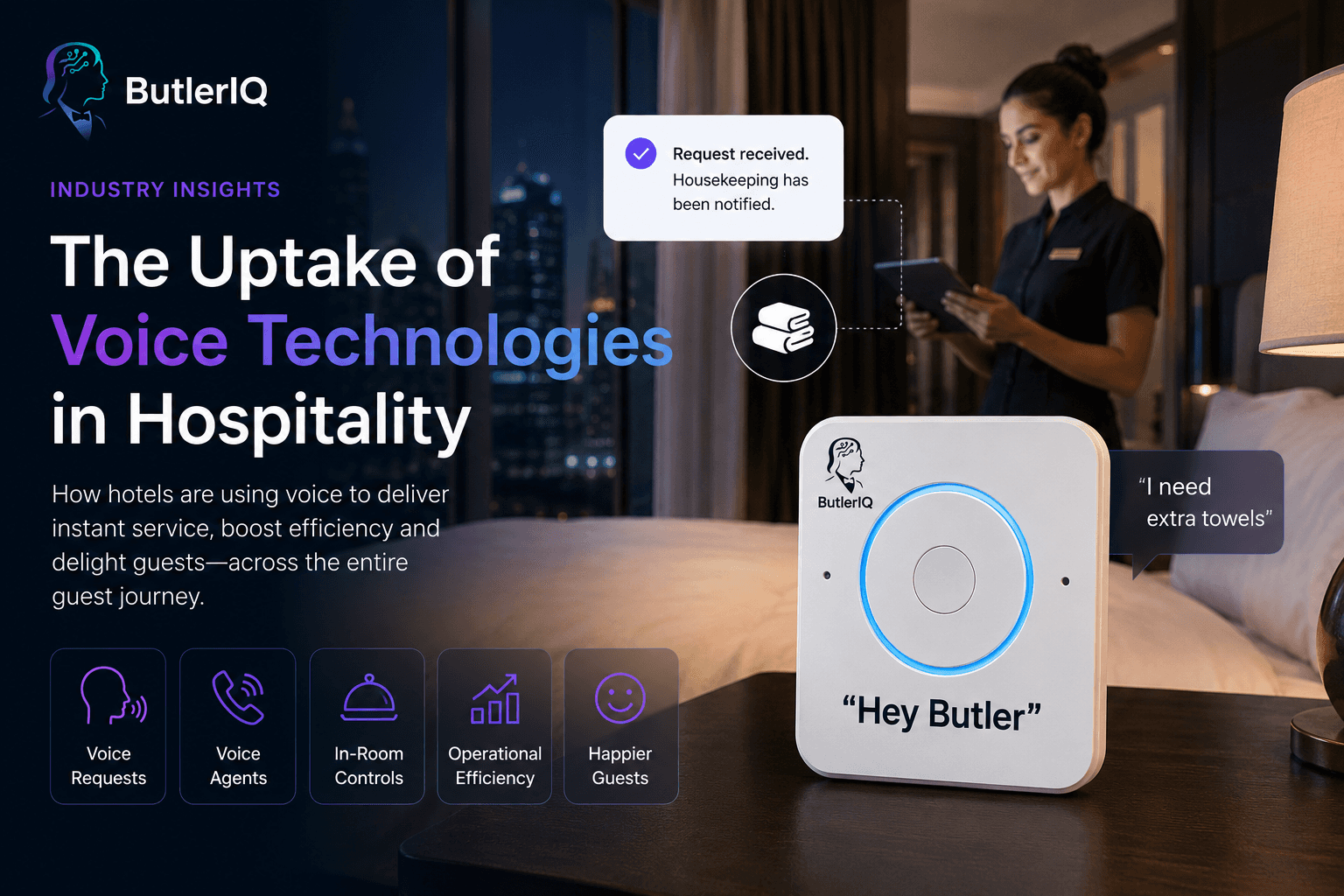
Industry Insights: Uptake of Voice Technologies in Hospitality
Explore how voice technologies transform hospitality by boosting guest service speed, operational efficiency, and staff well-being through practical, measurable solutions.
A guest asks for extra towels at 11pm, but the phone rings out and the queue at reception grows. That's the moment many hotels realise "good service" now means "instant service", without burning out staff or adding headcount. In this Industry Insights: Uptake of Voice Technologies in Hospitality piece, we unpack what's really driving adoption, where voice fits (and where it doesn't), and how to make it pay back in the real world.
Key Takeaways
The uptake of voice technologies in hospitality is driven by operational efficiency and guest demand for instant, hands-free service.
Voice tech in hotels spans in-room controls, guest requests, call handling, and voice search, improving service across the entire guest journey.
Successful adoption requires integrating voice systems with backend operations like housekeeping, PMS, and POS to ensure requests translate into real actions.
Voice technology enhances guest satisfaction, labour efficiency, and ancillary revenue by reducing wait times and enabling seamless upsell opportunities.
Privacy, accessibility, and clear operational ownership are critical to building guest trust and sustaining long-term voice technology success.
Piloting voice solutions with measurable outcomes and realistic use cases helps hotels scale effectively while avoiding common failures like poor integration and weak escalation.
What Counts As “Voice Tech” In Hospitality Today (And Why Adoption Is Accelerating)
A lot of teams still picture "voice tech" as a smart speaker on a bedside table. That narrow view slows decisions, because it misses where the value actually sits: in the end-to-end chain from guest intent to action.
In hospitality today, voice technologies usually fall into four practical buckets:
In-room voice assistants and controls: guests use voice to set lights, temperature, curtains, TV, music, or "do not disturb". A simple example is "set the room to 20 degrees" when your hands are full of luggage.
Voice-enabled guest request and service routing: "I need more pillows" triggers a task for housekeeping, with status updates and escalation if it's not done within a set time.
Voice agents for calls and messaging: a voice assistant answers common questions ("what time is breakfast?", "is the spa open?") and either resolves them or routes the call with context.
Voice search and voice-led discovery: guests ask phones and assistants questions like "family-friendly hotel near Paddington with parking". That changes how hotels think about content and visibility.
Adoption is accelerating for a few grounded reasons, not hype. Labour pressure is the obvious one: when reception and concierge teams run lean, every avoidable call matters. Then there's expectation drift: guests have trained themselves on instant answers through home devices and apps, and they bring that habit into a hotel.
But the biggest driver we see is operational. Voice interfaces create structured demand. A spoken request becomes a tagged task with a time stamp and outcome, rather than a note scribbled on paper or a missed call. Hotels that already track service performance metrics (response time, first-time resolution, repeat requests) tend to move faster, because voice technology plugs directly into what they care about.
If you want a useful mental model, treat voice as a front door to your service stack, not a gadget. The question is not "do we want a voice assistant?" It's "which guest intents do we want to capture, and what system or team owns the action on the other side?"
For a deeper look at how modern hotel voice assistants are changing stays, it's worth comparing patterns in how AI voice assistants are redefining hotel stays to what your own property can realistically support today.
Where Voice Is Being Used Across The Guest Journey
Voice adoption often fails when it's treated as an "in-room" project only. Guests don't think in departments: they think in moments, before they arrive, when they check in, while they stay, and after they leave.
Pre-stay: enquiries, booking, and confidence-building
A guest planning a weekend break asks a voice assistant a simple question: "Does this hotel have parking and late checkout?" If your website buries the answer, you lose the booking before your team even knows it existed.
Hotels use voice in pre-stay in two practical ways:
Voice agents for calls that answer FAQs and capture intent ("two adults, one child, next Friday"). A good setup reduces abandoned calls during peak periods.
Voice search readiness that makes key information easy to pull: location phrasing, amenities, accessibility details, breakfast times, pet policy, and parking.
If you already invest in direct booking strategy, voice becomes another route to reduce friction rather than another channel to manage.
Arrival and check-in: removing bottlenecks
The failure scenario is familiar: a late-afternoon rush, one new starter, two guests with special requests, and a phone that won't stop ringing. Voice can help by taking the "easy" questions out of the queue.
Common arrival-stage uses include:
Queue relief: voice agents answer calls about check-in times, directions, and booking amendments.
Wayfinding support: "Where is the lift?" or "How do I get to the gym?" works well when it triggers short, consistent answers.
Early task capture: "Can I have a cot in the room?" becomes a trackable request before the guest arrives upstairs.
Voice doesn't replace a welcome. It protects it by removing interruptions.
In-stay: service requests, room controls, and upsell moments
In-stay is where voice tech usually shows its fastest operational wins, because requests are high frequency and time sensitive.
Good in-stay use cases share one trait: they are clear, repeatable, and measurable.
Housekeeping and maintenance: "Need more towels", "TV isn't working", "room is too cold". Each request becomes a job with an SLA, not a guessing game.
Amenities and property info: "What time does breakfast start?" "Do you have allergy options?" "Is the pool open?"
Upsells that feel like service: "Book a table", "Order room service", "Request a late checkout". The win is not the ask, it's making the process simple.
Hotels exploring this usually benefit from seeing how an AI concierge model is framed operationally, such as in AI concierge for hotels, because it focuses on workload, not novelty.
Post-stay: feedback, recovery, and repeat visits
A missed opportunity shows up after check-out: the guest had a minor issue, they mention it in a review, and you only learn after the fact.
Post-stay voice applications are still emerging, but common patterns include:
Automated follow-up calls with a voice agent that captures feedback and flags issues for human follow-up.
Loyalty engagement prompts: "Would you like to rebook for the same weekend next year?"
Service recovery routing: a complaint triggers a case with context, rather than a vague note.
The practical test here is simple: can voice help you resolve issues while they're fixable, not after they're public?
Guest Expectations And Behaviour Shifts Driving Uptake
The fastest way to misread this market is to assume guests choose voice because it's trendy. Most guests choose it for one reason: it saves effort in the moment.
"Hands-free" has become normal, not special
A parent carrying a sleeping child doesn't want to open an app, log in, and navigate menus. A business traveller stepping out of the shower doesn't want to call reception and explain they need an iron. Voice is the obvious interface when hands, eyes, or time are limited.
That's why adoption correlates with contexts that create friction:
Families managing bags, prams, and unpredictable routines
Guests with mobility limitations or temporary injuries
Travellers arriving late who want fast answers without a conversation
When we design around those scenarios, voice feels like good service rather than a gimmick.
Guests expect immediacy, then escalation
A common guest frustration is not "I had to speak to a person." It's "I couldn't get anyone." Voice assistants set a new baseline: immediate acknowledgement and a clear next step.
The best guest experiences follow a simple rule:
Instant response for simple questions ("breakfast is 7–10").
Fast task capture for requests ("towels requested: ETA 10 minutes").
Confident escalation when the request is complex ("I'll connect you to reception and share what you've asked for").
This is where many hotels improve satisfaction without changing their service standards, just by changing the speed and clarity of the interaction.
Multilingual expectations are rising
International travel continues to rebound in uneven waves, but the direction is clear: guests expect service in their language more often, especially in city hotels and mixed-use properties.
Voice technology helps when it does more than translate words. It needs to translate intent accurately ("extra blanket" is easy: "quiet room away from lifts" needs nuance). If multilingual coverage is part of your uptake plan, you'll want to stress-test it with real phrases your guests use, not scripted demos.
A practical reference point is the operational value shown in multilingual voice interfaces for hotels, because it highlights where language support reduces misunderstandings and repeat calls.
Privacy sensitivity has also increased
Guests have become more aware of microphones in living spaces. They will use voice technology when you make control obvious: clear indicators, simple mute options, and plain-English explanations of what's stored and why.
So the expectation shift cuts both ways. Guests want convenience, but they also want to stay in control. Hotels that acknowledge that trade-off openly tend to see better uptake and fewer complaints.
The Business Case: ROI Levers Hotels Actually Track
A shiny demo does not get budget approval. Finance teams want to know which numbers move, by how much, and what has to change operationally to make the impact real.
In practice, hotels track ROI from voice technology across five levers.
1) Labour efficiency without service degradation
The simplest cost is time. If reception spends hours each day answering repeat questions, voice can remove a slice of that load.
Hotels measure this with concrete operational metrics:
Call volume reduction during peak times
Time saved per common request (for example, replacing a 90-second call with a 10-second voice interaction)
Shift coverage stability (fewer "we need one more person" moments)
The important caveat is ownership. If voice captures requests but nobody closes them, workload shifts rather than shrinks.
2) Faster service response and fewer repeat requests
Guests do not mind waiting as much as they mind uncertainty. Voice systems that confirm receipt and provide an ETA reduce follow-up calls like "Have you seen my request?"
Hotels track:
Average response time for housekeeping and maintenance tasks
First-time resolution rate
Number of repeat contacts per stay
A realistic win is not perfection: it's fewer "lost" requests and fewer handoffs.
3) Higher guest satisfaction and loyalty signals
Not every property trusts review scores as a decision tool, but most track some form of experience metric.
Common approaches include:
Post-stay survey uplift on "ease of getting help"
Complaint volume and type shifts (for example, fewer complaints about responsiveness)
Loyalty rebooking indicators
Voice affects experience when it removes friction, especially late at night when teams are thinner.
4) Ancillary revenue and conversion improvements
Upsell works when it feels like service. If a guest can ask for "late checkout", "extra pillows", or "room service" without navigating a phone menu, conversion rises.
Hotels track:
Attach rate for add-ons (late checkout, breakfast, parking)
Room service order frequency and average order value
Restaurant booking conversions
The key is guardrails. A voice assistant must know stock, hours, and policy so it does not sell what you cannot deliver.
5) Risk reduction through better audit trails
This is the least glamorous lever, but it matters. When voice requests become logged tasks, you create an audit trail that helps with disputes.
Examples include:
Timestamped maintenance reports ("AC not working reported at 18:12")
Safety-related requests and escalations
Service recovery notes attached to the stay record
ROI timelines vary by property size and scope, but the pattern is consistent: narrow, high-volume use cases pay back faster than broad "do everything" rollouts.
If you need to build the internal case, it helps to frame it like a staff protection and service quality initiative, similar to the thinking in hotel staff efficiency tools in 2026.
Implementation Realities: Integrations, Data Flows, And Operational Ownership
The fastest way to waste budget is to buy voice technology without mapping what it must connect to. The guest hears a confident answer, but the back end cannot act. That gap creates frustration, not delight.
The integration map most hotels actually need
At minimum, a workable voice setup touches systems that hold the truth about the guest, the room, and the service operation:
PMS for stay context (who is in the room, dates, status)
Housekeeping / task management for request routing and completion
POS for room service and outlet ordering (where applicable)
CRM or guest profile tools for preferences and service history
Maintenance systems for fault logging and prioritisation
If you add digital key or identity workflows, integration design becomes more sensitive and should be treated as a security project as much as a guest experience one.
Data flows: from intent to outcome
Voice is not the value. Resolved intent is the value. A sensible data flow looks like this:
Guest makes a request ("extra towels").
System confirms details (room number, quantity, delivery preference).
System creates a task with a priority and SLA.
Staff receive the task in the right queue.
Staff mark completion, with notes if needed.
System logs outcome to the guest record.
This is where analytics becomes useful. You can see which requests cluster by floor, room type, or guest segment. Then you fix root causes (for example, missing items in rooms) rather than just responding faster.
Operational ownership: who answers when it fails?
A voice assistant that works 95% of the time still fails in real life. When it fails, guests do not care whether the issue sits with IT, the vendor, or operations.
We see the best outcomes when hotels assign clear ownership across three roles:
Product owner (Operations): defines use cases, service standards, escalation rules.
Technical owner (IT or a trusted partner): manages integrations, device management, uptime.
Service owner (Guest services/Housekeeping): owns task completion, training, and daily feedback loops.
If you want voice to scale beyond one pilot floor, plan the ownership model upfront. Otherwise, rollout stops when the champion goes on leave.
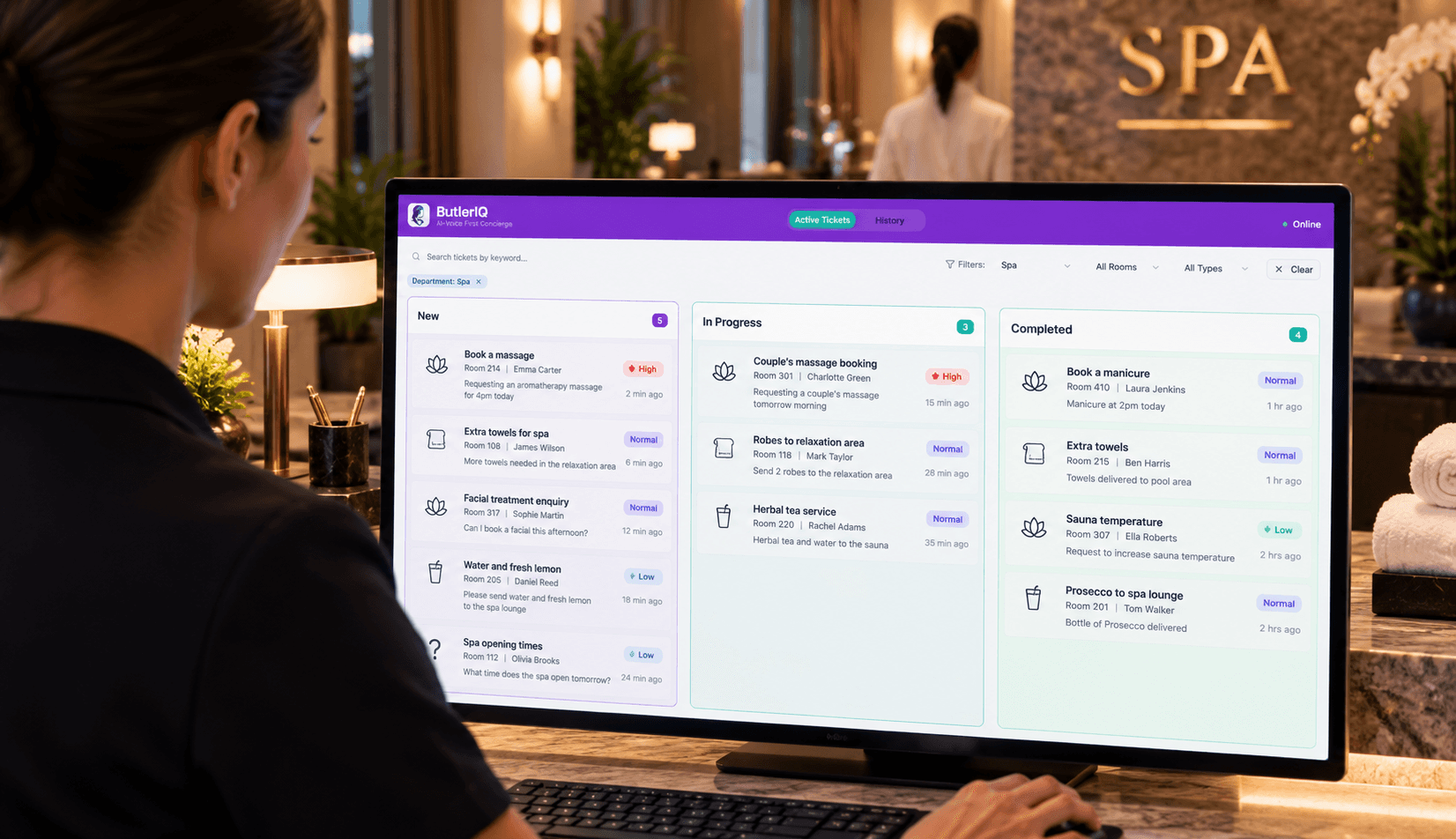
For teams that want a concrete reference for operational design, looking at how a staff dashboard for guest requests is structured can help you picture what "voice-to-task" actually means day to day.
Security, Privacy, And Compliance: Designing For Trust In Always-On Spaces
Nothing kills adoption faster than a guest thinking, "Is this device listening to me?" In a hotel room, privacy concerns feel personal, because the space is both public and intimate.
Start with a trust-first room experience
A practical scenario: a guest spots a microphone icon and covers the device with a towel. That is not a "difficult guest". That is a signal your design and messaging failed.
Trust-first design includes:
Clear physical indicators (mute button, light indicators that match what the device is doing)
Plain-language explanations in-room and in pre-arrival comms ("what it does", "what it doesn't do", "how to mute it")
Staff confidence so a receptionist can answer privacy questions without improvising
Data minimisation and retention by default
In UK and EU contexts, data minimisation is not just good practice: it aligns with GDPR principles. The operational version is simple: keep what you need to deliver the service, and delete the rest.
Concrete controls to ask for:
Configurable retention periods for transcripts and logs
Role-based access so only authorised staff can view request history
Options to disable or limit recording features in private spaces
You also need clarity on where data sits (cloud region), who processes it, and how deletion works when a guest asks.
Security in shared environments
Hotels are messy environments for security. Devices get unplugged, moved, or tampered with. Networks carry staff devices, guest devices, and third-party systems.
A workable approach includes:
Network segmentation (guest Wi‑Fi separated from operational systems)
Device management policies (provisioning, updates, remote wipe)
Audit logs for admin actions
If voice ties into security-related workflows, treat it as a serious control point. For a grounded view of what "good" looks like, the considerations outlined in voice-activated security protocols for hotels map well to real operational risks.
Compliance is a process, not a paragraph
Hotels often try to solve compliance by adding a clause to terms and conditions. That rarely reassures guests or protects the business.
Instead, build a simple operating rhythm:
Review privacy settings quarterly
Run access audits (who viewed what, when)
Update staff scripts when policies change
Test "right to delete" requests as a drill
Trust is not a marketing claim in hospitality. It's what the guest feels when they decide whether to use the service.
Accessibility And Inclusion: Voice As A Service Standard, Not A Nice-To-Have
Accessibility often gets discussed as a compliance tick-box, then quietly dropped in procurement. That is risky, because voice can either remove barriers or create new ones depending on how you carry out it.
Voice supports real needs in real moments
A guest with limited mobility may find it difficult to reach switches, curtains, or the phone. A visually impaired guest may struggle with small-print directories and app-only service menus. Voice can turn those into simple, independent actions.
High-value accessibility use cases include:
Controlling room features (lights, temperature, curtains) without moving around the room
Requesting assistance without navigating a handset or app
Accessing property information in a consistent, spoken format
The practical benefit is dignity. Guests can solve small problems without having to ask for help in a way that feels exposing.
Inclusion also means language and accent support
Accessibility is not only about disability. It also covers who gets understood.
If a voice assistant struggles with regional accents, speech differences, or non-native English, it creates an uneven experience. A strong approach includes:
Testing with real guest phrases, including common local accents
Supporting multiple languages relevant to your guest mix
Offering an easy fallback: "connect me to a person"
Design standards that prevent exclusion
Hotels can build inclusion into rollout with a few straightforward decisions:
Provide equivalent alternatives (voice is optional: key services still work by phone, staff, or in-person)
Keep commands natural ("I need help with my room") rather than requiring scripted phrases
Make mute and privacy controls physically accessible, not hidden in a menu
Measure it like any other service standard
If you treat accessibility as a service standard, you measure it:
Percentage of requests resolved without repetition
Escalation rates by language
Guest feedback from accessibility-related surveys
Voice becomes most powerful when it improves access without singling people out. That's the line we aim for: better service for everyone, with particular benefits for guests who need it most.
Common Failure Modes (And How To Avoid Them In Procurement And Rollout)
Most voice programmes do not fail because the technology "doesn't work". They fail because the hotel buys a promise and then deploys it into a messy reality without enough guardrails.
Failure mode 1: The assistant answers, but nothing happens
A guest says "send towels", the device replies "Sure", and no task reaches housekeeping. That is worse than no voice at all.
How we avoid it:
Require end-to-end demos that include task creation and closure
Test failure paths (PMS down, Wi‑Fi unstable, housekeeping queue full)
Set SLAs for integration uptime, not just "device uptime"
Failure mode 2: Too many use cases on day one
Teams often try to cover every guest question from the start. That creates inconsistent answers and training overload.
How we avoid it:
Launch with 10–20 high-frequency intents (towels, Wi‑Fi, breakfast, late checkout)
Use analytics to expand based on what guests actually ask
Freeze scope during the pilot so you can measure properly
Failure mode 3: Weak escalation and staff scepticism
If the voice assistant cannot hand over smoothly, staff end up doing extra work while guests get annoyed. Staff then stop trusting the system.
How we avoid it:
Build a clear "handover sentence" ("I'll connect you and share your request") and make it reliable
Give staff a simple dashboard view of voice requests and status
Run weekly feedback sessions for the first month to fix recurring issues
Failure mode 4: Privacy surprises
A guest discovers recording settings after the fact and complains publicly. Even if you are compliant, it damages trust.
How we avoid it:
Put privacy controls in the room, not buried online
Write a 30-second staff script for privacy questions
Make transcript retention optional and short by default
Failure mode 5: No named owner after go-live
A pilot runs well with a project team, then performance drops when responsibility becomes vague.
How we avoid it:
Assign an operational owner with time in their role to manage the system
Document processes for updates, outages, and new intents
Tie performance metrics to existing service KPIs
The procurement trick is to buy for the messy Tuesday night in February, not the vendor's best-case demo in a quiet boardroom.
How To Evaluate Vendors And Build A Pilot That Scales
A vendor can impress you with a scripted conversation. A scalable pilot proves the system still works when guests mumble, networks wobble, and staff get busy.
Step 1: Define the outcomes before you compare features
Start with three to five outcomes you can measure in 30–60 days. For example:
Reduce reception call volume by 15% during peak hours
Cut average housekeeping response time for "top 5 requests" by 10 minutes
Improve "ease of getting help" survey scores by 0.3 points
Without this, every vendor looks the same because every vendor promises "better experience".
Step 2: Score vendors on the things that break in real life
Feature lists hide weak foundations. We recommend scoring vendors on practical criteria:
Integration depth (PMS, housekeeping, POS) with proof, not claims
Escalation quality (handover to staff with context)
Multilingual and accent performance based on your guest mix
Analytics that show intents, resolution rates, and friction points
Admin controls for privacy settings, retention, and device management
If your team needs a clearer picture of what "admin controls" should look like, reviewing a purpose-built hotel voice admin console can help you ask sharper questions in demos.
Step 3: Design a pilot that reflects the real operation
A pilot should be small enough to control, but real enough to stress-test. A common setup is one floor or one room type, plus a defined set of intents.
Pilot design checklist:
Select rooms with mixed guest types (business, leisure, international)
Train the staff on the pilot area only, with short scripts and clear escalation steps
Set support rules (who responds when a device fails at 10pm)
Run a two-week "tuning period" where you fix misrecognitions and gaps
Step 4: Build the content layer like a service manual
Voice answers need to be consistent. "Breakfast is 7–10" should never become "maybe 7-ish" depending on who edited the content.
Practical steps:
Write approved answers for top questions (hours, policies, directions)
Include seasonal variations (bank holidays, events)
Set an approval workflow so changes do not create contradictions
Step 5: Plan the scale path before you declare success
A pilot is only useful if you can repeat it. Before you expand, confirm:
You can provision devices and rooms reliably
You have an owner and a weekly operating rhythm
Your integration approach supports more properties or brands
When you treat voice technology like a service system, measured, owned, and continuously improved, it stops being a novelty and starts being part of how you deliver hospitality.
And if you want uptake to stick, we recommend keeping one principle front and centre: voice should make it easier for guests to get help, and easier for staff to deliver it.
Conclusion
Voice technologies are moving from "smart room extras" to practical infrastructure for service delivery. The uptake of voice technologies in hospitality will keep rising in 2026 because it solves two problems at once: guests want fast, hands-free help, and hotels need to protect staff time without lowering standards.
If we focus on narrow, high-volume use cases, design for trust and accessibility, and run pilots with clear owners and measurable outcomes, voice becomes a straightforward operational upgrade. The winners will not be the hotels with the flashiest devices. They will be the ones that connect voice to real workflows and keep improving it like any other part of the guest experience.
Frequently Asked Questions on Voice Technologies in Hospitality
What types of voice technologies are commonly used in the hospitality industry today?
Hospitality voice tech includes in-room assistants for room controls, voice-enabled guest request systems for housekeeping and maintenance, voice agents handling calls and messaging, and voice search tools aiding guests in discovery and bookings.
How does voice technology improve guest service during a hotel stay?
Voice technology enhances guest service by enabling instant, hands-free requests for room service, amenities, or information, turning spoken needs into tracked tasks with clear response times and escalation if necessary—helping hotels deliver prompt, reliable service.
What operational benefits can hotels expect from adopting voice technologies?
Hotels gain labour efficiency by reducing call volumes, faster response times to guest requests, increased ancillary revenue through voice-enabled upselling, improved guest satisfaction, and better risk management via detailed audit trails of requests and outcomes.
How does voice technology help accommodate diverse guest needs, including accessibility and language diversity?
Voice tech supports guests with limited mobility or visual impairments by enabling room control and service access without physical effort. It also offers multilingual support and accent recognition, improving inclusivity and reducing misunderstandings for international and regional guests.
What are the key considerations for implementing voice technology securely and respectfully in hotel rooms?
Secure implementation includes clear privacy controls like mute buttons and indicators, data minimisation aligned with GDPR, role-based access, transparent guest communication about recordings, and strict network segmentation to protect guest data and build trust.
What steps should hotels take to successfully pilot and scale voice technology systems?
Hotels should define measurable outcomes, evaluate vendors on real-world resilience and integrations, pilot on limited floors with select use cases, train staff on escalation, create consistent voice content, and establish operational ownership and ongoing review for continuous improvement.
Sep 25, 2026
Hospitality Innovation
Guest Request Routing for Hotels in 2026: Cut Front Desk Workload Without Adding Headcount
Manual guest requests quietly eat hours of front desk time every week. See how automatic request routing works, what it saves your team, and how to evaluate it for your property.

Sep 15, 2026
Hotel Upselling Solutions: Why Pre-Arrival Isn't Enough
Hotel upselling doesn't require aggressive sales tactics—it requires smart timing and conversational delivery. Learn how modern hotels use voice-first AI and personalised offers to increase ancillary revenue by £15–£30 per stay while keeping guests feeling genuinely helped, not pressured. This guide covers proven upselling strategies, multilingual AI integration, and weekly KPI tracking for UK SME properties

Aug 14, 2026
Smart Hotel Rooms: Why the First Wave Failed, and What the Next One Looks Like
Smart hotel rooms promised a lot and delivered little. Here's what changed, what a genuinely smart room does in 2026, and how UK operators should approach it.
