
Hotel Digital concierge services: less admin, better service in 2026
Hotels still fielding the same guest questions all day are wasting their best people. This guide explains how digital concierge services work, what to look for, and how to implement them for measurable results.
If your front desk is still answering "What time is breakfast?" at 11pm, your best people are doing the wrong work. You lose time, consistency, and often revenue — because guests can't get the help they need when they need it, and your team is too busy to focus on the moments that actually drive satisfaction scores and repeat bookings.
Hotels that solve this use digital concierge services to handle the routine fast and route the complex to a person. This guide explains what they are, how they work, and when they make sense for your property in 2026.
Key Takeaways
Digital concierge services let hotel guests self-serve routine requests instantly, freeing staff to focus on high-value interactions and genuine service moments.
Unlike virtual front desk tools, digital concierge services prioritise the guest experience — information, upsells, recommendations, and service requests — rather than check-in processing.
Integration with your PMS, POS, and booking systems is essential. Without it, staff retype information, requests get missed, and the tool creates more work, not less.
Frictionless access — QR codes in rooms, links in pre-arrival emails, lobby signage — determines whether guests actually use the system.
Tracking response times, request volumes, and upsell conversions gives you the evidence to optimise operations and justify the investment.
Clear escalation rules ensure that sensitive matters — complaints, accessibility needs, billing disputes — always reach a person quickly.
What Digital Concierge Services Are (And How They Differ From a Virtual Front Desk)
When your phone rings at 10pm with "Can I get a late checkout?", you've already identified the problem: guests expect instant answers, but your property runs on limited staff and limited hours.
Digital concierge services are software-based assistants that let guests get information, make requests, and access hotel services through their own device — or through an in-room device provided by the hotel. In practice, that means "extra towels to room 214", "book a table in the restaurant", "what time does the spa open?", or "I need a taxi for 6am". The guest self-serves. The request routes automatically. Your team deals with it — or in many cases, the answer goes out without any staff involvement at all.
A virtual front desk is different in a useful way. It focuses on check-in and check-out workflows: ID capture, payment processing, key issuance, and the logistics of arrival and departure. Many platforms blend the two, but the distinction matters when you're planning: concierge tools are about experience and engagement; virtual front desk tools are about processing guests efficiently.
The simplest way to think about it: concierge = "help me enjoy my stay and get things done"; front desk = "help me complete the admin of arriving and leaving".
Why Hotels Are Moving to Digital Concierge in 2026
The case for digital concierge isn't about being innovative. It's about fixing real operational problems that are costing hotels money and reviews.
Guest behaviour has shifted. Guests — particularly under-50 travellers — now expect 24/7 self-service. They would rather send a message than call reception, especially for straightforward requests like directions to the nearest tube, restaurant hours, or whether the gym is open. If the answer lives in someone's head and that person isn't at the desk, your service quality is inconsistent across shifts.
Staffing pressure is real. Hospitality operates with lean teams, particularly at night and on weekends. Digital concierge tools reduce the volume of routine queries by turning them into automated flows: FAQs, service request forms, confirmations, and reminders. That gives your team back the hours they need to handle exceptions — complex complaints, accessibility requirements, VIP arrivals.
Upsell revenue gets left on the table. A concierge that knows context can offer the next logical step at the right moment: "Add breakfast for tomorrow?", "Reserve a table tonight?", "Late checkout available — add it now for £20?". Done well, this doesn't feel like a sales push — it feels like good service. If you want to see how this works end-to-end, the thinking in creating seamless guest journeys with AI voice assistants is a useful reference.
You get better operational data. Instead of guessing what guests ask, you see what they actually request, when they request it, and where they drop off. That makes improvements measurable rather than anecdotal.
Key Capabilities: From Messaging to In-Room Requests
If a guest says "I couldn't find it, so I just called reception", you've lost the benefit of the tool entirely. Information alone isn't the point — it's the right information in the right channel at the right moment.
Digital concierge services for hotels typically bundle these capabilities:
Two-way messaging (in-room device, WhatsApp, SMS, web chat): Guests can ask questions and make requests; staff receive routed notifications. A practical example: a noise complaint routes immediately to the duty manager, while "What's the Wi-Fi password?" goes out automatically without anyone lifting a phone.
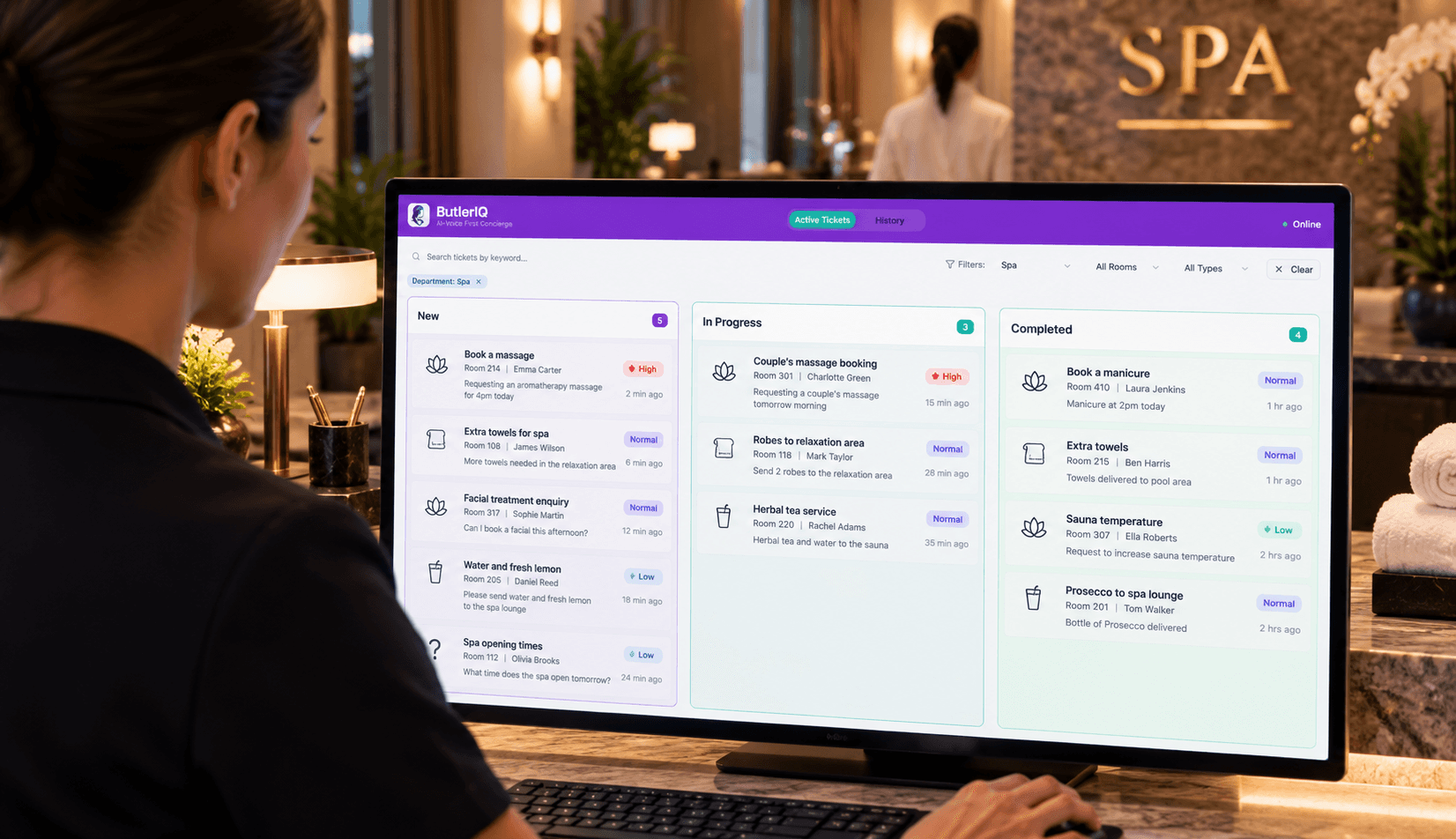
Service requests: Structured flows replace back-and-forth. "Extra pillow for room 308" captures the request, the room, and the time — and routes it to housekeeping without a call.
Recommendations and local information: A modern concierge surfaces what guests actually want: nearby restaurants, transport options, attraction hours, hotel facilities. When it's reliable and fast, guests stop calling reception to ask.
In-room upsell prompts: Breakfast add-ons, spa bookings, room upgrades, late checkout — all presented in context, not as pop-ups. This is where hotels recover revenue that currently goes uncaptured.
Check-in/check-out adjacent flows: Not always labelled "concierge", but often integrated — pre-arrival forms, arrival instructions, digital keys, and checkout prompts that reduce front desk queues at peak times.
The real value isn't any single feature. It's that a guest can start in self-service and your team can still step in immediately when the situation calls for a human response.
Core Features That Determine Whether Guests Actually Use It
Roll out a concierge that requires a login, an app download, or three clicks to find anything, and adoption collapses. You pay for software and still answer the phone.
These features separate tools that get used from tools that get ignored:
Frictionless access. A QR code in the room, a link in the pre-arrival email, a lobby screen. The guest should reach the concierge in under ten seconds — from bed, from the lift, from the spa. If it takes longer, they'll call instead.
Automation that feels like service, not a bot. Confirmations, estimated response times, "we've sent your request to housekeeping" — clear, human-sounding communication that sets expectations. Guests don't mind automation when it's fast and clear.
Real integrations. If the concierge doesn't connect to your PMS, POS, or restaurant booking system, staff end up retyping information and the tool creates friction rather than removing it. Integration is non-negotiable for any serious deployment. The full product stack that handles this — from guest device to staff console — is covered at ButlerIQ products.
Contextual upsell prompts. Not generic offers — relevant ones. A guest checking in for two nights sees a dinner reservation prompt for tonight. A guest on their third visit sees their usual preferences reflected back. That's the difference between a concierge and a noticeboard.
Operational reporting. Request volume by type, response times, peak hours, dropped conversations, upsell conversion rates. If you're making a case internally for staffing or investment decisions, this data is your evidence.
For a deeper look at what voice-led concierge experiences look like in practice, how AI voice assistants are redefining hotel stays covers the guest-side experience in detail.
Types of Digital Concierge Technology and Where They Fit
The fastest way to waste budget is to choose the wrong format for your property and your guests. A boutique hotel with 30 rooms has different needs from a 200-room city-centre property, even if both call it "concierge".
AI chat and guest messaging (in-room or mobile): Best when you receive repeated, predictable questions at volume. Automating "parking", "breakfast times", "late checkout", and "room service hours" frees your team for everything else. This is the most common starting point for independent hotels.
In-room devices (tablets or dedicated hardware): Ideal when you want consistent access without relying on guests using their own phones. A branded in-room device — placed where the old telephone used to sit — gives you full control of the experience and is particularly effective for room service, wake-up calls, and local recommendations. ButlerIQ's hardware approach is built around exactly this.
Mobile or web concierge portals: A single link — sent in a pre-arrival email or printed as a QR — that becomes the guest's hub for everything: FAQs, service requests, dining reservations, spa bookings, and checkout. Works well for properties where guests are comfortable using their own phones.
SMS and WhatsApp flows: Lowest friction for guests who won't scan a QR or engage with an in-room device. A simple "text us if you need anything" backed by automated responses and staff handover for complex queries. Common in boutique and lifestyle properties.
Self-service kiosks: Useful at check-in during peak periods — busy mornings, conference arrivals, weekend rushes — when queue time costs you reviews. Kiosks capture structured data fast and reduce front desk pressure at the moments it matters most.
For most hotels in 2026, the right starting point is in-room device or mobile/web, depending on your guest profile. Then you add messaging channels to catch guests wherever they are. Voice capability — hands-free, in-room — is the next frontier for properties that want to lead on experience.
How to Choose, Implement, and Measure Success
Buy a concierge tool and treat it as an IT project, and it will quietly fail. Staff won't trust it, guests won't use it, and the data will stay messy. Treat it as a service redesign — with a clear owner, defined workflows, and a 30-day window to prove it — and the results compound quickly.
1. Start with your top 20 guest interactions
Pull the last two weeks of front desk calls and messages. List the actual questions: "Where do I park?", "Can I get a late checkout?", "Is breakfast included?", "I need an extra blanket", "Can you book me a cab for 7am?". Your platform must handle these cleanly, with no dead ends and clear escalation when a human is needed.
2. Validate integrations before you commit
On day one, what does the concierge connect to? PMS, POS, restaurant booking, housekeeping system? If the answer is "nothing yet", understand the integration roadmap and timeline before signing. Disconnected tools create double-handling, and double-handling creates errors — wrong room allocations, missed requests, delayed responses.
3. Deploy across multiple access points
Use at least three: a pre-arrival link in the booking confirmation, an in-room QR code or device, and a widget on your website for guests still researching. Each touchpoint catches a different type of guest at a different moment. For the detail on how operational efficiency stacks up when you get this right, hotel staff efficiency tools in 2026 is worth reading.
4. Set clear escalation rules before you go live
Define what stays automated and what needs a person — and make sure every member of staff knows the rules. Suggested defaults: complaints, refunds, accessibility requests, safeguarding concerns, and anything emotionally charged always go to a human within a defined response window. Routine information requests, service logistics, and upsell flows stay automated.
5. Measure what matters, weekly
Track three categories:
Adoption: sessions started, messages sent, requests completed, drop-off points
Efficiency: first response time, resolution time, calls avoided, tickets reduced
Revenue: upsell conversion rate on two to three defined offers (late checkout, breakfast add-on, room upgrade)
Set a 30-day review. Low adoption? Fix access friction first — QR placement, email timing, wording. High adoption but weak outcomes? Fix workflows — routing rules, response templates, integration gaps.
Conclusion
If you're running a hotel in 2026 with a lean team and rising guest expectations, digital concierge services give you a way to do more without burning out your people. The key is to treat it as a service layer, not a shiny piece of technology: make access effortless, automate what repeats, and route anything sensitive to a human fast. Done well, you get faster responses, more consistent service, measurable operational savings, and a guest experience that earns better reviews — not because you spent more on staff, but because your team is spending their time on the things that actually matter.
Frequently Asked Questions
What are digital concierge services for hotels and how do they differ from a virtual front desk?
Digital concierge services let hotel guests access information, make service requests, and book hotel facilities through their own device or an in-room device — with a focus on experience, engagement, and upsell. A virtual front desk handles the transactional side of guest management: check-in, check-out, payment processing, and key issuance. Many platforms combine both, but concierge tools are primarily about improving the stay, while front desk tools are about processing arrivals and departures efficiently.
Why are hotels adopting digital concierge technology in 2026?
Mainly to address three pressures simultaneously: guest expectations for instant, 24/7 service; lean staffing that can't sustain high volumes of routine queries; and the need to capture upsell revenue that currently goes uncaptured. Digital concierge automates the repeatable, frees staff for high-value interactions, and surfaces revenue opportunities in context.
What features make hotel digital concierge tools actually work?
Frictionless access (QR codes, pre-arrival links, in-room devices), integrations with PMS and POS, automation that communicates clearly rather than feeling robotic, contextual upsell prompts, and operational reporting. The technology matters less than the access model — if guests can't find it or can't use it in seconds, they call reception instead.
Which type of digital concierge technology is best for hotels?
It depends on your property and guest profile. In-room devices work well for hotels that want a premium, consistent experience without relying on guests using their own phones. Mobile/web portals suit properties where guests are comfortable self-serving digitally. Most hotels in 2026 combine both, with messaging (WhatsApp or SMS) as a fallback for guests who prefer it.
How do you measure the success of a hotel digital concierge implementation?
Track adoption (sessions, completed requests, drop-off points), efficiency (response time, calls avoided, staff hours saved), and revenue impact (upsell conversion on defined offers). Set a 30-day review window and fix access friction before adjusting workflows. The data is only useful if you're reviewing it regularly and acting on what it tells you.
Can digital concierge services drive upsell revenue for hotels?
Yes — and it's one of the strongest commercial cases for the technology. A concierge that knows a guest's context (room type, length of stay, time of day) can surface relevant offers at the right moment: late checkout prompts on departure morning, dinner reservations when a guest checks in for the evening, breakfast add-ons the night before. The conversion rates are meaningful because the offer is timely and relevant, not a generic banner.
Sep 25, 2026
Hospitality Innovation
Guest Request Routing for Hotels in 2026: Cut Front Desk Workload Without Adding Headcount
Manual guest requests quietly eat hours of front desk time every week. See how automatic request routing works, what it saves your team, and how to evaluate it for your property.

Sep 15, 2026
Hotel Upselling Solutions: Why Pre-Arrival Isn't Enough
Hotel upselling doesn't require aggressive sales tactics—it requires smart timing and conversational delivery. Learn how modern hotels use voice-first AI and personalised offers to increase ancillary revenue by £15–£30 per stay while keeping guests feeling genuinely helped, not pressured. This guide covers proven upselling strategies, multilingual AI integration, and weekly KPI tracking for UK SME properties

Aug 14, 2026
Smart Hotel Rooms: Why the First Wave Failed, and What the Next One Looks Like
Smart hotel rooms promised a lot and delivered little. Here's what changed, what a genuinely smart room does in 2026, and how UK operators should approach it.
