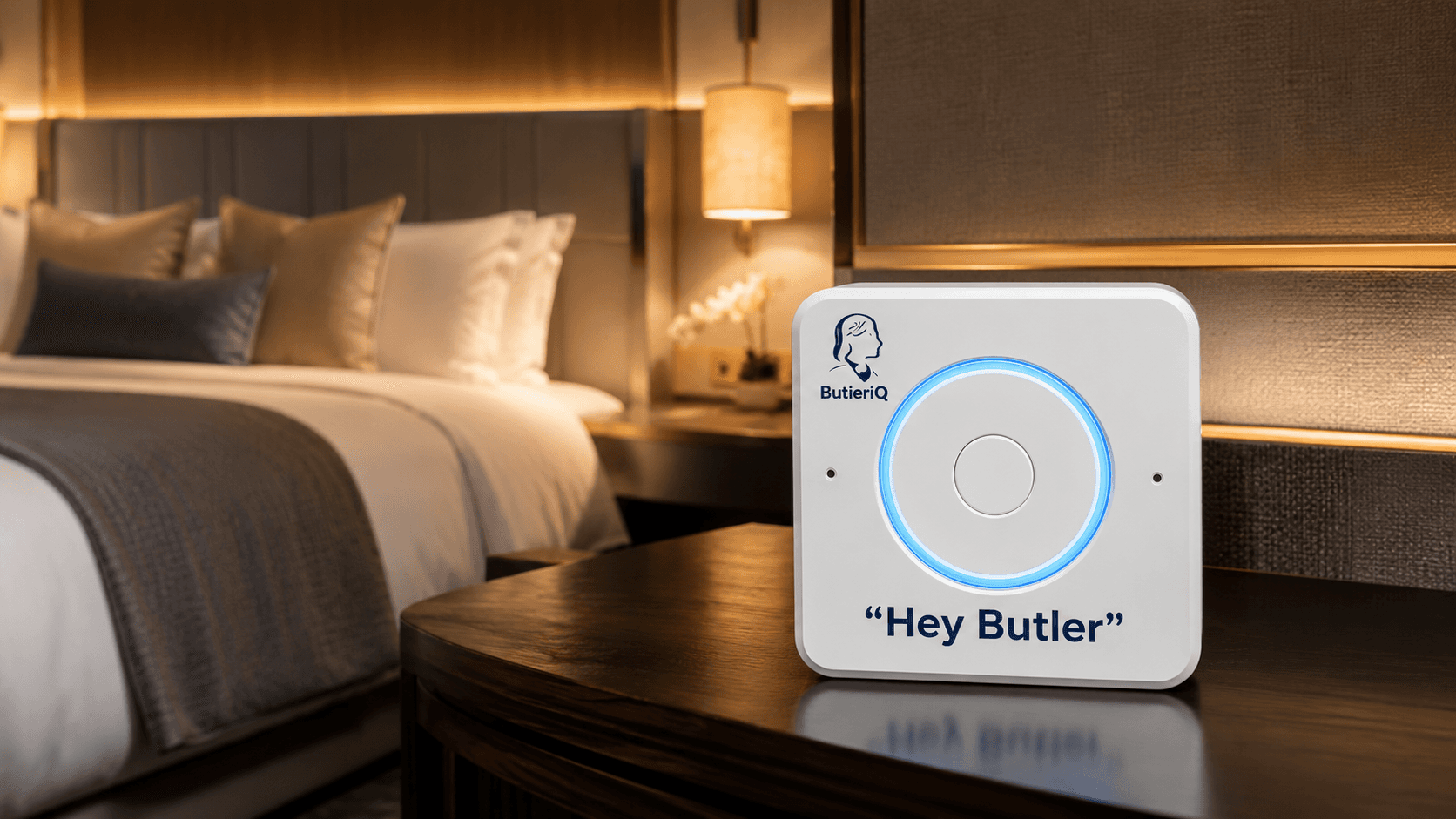
The Ultimate Guide To Voice Technology For Hotels
Discover how voice technology enhances hotel guest experience, boosts efficiency, and streamlines operations with practical, expert insights in this ultimate guide.
When guests call reception for "two more towels" at 10pm, your team loses time, the queue builds, and service feels slower than it should. If you're weighing voice assistants for guest rooms or staff workflows, you need clarity on what actually works, what it costs, and what can go wrong. In The Ultimate Guide to Voice Technology for Hotels, we show you how to pick practical use cases, reduce operational load, and protect guest trust without turning your hotel into a tech project.
Key Takeaways
Voice technology in hotels streamlines guest requests and staff workflows by enabling natural speech commands linked to systems like PMS and room controls.
Implementing voice assistants strategically at high-demand points reduces reception calls and operational load while enhancing guest satisfaction and staff efficiency.
Effective voice solutions include in-room controls, guest information, service requests, and back-of-house tasks, focusing on frequent and simple use cases first.
Address challenges such as voice accuracy, system reliability, seamless integration, and guest/staff training to ensure smooth operation and adoption.
Prioritise privacy and security by conducting a Data Protection Impact Assessment, offering clear opt-outs, and maintaining strict UK/EU GDPR compliance.
Follow a phased rollout roadmap starting with a clear objective, a pilot group, vendor selection, workflow design, staff and guest enablement, then measure and expand based on results.
What Voice Technology Means In A Hotel (And How It Fits Into Hospitality Tech)
If you've ever watched a guest tap through three screens just to find breakfast times, you already know the problem: small friction points create big workload. Voice technology in hotels means speech-driven systems, usually in-room assistants or staff voice tools, that let people request services or control the room using natural language instead of a phone or app.
In practice, it's often a managed smart speaker or in-room device that connects to your existing stack: PMS, guest messaging, IPTV, HVAC, lighting, curtains, and a service-request platform. A guest says, "Turn the temperature to 20 degrees," and the request goes straight to the room controls. Or they say, "I need extra pillows," and the system creates a task for housekeeping with room number, time stamp, and status tracking.
It's not a replacement for your PMS or your guest app. It's a front door to them, another interface, like a webchat widget or a reception phone line. The best implementations treat voice as part of the wider hospitality tech ecosystem, with clear workflows, sensible fallbacks (phone/app/human), and reporting so you can see what guests actually ask for.
If you're exploring where AI voice fits more broadly in the smart-hotel trend, the examples in the future of smart hotels with AI voice assistants can help you benchmark what's realistic for an SME setup.
Where Voice Technology Delivers Value Across The Guest Journey And Operations
The quickest way to waste budget is to add voice tech in rooms and then realise guests still ring reception for the same five things. Value comes when you place voice at the moments where guests need answers fast and your team is busiest.
Pre-arrival and booking: If you handle calls in-house, voice-enabled call handling can capture intent ("family room for two nights, parking needed"), route the call to the right person, and prompt agents with consistent scripts. For example, you can standardise how you explain breakfast add-ons or parking rules so new staff don't improvise under pressure.
On-property (the stay): This is where most hotels see the clearest operational impact. In-room voice can cover the high-frequency requests that clog the phone: towels, late checkout, extra hangers, room service, "how do I connect to Wi‑Fi?", "what time does the gym close?", and simple maintenance reports. When voice creates a tracked task instead of a phone message, you remove the "did anyone log that?" gap.
Back-of-house operations: Staff voice interfaces can reduce admin when teams update room status, log minibar issues, or confirm a job is complete. A maintenance tech can say, "Close ticket 214, AC fixed," while standing in the corridor instead of hunting for a terminal.
Post-stay: Spoken interactions are a goldmine for friction. If multiple guests ask, "Where is the car park entrance?" you have a signage or pre-arrival comms problem you can fix.
For a practical view of how AI voice supports end-to-end service, creating seamless guest journeys with AI voice assistants is a useful reference point.
The Business Benefits: Experience, Efficiency, Revenue, And Accessibility
If you're running an SME hotel, you don't adopt technology for fun, you adopt it because you need results with the team you already have. Voice technology tends to land in four measurable buckets.
Guest experience: Guests get immediate answers without waiting on hold. A tired business traveller can ask, "Can I get an iron?" while unpacking. A family can say, "Turn off the lights," without finding switches in an unfamiliar room. That convenience shows up in satisfaction scores because it reduces moments where guests feel ignored.
Efficiency: Reception calls drop when common queries move to self-serve voice. Housekeeping and maintenance benefit when requests become structured tasks with timestamps and clear ownership. You also cut training time because staff don't need to memorise where to log things across multiple systems, voice can act as the simple capture layer.
Revenue: Voice can drive low-friction upsell when it's done with restraint. A guest asks, "Can I check out later?" and the assistant can offer the paid late checkout option with clear pricing and a one-step confirmation. The same applies to breakfast upgrades, spa availability, or room service prompts at sensible times.
Accessibility: Voice control matters for guests with limited mobility or vision. If a guest can adjust temperature, lighting, curtains, and request assistance by voice, you reduce barriers without asking them to navigate apps or touch panels.
If you want more specific ways multilingual voice can improve perceived service quality, how multilingual voice interfaces boost guest experience is especially relevant for UK properties with international leisure and business mix.
Common Use Cases In Hotels (From In-Room Controls To Guest Services)
Most hotels don't fail with voice because the tech "doesn't work": they fail because they try to do everything at once. Start with use cases that are frequent, easy to understand, and simple to fulfil.
1) In-room controls (the ‘instant win' set):
Lights on/off, dimming, and "all off" at bedtime.
Temperature changes with clear guardrails (for example, set limits so guests can't push HVAC outside safe ranges).
TV controls, basic channel navigation, and volume.
Curtains or blinds where the hardware supports it.
2) Hotel information and wayfinding:
Breakfast times, check-out time, gym opening hours, Wi‑Fi instructions.
Directions like "How do I get to the lift?" or "Where is the restaurant?"
Local recommendations with boundaries ("nearest pharmacy", "taxi to the station").
3) Guest service requests and amenity ordering:
Towels, pillows, toiletries, irons, cots.
Housekeeping requests such as "clean my room at 2pm" with confirmation.
Maintenance reports such as "the shower is leaking" that open a ticket with urgency flags.
4) Staff-facing workflows:
Voice notes that turn into tasks ("Room 307 needs a lamp replacement").
Status updates ("Room 512 cleaned and inspected").
5) Reservations and sales support (where it fits):
Voice routing and guided scripting in reservations, especially for small teams.
Follow-up prompts for missed calls or abandoned enquiries.
If your priority is reducing pressure on reception and service teams, the approaches in AI concierge for hotels, better service without more staff pair well with these practical use cases.
Key Challenges And Risks To Plan For
A guest who asks twice and still doesn't get towels won't blame the device, they'll blame you. The risks are manageable, but only if you plan for them early.
Accuracy in real hotel conditions: Corridors are noisy, guests have different accents, and some rooms echo. You reduce failures by testing commands in real rooms, limiting the number of phrases for each task, and providing clear examples on a bedside card ("Say: ‘Send extra towels'").
Reliability and fallbacks: Voice must fail gracefully. If the Wi‑Fi drops or a device hangs, guests still need a phone option and your staff need a visible task queue so requests don't vanish. Set a rule such as: if the assistant can't confirm a request within 10 seconds, it offers to connect the guest to reception.
Integration complexity: The hard part is not the speaker, it's mapping voice intents to your PMS, service-ticketing, and room controls without messy workarounds. Before you sign anything, list the exact systems you use (PMS brand/version, building management, IPTV, guest messaging) and confirm which integrations are native versus "custom".
Change management: Guests won't automatically trust voice in the room. You need simple messaging at check-in ("You can ask for towels or checkout times by voice, or call us as usual") and staff training that focuses on what happens behind the scenes when a request comes in.
Vendor lock-in and ageing tech: Platforms and pricing models change. Protect yourself with contract clauses on data access, device replacement cycles, and exit options.
Privacy, Security, And Compliance In The UK And EU Context
If you get privacy wrong, you don't just risk a complaint, you risk reputational damage that is hard to reverse in hospitality. Voice interactions can involve personal data (room numbers, names, preferences, sometimes even health-related requests), so you need a UK/EU GDPR mindset from day one.
Start with a Data Protection Impact Assessment (DPIA) for the voice deployment. Document what data you collect, where it is processed (on-device vs cloud), and who can access it. Then set practical controls:
Transparency in-room: Provide a short, plain notice in the room that explains what the device does, whether it stores recordings, and how guests can opt out.
Opt-out and mute: Make the physical mute button visible and usable, and train housekeeping to check device settings during room resets.
Data minimisation and retention: Configure the platform to store the least possible data for the shortest time that still supports service improvement.
Guest profile reset: Ensure devices and linked profiles are cleared between stays so one guest's requests don't personalise another guest's experience.
Security hygiene: Segment voice devices onto a separate network, apply patching policies, and encrypt data in transit and at rest.
Vendor paperwork: Put a Data Processing Agreement in place and verify safeguards if any data leaves the UK/EU.
If you want a deeper security-led view of what good looks like in 2026, voice-activated security protocols for hotels is a strong starting point.
How To Implement Voice Technology: A Practical Roadmap For SMEs
If you try to roll voice into every room, every language, and every system in one go, you'll turn a service upgrade into an operations headache. A staged rollout keeps risk low and helps you prove ROI before you scale.
1) Define a single primary objective
Pick one: reduce reception calls, cut time-to-fulfil for amenities, improve room-control experience, or increase F&B orders. For example, you might target "reduce night-shift calls by 25% in 8 weeks" so you can measure impact.
2) Map your current stack and friction points
Write down your PMS, ticketing method (email, WhatsApp, paper log), Wi‑Fi constraints, and room-control hardware. Then list the top 10 guest requests by volume (towels, Wi‑Fi help, checkout time). Those become your first intents.
3) Choose a pilot that staff can actually support
Start with 10–20 rooms, ideally on one floor, and include a mix of guest types (business and leisure). Keep the initial command set tight: room controls + 5–8 service requests + hotel info.
4) Select a vendor using a simple scorecard
Score vendors on: PMS and room-control integration, UK/EU data posture, multi-accent performance, device management, and reporting. If you'll manage multiple devices, prioritise a central console so you can push updates and reset rooms at checkout.
If you're comparing how different systems support hotel teams behind the scenes, the product view of a hotel staff dashboard for managing requests can help you picture the operational layer you need.
5) Design the workflow end-to-end (not just the voice command)
Define who receives each request, how it is prioritised, and what "done" looks like. Example: "Extra towels" creates a housekeeping task with a 15-minute SLA during daytime and a 25-minute SLA overnight, with escalation to duty manager if overdue.
6) Prepare guest and staff enablement
Create a one-card guide in the room with three example phrases and one privacy note. Train staff using real scenarios: a guest asks for late checkout, the assistant confirms pricing, staff see the task, and reception updates the PMS.
7) Measure, iterate, then scale
Track call volume, request fulfilment time, guest satisfaction mentions, and upsell conversion where relevant. After two to four weeks, refine phrases that misfire, remove low-value intents, and only then expand to more rooms.
If you want a broader operational perspective on reducing admin time while protecting the team, hotel staff efficiency tools in 2026 complements this roadmap nicely.
Frequently Asked Questions about Voice Technology for Hotels
What is voice technology in hotels and how does it integrate with hospitality systems?
Voice technology in hotels refers to speech-driven systems like in-room assistants that allow guests to control room features and request services using natural language. These devices integrate with PMS, IPTV, HVAC, and service platforms to create seamless guest interactions and operational workflows.
How does voice technology improve the guest experience in hotels?
Voice technology enhances guest experience by offering immediate, hands-free service such as controlling lights and temperature or requesting amenities. This convenience reduces wait times, increases satisfaction, and improves accessibility for guests with limited mobility or vision.
What are common practical use cases for voice technology in hotel operations?
Typical use cases include in-room controls for lighting, temperature, TV, and curtains; guest service requests like extra towels or maintenance reports; providing hotel information; staff workflow tasks; and voice-enabled reservation support with guided scripting.
What challenges should hotels anticipate when implementing voice technology?
Hotels should plan for accuracy issues caused by noise and accents, ensure reliable fallbacks like phone or app, manage complex integrations with PMS and room controls, train staff and guests on new systems, and mitigate risks of vendor lock-in and outdated tech.
How do UK and EU data privacy regulations affect voice technology deployment in hotels?
Hotels must comply with UK/EU GDPR by conducting Data Protection Impact Assessments, minimizing data collection, providing clear in-room privacy notices and opt-out options, ensuring secure data processing with encrypted networks, and securing vendor agreements for lawful data handling.
What steps should an SME hotel follow to implement voice technology effectively?
SME hotels should start by defining clear objectives, assessing their current systems, selecting focused use cases for a small pilot, choosing vendors with strong integration and data compliance, designing workflows with fallback options, training staff and guests, measuring results, and scaling gradually.

Sep 15, 2026
Hotel Upselling Solutions: Why Pre-Arrival Isn't Enough
Hotel upselling doesn't require aggressive sales tactics—it requires smart timing and conversational delivery. Learn how modern hotels use voice-first AI and personalised offers to increase ancillary revenue by £15–£30 per stay while keeping guests feeling genuinely helped, not pressured. This guide covers proven upselling strategies, multilingual AI integration, and weekly KPI tracking for UK SME properties

Aug 14, 2026
Smart Hotel Rooms: Why the First Wave Failed, and What the Next One Looks Like
Smart hotel rooms promised a lot and delivered little. Here's what changed, what a genuinely smart room does in 2026, and how UK operators should approach it.

Jul 30, 2026
Voice-First Hotel AI Concierge: Turn Guest Requests Into Revenue And Free Your Front Desk
A voice-first hotel AI concierge captures guest requests, routes them to your team, and turns everyday asks into upsell revenue. See how it works.
