
Voice Assistant Trends for Hotels in 2026 | ButlerIQ
See how voice-first concierges are reshaping hotels in 2026. ButlerIQ turns in-room guest requests into trackable tasks your team can action instantly.
You can lose guest goodwill in the ten seconds it takes someone to give up on a fiddly in-room phone, a QR code they can't be bothered to scan, or a request that reception never quite gets round to. In 2026, that pressure is growing because guests expect answers instantly, and your team can't be everywhere at once. In this guide we break down the most important voice assistant trends in the hotel industry, and where a voice-first in-room concierge like ButlerIQ fits, so you can decide what to trial, what to ignore, and what will actually save time and protect revenue. We'll keep it practical: which use cases pay back fastest, and what to check before you roll anything out.
Key Takeaways
Voice in hotels has moved from novelty in-room speakers to operational tools that capture a guest request and route it to the right team to fulfil.
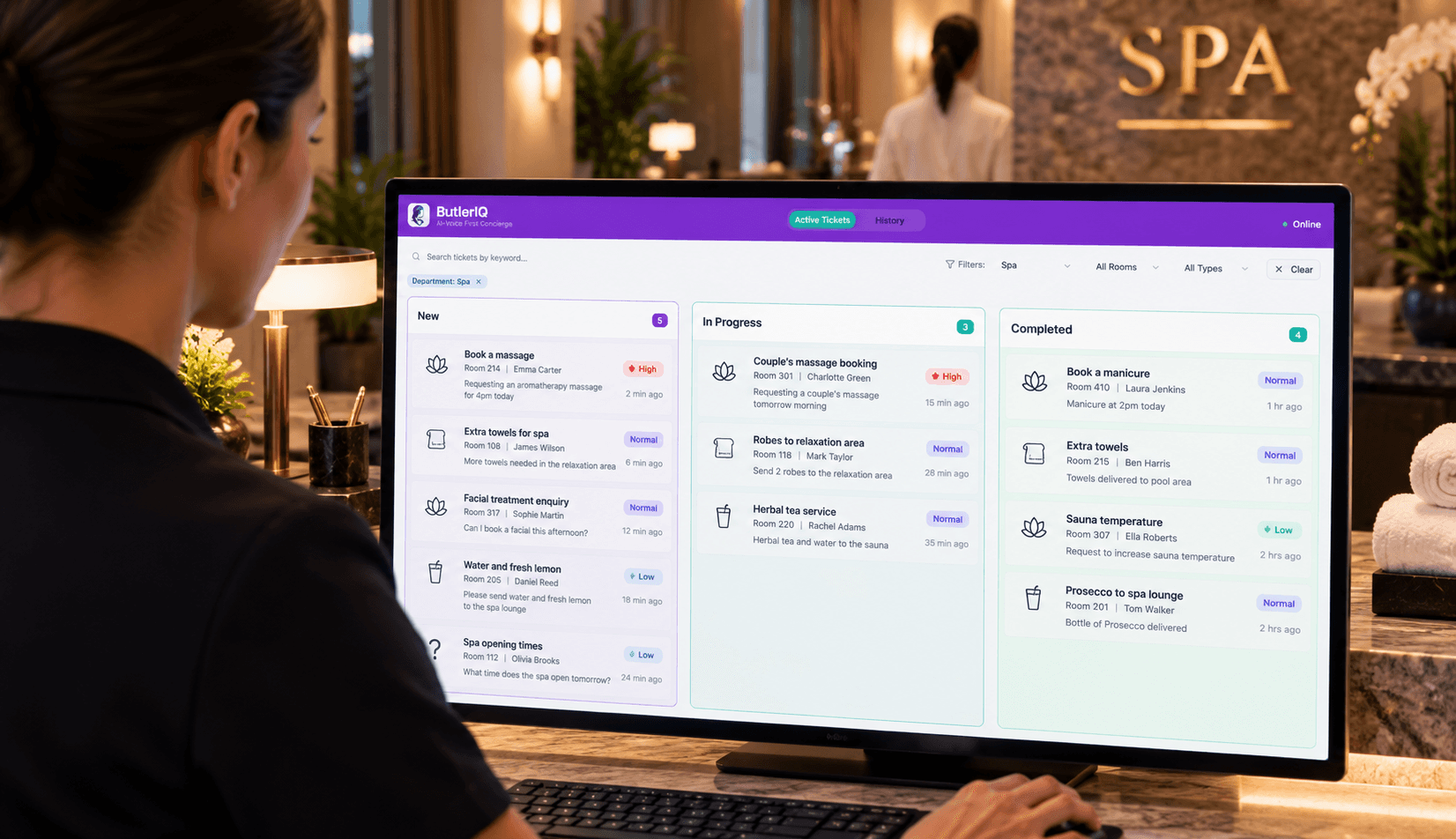
The strongest returns come from in-room guest service: a guest asks naturally, the request is logged with room number, priority and time, and staff see it on a live board.
ButlerIQ works by a guest pressing the middle button on the in-room device (or saying "Hey Butler"), then routing that request to a Kanban-style board for staff to manage and complete.
Prioritise high-impact use cases: service requests that become trackable tasks, property-specific FAQs, well-timed upsell, and multilingual support.
Make sure any voice tool is hotel-aware, honours guest privacy with clear controls, and integrates cleanly with the systems your team already uses.
Start small with a pilot on one measurable problem, train staff on how requests appear and get actioned, then expand.
Conversational AI in hospitality: what's changed since "Alexa in the room"
The old "Alexa in the room" pilots often created a new kind of complaint: a guest asked a normal question, got a generic answer, and phoned reception anyway. That failure mattered because it trained teams to see voice as a gimmick rather than an operational tool.
What's changed is the move from simple command-and-control to conversational workflows that actually do something. A modern in-room concierge combines speech recognition, natural language understanding and integration with your operations, so the assistant can act on a request instead of only answering it. When a guest says, "We need extra towels and the fan's rattling," you want one interaction that creates two tasks, each with room number, priority and a timestamp, ready for the right team to pick up.
This is the model ButlerIQ is built around. A guest presses the middle button on the in-room device, or says "Hey Butler," and makes a request in their own words. ButlerIQ turns that into a clear task and routes it to a Kanban-style board your staff already understand: to do, in progress, done. Nothing gets scribbled on a notepad and lost during a busy check-in. If you want a useful baseline for how the wider guest journey is stitched together, our view aligns with the approach in creating seamless guest journeys with AI voice assistants: start with the moments where guests get stuck, then automate the hand-offs.
Finally, 2026 deployments are more "hotel-aware". Instead of guessing, ButlerIQ is set up with your property's own information, such as breakfast times, parking, pet and late check-out policies, and your brand tone, so answers sound consistent with how you'd brief a new team member.
Why the in-room moment is where voice earns its keep
Guests already have a phone in their pocket. What they don't want is another app to download, another QR code to scan, or a hunt for the right extension on a bedside handset. The in-room moment, when a guest simply needs something and wants to ask for it, is exactly where a voice-first concierge removes friction.
That is deliberately where ButlerIQ focuses. It isn't a call-centre or reservations system, and it doesn't try to replace your phone lines. It sits in the room, ready the moment a guest has a need, and it makes that need visible to your team instantly. A simple operational step to see the value: write down the top 25 requests your guests actually make in-room, from your logs or from asking your team, then note how many currently arrive reliably and on time. That gap is what an in-room concierge closes.
Because ButlerIQ captures the request in context, the room number, the request type and the time are attached automatically. Your team spends less time chasing detail and more time delivering the service. For the wider commercial case, why hotels are investing in AI voice technology sets out where hotels tend to feel the benefit first.
High-impact use cases hotels are prioritising
When budgets are tight, the risk is picking a flashy feature guests try once and forget. The hotels seeing results in 2026 start with use cases that reduce friction guests complain about and lighten the load on staff.
Service requests that become trackable tasks. "More pillows," "late checkout," "extra hangers" sound small, but they generate interruptions and lost notes. With ButlerIQ, the guest asks and the request lands on the staff board with room number, request type and time promised, so nothing slips.
Property-specific FAQs, answered in the guest's own words. Guests don't want generic responses. They want your breakfast times, your parking rules, your pet policy. ButlerIQ is set up with an approved knowledge base drawn from your own information, so answers are consistent and correct. A good first step is to gather that content from your website and internal SOPs, then test it against real guest questions.
Well-timed upsell that feels like service, not sales. "Would you like a late checkout for £20?" works when it's timed well (the night before departure, say) and when staff can see and honour it. Because the offer and any acceptance flow through to the same board, your team can act on it. We expand on keeping this on-brand in AI concierge for hotels: better service without more staff.
Multilingual requests without a language barrier. International guests can ask in their own language and still be understood, which lifts both adoption and satisfaction. We cover the practical considerations in how multilingual voice interfaces boost guest experience.
Internal task capture for your team. Staff can raise a task too, so a maintenance issue spotted on the corridor becomes a ticket on the board rather than a mental note that evaporates by the next floor. This helps even before guest adoption is high, because your team uses the board every day.
From basic voice assistants to a proper concierge: what's different
If your last exposure to hotel voice was a device that told you the weather and played music, you might assume the category hasn't matured. That assumption can cost you, because the operational gains now come from tools that act less like a gadget and more like a well-briefed team member.
Basic voice assistants rely on fixed commands, limited context and shallow integration. They break the moment a guest phrases a request differently ("it's too dark in here") or adds a follow-up ("and can you bring two extra towels?"). The result is predictable: the guest gives up and rings reception anyway.
A hotel-specific concierge is designed for real requests and, crucially, for what happens after the request. ButlerIQ's difference is that the interaction doesn't end with a spoken answer; it ends with a task on a board that a named team can action and mark complete. That produces something a smart speaker never could: a record of what guests are actually asking for. If ButlerIQ shows that a large share of requests are about parking or breakfast timings, you can update your pre-arrival email or in-room information and cut those requests next week.
One more practical point worth calling out: reliable triggering. Rather than depending on a wake word that mishears or listens when it shouldn't, ButlerIQ lets a guest simply press the middle button to talk. It's a small design choice that removes a common source of frustration, and it's an easy answer to the two questions guests ask most about any in-room device: "is it always listening?" and "how do I actually use it?"
Privacy, accuracy, integration and guest trust
One privacy misstep can undo months of guest-experience work, especially when a device sits in a bedroom. So the first job isn't choosing a voice; it's choosing an approach you can explain clearly at check-in and stand behind under GDPR.
Privacy needs visible, plain-English controls: a clear way for guests to understand what the device does, straightforward signage, and retention rules that match your legal basis. The button-to-talk model helps here, because it's obvious to a guest when the device is being used. A practical step: add a short "in-room concierge" note to your guest directory and brief staff to answer two questions confidently: "is it always listening?" and "what happens to my data?"
Accuracy is where many projects quietly fail. UK properties deal with accents, background noise and, in tourist areas, multiple languages. Test with real phrases from real guests, not vendor demo scripts. Multilingual support isn't a nice-to-have for international properties; it's the difference between adoption and avoidance.
Integration decides whether voice reduces work or adds to it. The point of ButlerIQ is that a request doesn't stop at a transcript; it becomes a task your team can see and complete, so no one re-keys information by hand. Before you commit to anything, map two or three of your most common requests end-to-end, for example "extra towels" from guest ask to delivery confirmed, and check every hand-off works.
Guest trust is earned through reliability and respectful escalation. When a request needs a person, it should reach the right person with the context already attached. If you want a security lens, treat any in-room device as an access point and align it to your policies: voice-activated security protocols for hotels is a useful reference for what "good" looks like.
How to trial an in-room concierge without blowing the budget
The quickest way to waste money is to roll something out everywhere at once, then discover staff don't trust the outputs. A narrow pilot that proves one clear win, then expands, works far better.
Start with a single high-friction problem you can already measure, such as requests that arrive late or get lost between guest and team. If your staff currently jot requests on paper during peak check-in, that's a strong signal an in-room concierge with a shared task board will pay back quickly.
A simple three-stage rollout:
Discovery (1–2 weeks). List your most common in-room requests and questions. Group them into "handle automatically," "capture and route to staff," and "needs a person." Set a clear standard, for example: the request must capture room, request type and timing every time.
Pilot (4–6 weeks). Deploy in a set of rooms or one floor. Train staff on how requests appear on the board and how to action them, and add a daily feedback loop so they can flag anything that looks wrong. If staffing pressure is part of the driver, hotel staff efficiency tools in 2026 has good examples of what to measure.
Expand (6–12 weeks). Add one thing at a time: more room types, then upsell offers, then multilingual coverage. Each step should include a short staff refresher and a quick check that everything still flows to the board.
To keep costs sensible, ask for clear pricing tied to rooms or property, and don't pay for features you can't support operationally. And don't skip the human side: a 20-minute briefing with real examples ("here's how a late-checkout request will appear on your board") often does more for adoption than any notice in the lobby.
Conclusion
Voice is no longer a novelty in hotels. In 2026 it's becoming a practical service layer, and the clearest returns come from the in-room moment, where a guest simply asks for what they need. Focus on one measurable problem, insist on requests that turn into trackable tasks, and communicate privacy in plain English, and you can improve response times without stretching your team. That's exactly what ButlerIQ is built to do: a guest presses a button or says "Hey Butler," and your team gets a clear, routed task they can actually act on.
Voice concierge FAQs for hotels
What are the key voice assistant trends shaping hotels in 2026? Hotels are moving beyond novelty in-room speakers to voice-first concierges that capture a guest request and route it to staff to fulfil. The trend is towards contextual, conversational tools that log requests with room number, priority and time, rather than simply answering questions.
How does ButlerIQ actually work? A guest presses the middle button on the in-room device, or says "Hey Butler," and makes a request in their own words. ButlerIQ turns that into a task and routes it to a Kanban-style board, where staff manage and complete it, so nothing gets lost.
How is a hotel concierge different from a basic voice assistant? A basic assistant handles fixed commands and stops at a spoken answer. A concierge like ButlerIQ handles natural, multi-turn requests and, crucially, turns them into trackable tasks a named team can action and close, producing a useful record of what guests actually ask for.
Which use cases deliver the most value? Service requests that become trackable tasks, property-specific FAQs answered in the guest's own words, well-timed upsell, multilingual support, and internal task capture for staff, all designed to reduce friction and improve efficiency.
How can smaller hotels trial voice without overspending? Start with a narrow pilot on one measurable, high-friction problem such as late or lost requests. Validate that requests flow cleanly to your team, train staff, and expand one step at a time, with pricing tied to rooms or property.
What privacy and accuracy points should hotels address? Provide GDPR-friendly, plain-English controls and clear guest information, helped by a button-to-talk model that makes device use obvious. Test accuracy with real accents and languages, not demo scripts, to protect adoption and guest trust.
Sep 25, 2026
Hospitality Innovation
Guest Request Routing for Hotels in 2026: Cut Front Desk Workload Without Adding Headcount
Manual guest requests quietly eat hours of front desk time every week. See how automatic request routing works, what it saves your team, and how to evaluate it for your property.

Sep 15, 2026
Hotel Upselling Solutions: Why Pre-Arrival Isn't Enough
Hotel upselling doesn't require aggressive sales tactics—it requires smart timing and conversational delivery. Learn how modern hotels use voice-first AI and personalised offers to increase ancillary revenue by £15–£30 per stay while keeping guests feeling genuinely helped, not pressured. This guide covers proven upselling strategies, multilingual AI integration, and weekly KPI tracking for UK SME properties

Aug 14, 2026
Smart Hotel Rooms: Why the First Wave Failed, and What the Next One Looks Like
Smart hotel rooms promised a lot and delivered little. Here's what changed, what a genuinely smart room does in 2026, and how UK operators should approach it.
