
Smart Hotel Rooms: Why the First Wave Failed, and What the Next One Looks Like
Smart hotel rooms promised a lot and delivered little. Here's what changed, what a genuinely smart room does in 2026, and how UK operators should approach it.
The hotel room is the least intelligent space most people occupy all day.
Your guest has a phone in their pocket that answers almost anything, and a room where the fastest way to ask about the car park barrier is a laminated card, a QR code that opens a slow PDF, or a phone that rings a front desk already dealing with three arrivals.
Plenty of people have tried to fix this. Most of them failed. It's worth understanding why, because the reasons tell you exactly what the next generation of smart rooms has to get right — and what to look for when someone tries to sell you one.
Smart rooms 1.0: a good idea, badly timed
Between roughly 2016 and 2020, in-room technology had its first serious moment. Hotels deployed consumer smart speakers, in-room tablets, branded guest apps and, after 2020, QR codes on every surface.
Almost none of it stuck. Four reasons, and they're all still relevant:
The AI wasn't good enough. Voice assistants of that era were command interpreters, not conversationalists. They handled "set an alarm" and fell over on "is there anywhere near here that's still doing food?" A system that fails the second question doesn't get asked a third.
Nothing knew anything about the hotel. A generic assistant in a hotel room is a stranger who has never seen the building. It couldn't tell a guest which lift goes to the spa, or that breakfast moves to 07:00 at weekends.
The hardware belonged to someone else. Consumer speakers brought consumer branding, consumer data practices and consumer support into a premium environment. Guests noticed. So did legal teams.
Nobody closed the loop. A guest could ask for towels and the request went nowhere useful — no queue, no owner, no record. The technology created an expectation the operation couldn't meet, which is worse than not offering it.
Tablets had their own version of the same problem: expensive, hard to keep charged and clean, and mostly used as an overpriced TV remote. Apps asked guests to download something for two nights. QR codes solved distribution and nothing else.
The lesson isn't "guests don't want in-room technology." It's that guests won't tolerate technology that's slower than asking a person.
What has actually changed
Four things, and they've changed at roughly the same time — which is why this is a genuine inflection rather than another cycle of the same idea.
Conversation quality. Modern language models handle open, messy, real questions. Guests don't have to learn a syntax. That single change removes the biggest source of first-use abandonment.
Latency. Response times have dropped to the point where speaking to a system feels like a conversation rather than a transaction. Anything slower than about a second reads as broken, however good the answer.
Language. Multilingual support is no longer a premium module. A system that answers in fluent Spanish, Mandarin or Arabic at 2am is doing work your night team genuinely can't, and it costs no more than the English version.
Constrained context. The important technical shift isn't a bigger model — it's the ability to ground a system in one property's actual information, so it answers about your hotel and declines to invent things it doesn't know.
Meanwhile the commercial pressure has intensified. Recruitment remains hard, guest expectations have been reset by every other digital service they use, and international guests are back.
What a genuinely smart room does in 2026
Ignore feature lists. Five tests separate a smart room from an expensive gadget.
1. It answers instantly, in the guest's language, without setup. No download, no login, no scan, no account. The guest speaks and gets an answer. Anything that requires a step before the first useful moment will lose to the front desk phone.
2. It knows this hotel, not hotels in general. Your check-out time, your parking arrangement, your accessible entrance, your restaurant's closing time. And when it doesn't know, it says so and hands over rather than guessing.
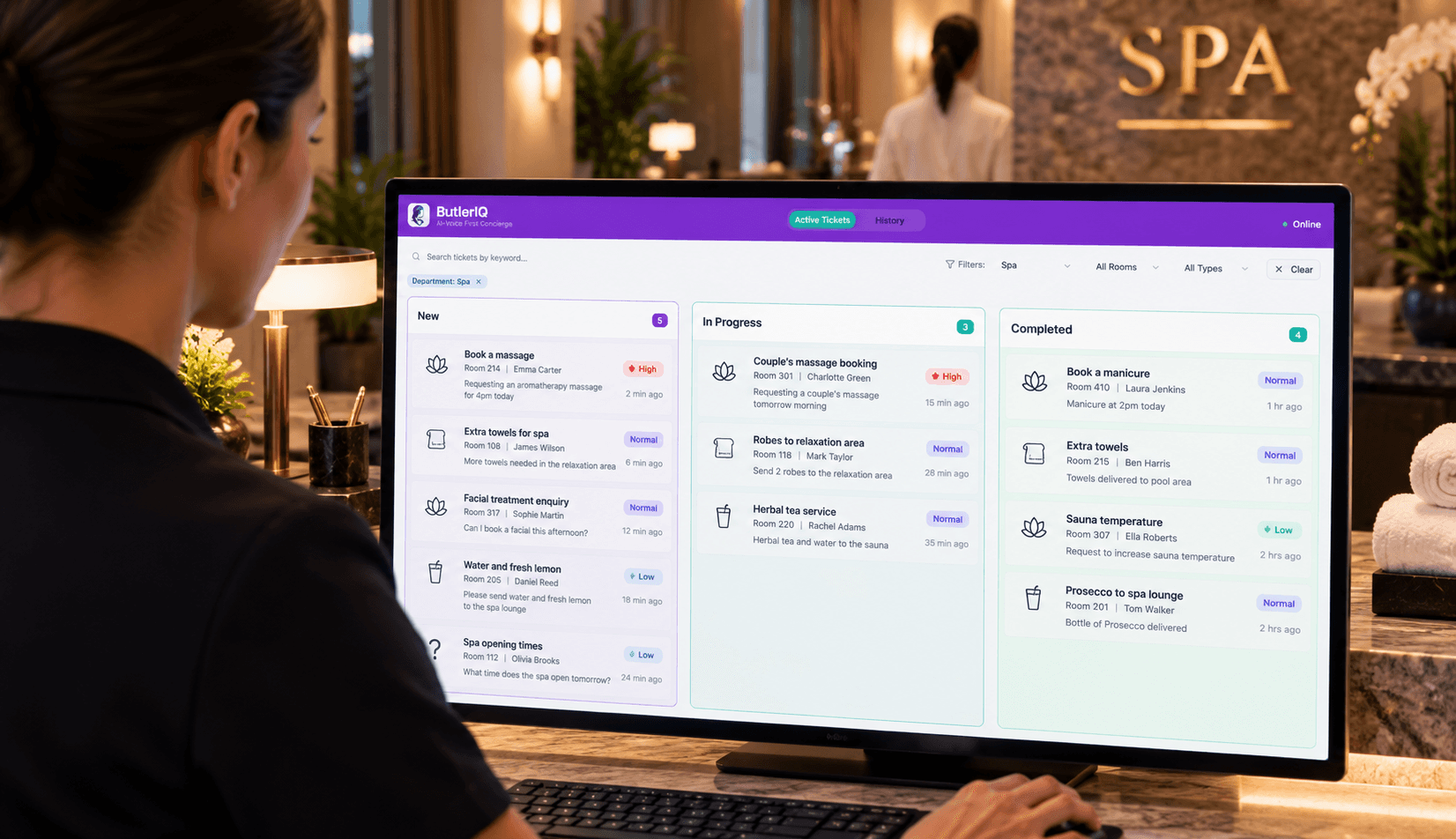
3. Requests become tracked work. "Can I have more towels" should create a real item with an owner, a priority and a timestamp — visible to the team, closeable, measurable. This is the part most in-room technology skips, and it's the part that determines whether the room feels smart on night two. Our staff dashboard overview shows how request queues and escalation work in practice.
4. It knows what it shouldn't handle. Complaints, refunds, accessibility needs, safety, anything emotional or high-value — these route to a person, quickly and with context. A smart room isn't one that handles everything. It's one that draws the line accurately.
5. It belongs in the room. In a boutique or premium property, a consumer speaker with someone else's logo is a design failure and a trust problem. The device should read as part of the room, and the data behaviour behind it should be something you're comfortable putting in writing. (Ours is in our privacy policy; whatever provider you choose, the equivalent should be that easy to find.)
If a system passes five out of five, it's a smart room. Four out of five is a pilot. Three is a gadget.
Where ButlerIQ is heading
We build against those five tests, in that order. Here's the honest state of it.
What's working now. A voice-first, hotel-branded in-room device that answers property and local questions in multiple languages, captures service requests, and routes them to a staff console where they can be seen, prioritised and closed. Configured per property, so it speaks about your hotel specifically.
One design decision worth explaining: we've moved away from relying on a wake word. Wake words fail in real rooms — television audio, air conditioning, multiple accents, guests who don't know the phrase and shouldn't have to learn it. A clear press-to-talk interaction is more reliable, more private, and more obvious to a guest who has never seen the device before. It's less impressive in a demo and considerably better in a bedroom.
What we're building next. Deeper operational workflow — sharper routing by department, escalation rules that reflect how a real rota works, and reporting that ties interactions to outcomes an owner cares about: front desk call volume, request resolution time, upsell conversion.
What's further out. Full orchestration across hotel systems — the point where in-room requests, housekeeping and property systems move as one flow without anyone copying information between screens. That's where the industry is going, and we're designing towards it. We're not going to claim it's shipping today, because you'd find out during onboarding.
That distinction matters more than any feature. The reason smart rooms 1.0 failed was over-promise, not under-technology. If you're evaluating anyone, including us, ask which capabilities are live in a named property right now and which are on a roadmap. A straight answer is a good sign.
You can see how we split the product into components — guest devices, staff workflow, admin control — on our products overview, and the FAQ covers deployment and day-to-day operation.
What UK operators should do in the next 90 days
You don't need a strategy. You need one controlled experiment.
Pick one moment, not one technology. Choose the interaction that generates the most repetitive calls — usually parking, late arrival, breakfast times, or Wi-Fi. That's your test case.
Count it first. For two weeks, log how often it comes up and how long it takes. Without a baseline you'll be arguing about impressions later.
Clean the inputs. Accurate amenity information, correct opening hours, current room types. Any AI system amplifies whatever you give it, and most disappointing pilots are data problems wearing a technology costume.
Write the escalation rules before you switch anything on. Define exactly what must reach a human, and how fast. Ten minutes of policy prevents the complaint that kills the pilot.
Agree the exit. One property, one use case, an agreed metric, a defined end date and a clean way to stop. Any vendor unwilling to structure a pilot that way is telling you something.
For adjacent quick wins, our guide to hotel staff efficiency tools in 2026 covers what to fix without an IT team, and enhancing guest loyalty through AI looks at personalisation that doesn't tip into spam.
The short version
Smart rooms didn't fail because guests dislike technology. They failed because the technology was slower, dumber and less trustworthy than asking a person — and because requests went into systems that couldn't act on them.
That's now fixable. The operators who move first won't be the ones who bought the most features. They'll be the ones who picked a single guest moment, measured it honestly, and made the hand-off to their team faster rather than replacing it.
Frequently asked questions
What is a smart hotel room? Practically, it's a room where a guest can get a fast, accurate answer or make a request without leaving the room, downloading anything or waiting for the front desk — and where that request reaches the right team member as tracked work rather than disappearing.
Didn't hotels already try smart speakers? Yes, mostly between 2016 and 2020, and the majority of those deployments stalled. The assistants couldn't hold a real conversation, knew nothing about the specific property, carried consumer branding into premium rooms, and had no way to turn a request into an actual task.
Do guests actually use voice in a hotel room? Usage depends almost entirely on friction and reliability. If the first interaction produces a correct, instant answer, guests come back. If it misunderstands or answers generically, they don't try again — which is why response quality matters more than feature breadth.
Is a tablet or an app a better option than voice? Both add a step. Tablets need charging, cleaning and physical maintenance, and are frequently used for very little. Apps ask for a download for a two-night stay. Voice removes the setup entirely, which is why it tends to win on first-use rates.
What about guest privacy? You need clear answers on what is recorded, how long it's kept, who can access it and when it's deleted — written in language a guest could understand. Press-to-talk interaction also helps, because the device isn't continuously listening for a wake word.
How much does a smart room deployment cost? It varies by device model, room count and how much configuration your property needs. The more useful question is what a pilot costs across one floor or one room type, with an agreed success metric and a defined end point, rather than committing the whole estate up front.
How long does it take to deploy? For a pilot, the constraint is usually not installation — it's the quality of your property information. Hotels with accurate, current amenity and service data move quickly; those without spend most of the timeline fixing it.
Sep 25, 2026
Hospitality Innovation
Guest Request Routing for Hotels in 2026: Cut Front Desk Workload Without Adding Headcount
Manual guest requests quietly eat hours of front desk time every week. See how automatic request routing works, what it saves your team, and how to evaluate it for your property.

Sep 15, 2026
Hotel Upselling Solutions: Why Pre-Arrival Isn't Enough
Hotel upselling doesn't require aggressive sales tactics—it requires smart timing and conversational delivery. Learn how modern hotels use voice-first AI and personalised offers to increase ancillary revenue by £15–£30 per stay while keeping guests feeling genuinely helped, not pressured. This guide covers proven upselling strategies, multilingual AI integration, and weekly KPI tracking for UK SME properties
