
Luxury Hotel AI: Better Guest Experiences, Less Staff Pressure
Discover how luxury hotel AI improves guest experiences, delivers 24/7 concierge support and frees staff to focus on personal service.
Luxury Hotel AI: How to Deliver Exceptional Guest Experiences Without Adding Staff Pressure
Luxury hospitality has always been about the details. A team member remembering a guest's preferences. A request handled before it becomes a complaint. The feeling that everything has been taken care of, without the guest needing to ask twice.
But delivering that level of service is becoming harder. Hotel teams are balancing rising guest expectations, staffing pressures and an ever-growing number of requests across the day and night.
Luxury hotel AI offers a way forward, not by replacing the human touch, but by giving hotel teams more time to deliver it.
From voice-first AI concierges to intelligent guest personalisation, the opportunity is to make service more responsive, consistent and convenient while keeping people at the heart of hospitality.
In this guide, we'll explore where AI can make a meaningful difference, what luxury hotels should keep firmly in human hands, and how to introduce the technology without compromising the experience that makes a property special.
What Does Luxury Mean in the Age of AI?
Luxury has traditionally been associated with exceptional surroundings, attentive service and anticipating what a guest might need before they ask.
Those expectations haven't changed. What has changed is how quickly guests expect things to happen.
A guest arriving late wants a straightforward answer about room service. Someone settling into their suite might want to know how to arrange a spa treatment. Another guest may simply want the room temperature adjusted without calling reception.
None of these requests is particularly complicated. Yet, when a hotel team is busy, even simple questions can create delays.
Today's luxury experience increasingly depends on three things:
Recognition: Remembering declared preferences and relevant details so guests don't have to repeat themselves.
Convenience: Making information and services accessible whenever guests need them, including outside traditional reception hours.
Discretion: Using technology in a way that feels helpful and natural, rather than intrusive or impersonal.
AI can support all three. It can handle routine questions, make information easier to access and help teams maintain consistent service when the property is busy.
The distinction is important: guests shouldn't have to think about the technology behind the experience. They should simply feel that the hotel is responsive, attentive and well organised.
For independent luxury hotels and boutique properties, this creates an opportunity to deliver more consistent service without expecting an already stretched team to do everything manually.
5 Ways Luxury Hotel AI Can Improve the Guest Experience
Not every AI application delivers meaningful value to a hotel. The best starting point is to identify where guests experience unnecessary friction and where staff spend time answering the same questions or coordinating routine requests.
1. Provide 24/7 Concierge Support
A hotel doesn't stop operating when the day shift ends. Guest questions and requests continue late into the evening, overnight and before breakfast.
An AI concierge can provide immediate answers to common questions about hotel facilities, dining options, spa opening times, local recommendations and available services.
Instead of waiting for someone to become available, guests can access useful information when they need it.
This doesn't mean every request should be automated. Complaints, unusual requests and situations requiring judgement should reach the appropriate member of staff. The aim is to handle straightforward interactions efficiently while making sure more complex ones receive the attention they deserve.
For hotels, the benefit is twofold: guests get faster answers, and staff spend less time repeatedly responding to routine enquiries.
2. Make Voice-First Service Feel Natural
Hotel technology often introduces another screen, another application or another process for guests to learn.
That can create friction rather than remove it.
Voice AI offers a different approach. Guests can speak naturally to request information or assistance, without needing to download an app or navigate a digital interface.
Imagine a guest settling into their room and asking, "Could you recommend somewhere nearby for dinner tonight?"
Or asking, "What time does the spa open tomorrow?"
A well-designed voice-first concierge can respond conversationally, making everyday interactions feel simple and accessible.
For luxury properties, the opportunity is particularly interesting. The interface becomes less visible, allowing the experience to feel more like a natural conversation than a transaction with software.
Of course, voice AI needs to be implemented thoughtfully. Clear privacy information, appropriate controls and a reliable route to human assistance are essential. Technology should never leave guests wondering whether they are being listened to or how their information is being used.
3. Personalise Service Without Making Guests Uncomfortable
Personalisation is one of hospitality's greatest strengths. Remembering that a guest prefers a particular type of pillow or helping them find a suitable restaurant can make a stay feel genuinely considered.
AI can help make relevant information more accessible and support more consistent responses to guest preferences.
The important distinction is between helpful recognition and intrusive assumptions.
If a guest has explicitly shared a dietary requirement, using that information to make a relevant recommendation can improve their experience. Making assumptions about their personal circumstances, however, can quickly feel uncomfortable.
Luxury hotel AI should support personalisation based on appropriate, declared information and the hotel's agreed privacy practices.
The goal isn't to demonstrate how much a hotel knows about someone. It's to make their stay easier.
4. Reduce Pressure on Front Desk and Guest Services Teams
Hotel teams often lose valuable time answering the same questions throughout the day.
Where is breakfast served? Can I book a taxi? How do I connect to the Wi-Fi? Is late checkout available?
Individually, these interactions are small. Collectively, they can interrupt other work and make it harder for staff to focus on guests who need personal attention.
An AI concierge can take responsibility for suitable routine enquiries, allowing team members to concentrate on arrivals, service recovery, special requests and the interactions where human judgement matters most.
This is particularly valuable during busy periods, when delays can quickly affect the guest experience.
The objective isn't simply to reduce staff involvement. It's to make better use of the team's time.
5. Create a More Consistent Guest Journey
Guests don't experience a hotel as a collection of departments. They experience one property, one brand and one stay.
Yet information can become fragmented across reception, housekeeping, guest services and other teams. A request made during one shift may need to be repeated to the next.
AI can help provide consistent answers and support the flow of information between guests and hotel teams, depending on the systems and integrations available.
That consistency matters. A guest should receive accurate information about hotel facilities whether they ask in the afternoon or at midnight.
For hotel operators, the opportunity is to reduce avoidable confusion, improve response times and make the overall service experience feel more joined up.
Back-of-House AI: Improving Operations Behind the Scenes
Guest-facing AI is only part of the opportunity. Other applications can help hotel teams plan and coordinate their work more effectively.
Demand forecasting and resource planning
Forecasting tools can help hotels anticipate demand using relevant information such as occupancy, booking patterns and local events. Better forecasts may support decisions about housekeeping, breakfast staffing and inventory.
The value comes from using those insights to prepare earlier, rather than reacting once pressure builds.
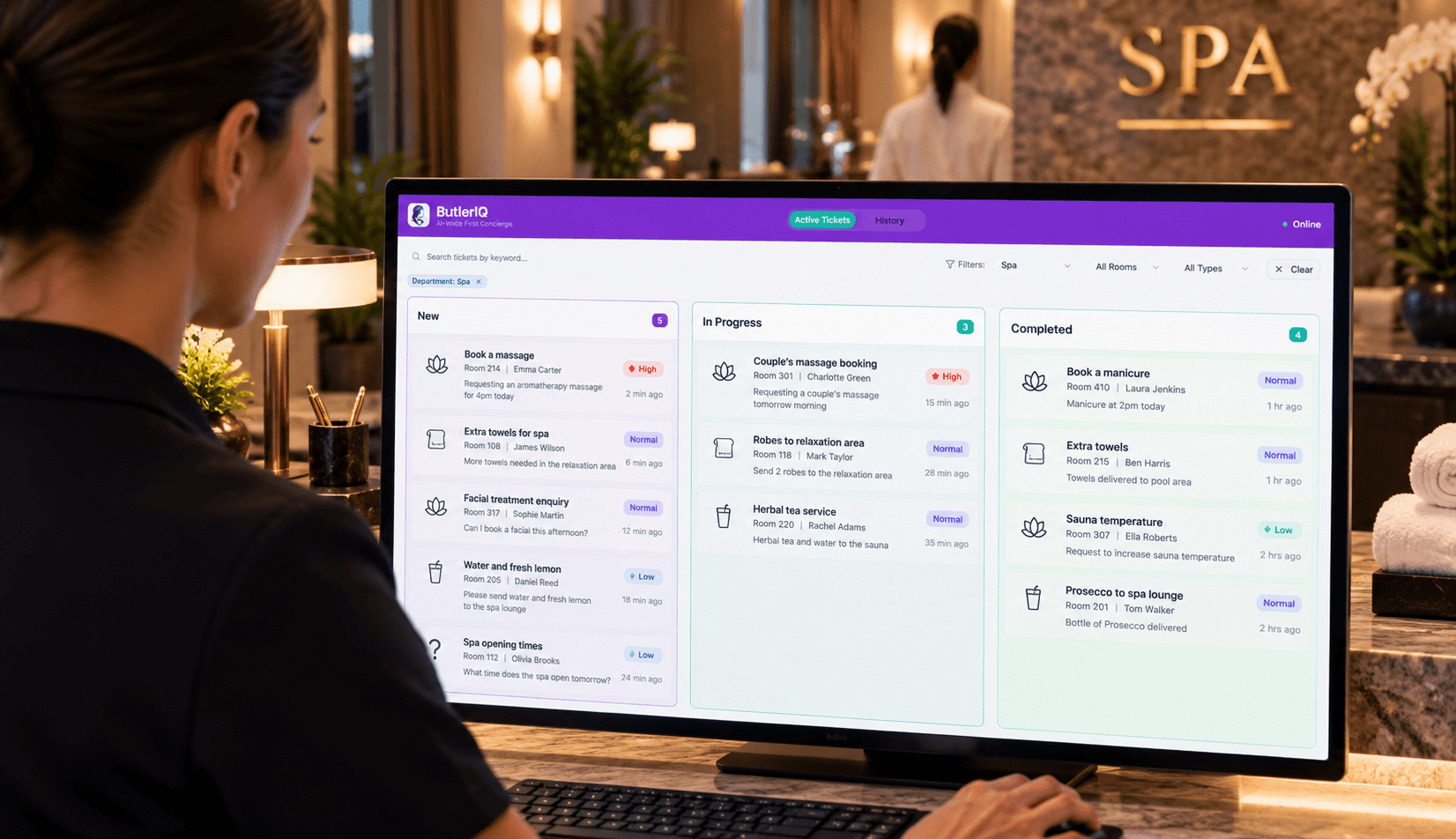
Smarter service request management
AI can help categorise requests and identify which require immediate attention.
A report of no hot water needs a different response from a request for extra hangers. Prioritising requests appropriately can help teams allocate their time and prevent important issues from being overlooked.
Revenue management support
AI-assisted revenue management can help identify demand patterns and inform pricing decisions. However, recommendations should remain subject to commercial strategy, brand positioning and appropriate human oversight.
These applications may require different tools and integrations. Hotels should assess them separately rather than assuming one AI platform will solve every operational challenge.
For a practical look at the wider opportunity, read our guide to hotel staff efficiency tools in 2026.
Can Luxury Hotel AI Help Increase Direct Bookings?
Potentially, yes. AI can support the booking journey by helping prospective guests find accurate answers and understand whether a property meets their needs.
A guest considering a direct booking may want to know about parking, accessibility, family policies, room configurations, cancellation terms or spa access.
If those answers are difficult to find, they may contact the hotel, abandon the booking or choose a platform that makes the information easier to access.
AI-powered website assistance can help answer routine questions quickly, provided it uses accurate, up-to-date information and clearly acknowledges when it cannot answer confidently.
Hotels can also improve conversion by reviewing the questions guests ask most frequently and making the answers easier to find across their websites and booking journeys.
However, AI doesn't automatically generate more bookings. Its impact depends on the quality of the information, the relevance of the assistance and the wider booking experience.
Measure the results rather than assuming the technology is working. Useful indicators include enquiry response times, conversion rates, the proportion of enquiries resolved without staff intervention and the number of prospective guests who still need to contact the hotel for basic information.
What Should Luxury Hotels Never Fully Automate?
The most effective approach to luxury hotel AI starts with clear boundaries.
Technology can handle many routine interactions, but exceptional hospitality still depends on empathy, judgement and accountability.
Complaints and service recovery
When a guest is upset, the response needs to reflect the situation. An automated apology may be technically correct yet feel dismissive.
AI can help staff summarise an issue or prepare internal notes, but sensitive complaints and service recovery should have an appropriate human owner.
Sensitive personal information
Hotels should use guest information only for appropriate, clearly explained purposes. Access controls, retention policies and transparent privacy practices matter, particularly when voice technology is involved.
Personalisation should make guests feel recognised, not monitored.
Decisions affecting comfort, safety or money
Room changes, refunds, exceptional charges and safety-related matters may require confirmation from an authorised member of staff.
The correct level of human oversight depends on the decision, the risk and the hotel's operating procedures.
The moments that make hospitality memorable
Some of the most valuable interactions cannot be reduced to a response time or a completed task.
A thoughtful conversation with a concierge, a manager resolving a difficult situation or a team member noticing that a guest needs help can define the entire stay.
AI should protect time for those moments, not crowd them out.
How ButlerIQ Approaches AI for Hospitality
At ButlerIQ, we believe the future of hotel AI should feel less like using software and more like receiving good service.
Our voice-first AI concierge is designed to give hotel guests a natural way to ask questions and access assistance, without needing another app or screen.
For guests, that means a convenient way to find information and make routine requests. For hotel teams, it creates an opportunity to reduce repetitive enquiries and protect time for the personal interactions that define great hospitality.
ButlerIQ is designed around three areas of hospitality:
ButlerIQ Meet: Voice-first assistance for meeting rooms and public spaces.
ButlerIQ Guest: In-room concierge assistance, available around the clock.
ButlerIQ Signature: A multi-property approach for hotel groups looking to deliver a more consistent experience across their portfolio.
The precise capabilities available depend on the deployment and the services configured for each property. The principle remains the same: use AI where it improves convenience and consistency, while keeping hotel teams firmly in control of the service experience.
For a closer look at the role of conversational technology, read our guide to AI concierge solutions for hotels.
How to Introduce AI Into a Luxury Hotel
The best starting point isn't a large technology programme. It's a specific guest or operational problem worth solving.
1. Identify the friction. Speak to reception, housekeeping and guest services. Find out which questions are repeated most often and where delays occur.
2. Choose one practical use case. Routine guest questions or in-room concierge support may be a sensible starting point for a voice-first solution.
3. Set clear boundaries. Define what AI can answer, what it can initiate and when a member of staff must take over.
4. Make privacy and accuracy part of the design. Establish clear expectations about voice technology, data handling and the information the system can access.
5. Pilot and measure. Start with a controlled deployment and collect feedback from both guests and staff before expanding.
Track measures such as response times, routine enquiries handled, staff feedback, guest satisfaction and the frequency of incorrect answers or escalations.
A successful pilot should demonstrate a meaningful improvement in the guest experience or hotel operations, not simply prove that the technology works.
The Future of Luxury Hospitality Is Human-Led and AI-Assisted
Luxury hotel AI works best when it removes friction without removing the people who make hospitality special.
A guest shouldn't have to wait unnecessarily for a simple answer. A receptionist shouldn't spend every busy shift repeating the same information. And a hotel shouldn't have to choose between convenient service and personal attention.
Voice-first concierge technology, intelligent assistance and better operational processes can help close that gap.
The opportunity for hotel owners and general managers is to be selective. Start with a real problem, introduce technology thoughtfully and measure whether it improves the experience for guests and staff alike.
The best hotel AI won't be remembered for being clever. It will be remembered because the service felt effortless.
If you're exploring how a voice-first AI concierge could work in your property, discover ButlerIQ and consider where a more natural, responsive guest experience could make the biggest difference.
Frequently Asked Questions About Luxury Hotel AI
What is luxury hotel AI?
Luxury hotel AI refers to artificial intelligence used to improve guest services and hotel operations. Applications can include conversational concierge services, routine enquiry handling, guest personalisation, demand forecasting and service request management.
How does AI improve the luxury hotel guest experience?
AI can provide faster answers to routine questions, make hotel information available around the clock and support more consistent personalisation. The strongest implementations complement human service rather than attempting to replace it.
What is an AI concierge for hotels?
An AI concierge helps guests access information and assistance through conversational interfaces, such as voice or chat. Depending on its configuration, it may answer questions about hotel facilities, local recommendations and available services, while directing more complex requests to staff.
Can hotels use voice AI without requiring guests to download an app?
Yes. Voice-first systems can provide a conversational interface without requiring a guest to install a dedicated application. The experience depends on the hardware, software and configuration deployed by the hotel.
Will AI replace hotel staff?
AI can automate or assist with suitable routine tasks, but it cannot reliably replace the judgement, empathy and relationship-building that define excellent hospitality. Its role should be to support staff and give them more time for meaningful guest interactions.
Is AI suitable for independent and boutique hotels?
It can be, particularly where teams need to manage recurring guest enquiries and provide more consistent assistance without adding unnecessary complexity. Hotels should assess setup costs, ongoing fees, privacy, usability and the likely operational benefits before committing.
How should hotels measure the success of an AI concierge?
Useful measures include guest satisfaction, response times, routine enquiry resolution, staff time spent on repetitive questions, escalation rates and the accuracy of answers. Establish a baseline before a pilot so results can be assessed meaningfully.
Sep 25, 2026
Hospitality Innovation
Guest Request Routing for Hotels in 2026: Cut Front Desk Workload Without Adding Headcount
Manual guest requests quietly eat hours of front desk time every week. See how automatic request routing works, what it saves your team, and how to evaluate it for your property.

Sep 15, 2026
Hotel Upselling Solutions: Why Pre-Arrival Isn't Enough
Hotel upselling doesn't require aggressive sales tactics—it requires smart timing and conversational delivery. Learn how modern hotels use voice-first AI and personalised offers to increase ancillary revenue by £15–£30 per stay while keeping guests feeling genuinely helped, not pressured. This guide covers proven upselling strategies, multilingual AI integration, and weekly KPI tracking for UK SME properties
