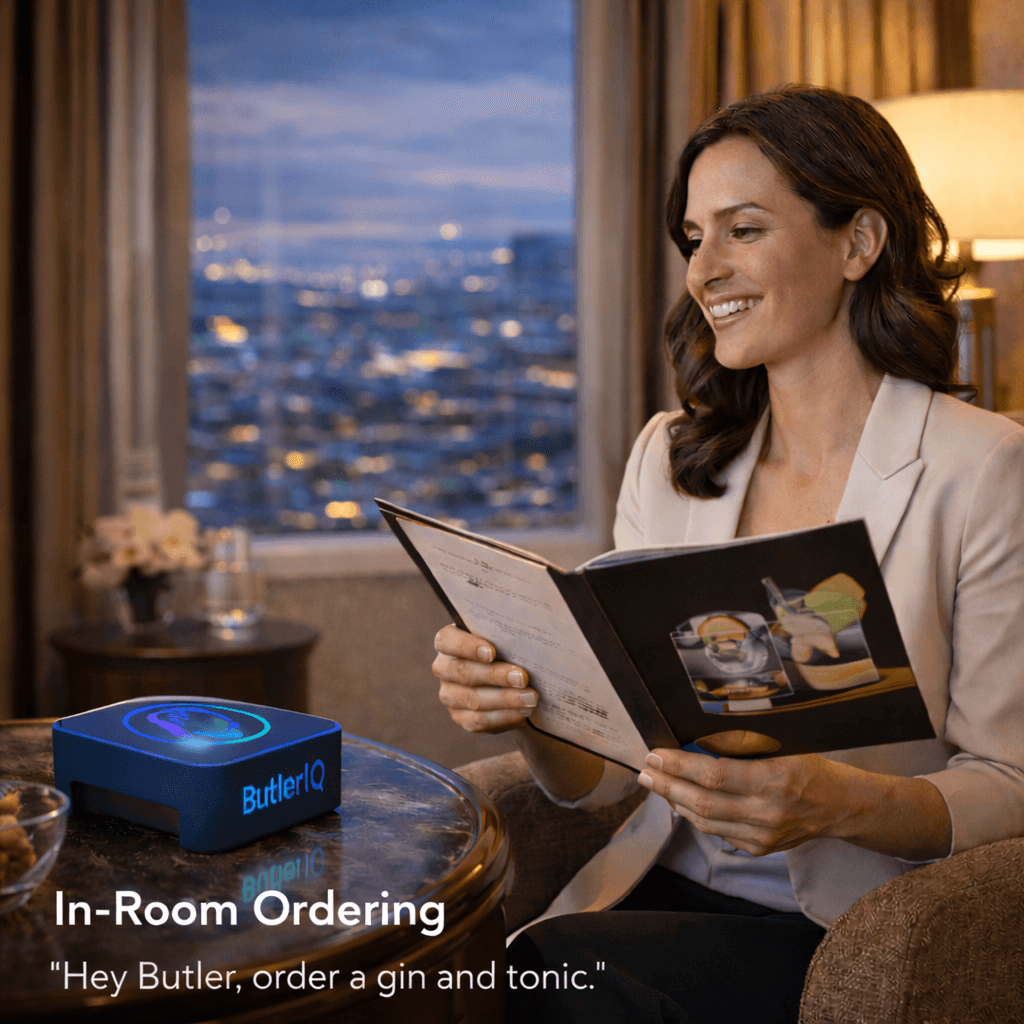
AI Concierge for Hotels: Better Service Without More Staff
Discover how an AI concierge for hotels enhances guest service, boosts direct bookings, and cuts staff workload with smart, seamless automation.
A guest lands at 21:40, your night porter is covering two jobs, and the phone starts ringing with the same questions you answered earlier. That's where an ai concierge for hotels earns its keep: it handles the repetitive, time-sensitive requests fast, so your team can focus on the moments that actually shape reviews and repeat stays. In this guide, we'll show you what the tech really does, where it pays back, and how to roll it out in a UK hotel without creating a new IT headache.
Key Takeaways
An AI concierge for hotels efficiently handles repetitive guest enquiries, freeing staff to focus on personalised service that enhances reviews and repeat bookings.
Integrating AI concierge across all guest journey phases—pre-stay, in-stay, and post-stay—maximises operational relief and revenue opportunities.
AI concierges must connect seamlessly with hotel systems like PMS, booking engines, and task management to automate requests and reduce workload effectively.
Implementing AI concierge in UK hotels requires clear scope definition, content ownership, staff training, and strict governance to build trust and ensure GDPR compliance.
Measuring success through operational, commercial, and guest experience KPIs is essential to prove ROI and continuously improve the AI concierge performance.
Using AI for accurate, fast responses increases direct bookings, upsell acceptance, guest satisfaction, and ultimately drives ancillary revenue without replacing human hospitality.
What An AI Concierge Is (And What It Is Not)
A busy Friday check-in is a good test of any guest service setup: the queue builds, someone asks about parking, another wants to change dates, and a third needs a cot in 20 minutes. An AI concierge is designed for exactly this kind of high-volume pressure. It's a digital guest service system that can understand requests, answer accurately, and trigger actions (like creating a task or updating a booking) when it connects to your hotel tools.
What it is not is a bit of scripted website chat that only says "Sorry, I don't understand" when a guest goes off-menu. And it's not a replacement for human hospitality. In practice, the strongest hotels use AI to cover the predictable 80% and then hand the nuanced 20% to staff, things like goodwill gestures, complex complaints, or a special occasion you want to handle with care.
AI Concierge Vs Chatbots Vs Human Concierge
A common mistake is buying a "chatbot", expecting a concierge, and then wondering why it doesn't reduce workload.
Chatbots tend to rely on pre-written flows. If a guest asks, "Can I check out late if I book breakfast?" a basic bot often fails because it can't combine policy, availability, and an offer.
An AI concierge can handle that same request by pulling your late check-out rules, checking the room status window, and offering a paid late check-out or breakfast package, then logging it for the team.
A human concierge still wins on judgement and relationship building. If a guest says, "My partner is anxious about travelling, can you help make this stay calm?" that's a human moment.
Speed and coverage matter too. Many hotels aim for responses in under two minutes for common requests because it stops guests calling the front desk "just to be sure". A human team can't always hit that at 01:00 without adding cost.
Where It Lives In The Guest Journey: Pre-Stay, In-Stay, Post-Stay
If you place AI in only one part of the journey, you usually leave value on the table.
Pre-stay: Guests ask the same conversion-killing questions: "Is parking guaranteed?", "Can I bring a dog?", "What's the cancellation policy?" An AI concierge can answer instantly and, if it ties into your booking flow, guide the guest towards a direct booking rather than an OTA tab.
In-stay: This is where the workload relief shows up. Think towels, Wi‑Fi help, extra pillows, maintenance issues, room service timings, late check-out requests, taxi bookings. When the AI can raise a task and confirm back to the guest, you reduce calls and stop the "did anyone get my message?" problem.
Post-stay: After checkout, speed still matters. An AI concierge can send a short feedback prompt, help a guest retrieve an invoice, or route a complaint into the right queue with the right context. That stops slow follow-ups that turn into negative reviews.
The key is simple: an AI concierge sits where your guests already talk (web, messaging, email) and where your staff already work (PMS, housekeeping, ticketing). If either side is missing, it becomes another channel to babysit.
The Business Case For Hotels: Benefits That Show Up On The P&L
If you run a small or mid-sized hotel, you don't have the luxury of hiring your way out of operational strain. Wages rise, recruitment stays hard, and guest expectations keep climbing because travellers compare you to the last great experience they had, often at a larger chain with more resources. The business case for an AI concierge is that it improves service and reduces avoidable cost at the same time.
Across hospitality, automation of routine work is often cited as a major cost lever, with industry estimates suggesting material savings at scale. But the more useful question is: what changes in your own P&L next month if you carry out it well?
Reducing Front Desk Workload And After-Hours Coverage
The most immediate win is fewer interruptions.
Deflection of repetitive queries: Guests ask about breakfast times, parking, directions, Wi‑Fi, late check-out, luggage storage. When an AI concierge answers those consistently, your front desk regains time during peak arrivals.
After-hours coverage without overtime: A lot of smaller properties rely on a skeleton night shift. When a guest messages at 02:00 about a noisy room or the heating, an AI concierge can acknowledge, capture the details, and trigger a task with an agreed priority. That reduces missed calls and lowers the risk of a bad review that starts with "no one answered".
A concrete way to think about it: if your team handles 80 messages/calls a day and AI fully resolves even 30 of them, that's 30 fewer interruptions that break concentration during check-in and billing.
Boosting Direct Bookings, Upsells, And Ancillary Revenue
Revenue lift is real, but it only happens when the AI is allowed to do more than "answer questions".
Direct bookings: When the AI can respond instantly on your website with accurate policies and availability guidance, you prevent drop-off. Even a small uplift in conversion (for example, 2–3%) can be meaningful for an SME property because it compounds across the year.
Upsells that feel helpful: Timing matters. An AI concierge can offer late check-out when the guest asks about checkout time, or propose parking when the guest asks about driving in. Industry case studies often report materially higher upsell acceptance when the offer matches the moment, compared with generic pre-arrival emails.
Ancillary revenue: Think breakfast add-ons, room upgrades, spa slots, partner tours, restaurant reservations. If the AI can present options with clear prices and then pass the request into your workflow, you stop losing revenue to "we'll ask at reception later".
A practical example: if a guest asks, "Can we check in early?" the AI can reply with your policy and, if you support it, offer a paid early check-in subject to housekeeping status.
Improving Reviews With Faster, More Consistent Responses
A review often reflects one thing: how fast you fixed a problem.
Speed: Many properties see response times drop from double-digit minutes to under two minutes for standard queries when AI handles first response.
Consistency: You reduce the risk of mixed messages like "late check-out is free" vs "late check-out is £20". The AI can stick to approved policy every time.
Better escalation: When AI hands over with context ("Room 214 reports AC not cooling: started 19:40: guest prefers engineer visit before 21:00"), your team resolves faster and looks more organised.
For hotels competing on reputation, this matters because review platforms reward responsiveness. Faster, clearer replies lead to more mentions of "helpful", "quick", and "easy", which are the words future guests actually scan for.
Core Features To Look For In An AI Concierge
Buying the wrong system is costly in a quiet, draining way: staff ignore it, guests abandon it, and you end up paying for software that adds another inbox. To avoid that, we look for features that reduce work and improve the guest experience on day one.
Multichannel Support: Website, WhatsApp, SMS, Email, Social
Guests don't care what your tech stack looks like. They care that you reply where they are.
Website chat for pre-stay conversion: This is where you catch "quick questions" that decide the booking.
WhatsApp or SMS for in-stay speed: In the UK, SMS still matters for some demographics, while WhatsApp is essential for many international travellers.
Email and social messaging: Useful for post-stay follow-up and handling queries that start on Instagram or Facebook.
The concrete requirement: the system should keep context when the channel changes. If a guest starts on your website and then moves to WhatsApp, they shouldn't have to repeat dates, room type, or the problem.
Property Knowledge: Amenities, Policies, Local Area, Transport
If the AI gives the wrong pool hours or misstates a pet policy, you create friction fast. You want an AI concierge that can answer, with specifics, on:
Amenities: opening hours, booking rules, prices, age limits (for example, spa access), accessibility notes.
Policies: cancellations, deposits, early/late check-in, parking rules, group bookings, noise policies.
Local area and transport: nearest rail station, airport options, taxi estimates, parking zones, event venues, walking times.
A simple test we use: ask it 20 real guest questions from your reviews or inbox history. If it can't answer with accurate detail (and cite where the rule comes from internally), it isn't ready.
Operational Integrations: PMS, Booking Engine, CRM, Ticketing
This is the line between "nice chat" and "real workload reduction". For an ai concierge for hotels to pay back, it must connect to the tools that run the property.
Look for integrations (or reliable workarounds) with:
PMS: so the AI can identify bookings, note preferences, and support changes with the right guardrails.
Booking engine/channel manager: so availability and rate questions are based on live data, not guesswork.
CRM/guest profiles: so you can recognise repeat guests and keep preferences consistent.
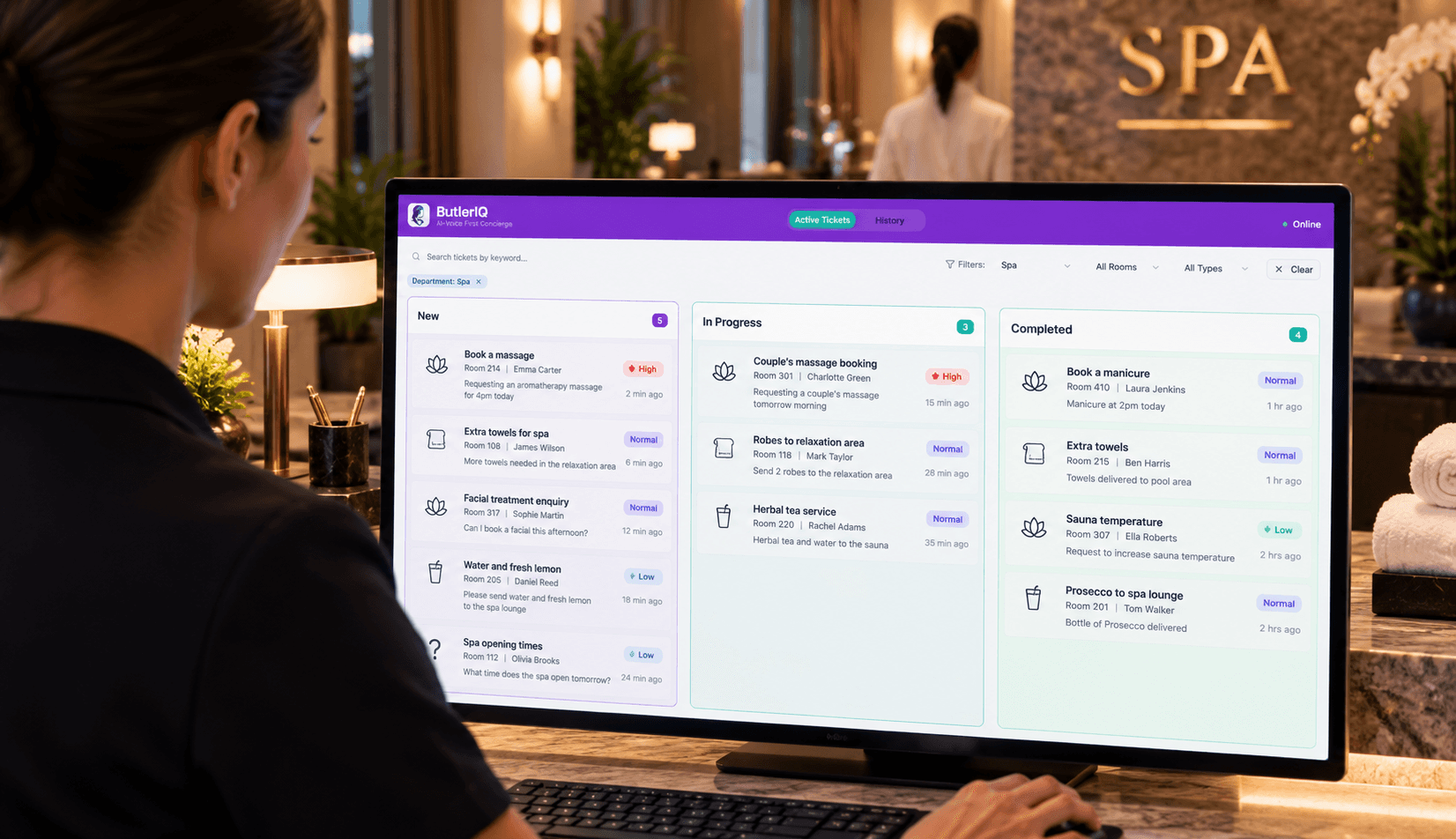
Ticketing or task management: so a towel request becomes a trackable housekeeping task, not a message lost in a chat thread.
A practical requirement: you should be able to see a timeline, guest asked, AI responded, task created, staff completed, guest confirmed. Without that audit trail, you will struggle to prove ROI and you'll miss service failures.
Key Hotel Use Cases That Actually Matter Day To Day
It's easy to get distracted by flashy demos. In reality, the best use cases are the boring ones that happen 50 times a day and quietly eat your labour budget. We focus on three categories because they show immediate operational and revenue impact.
Reservation Help: Availability, Rates, Policies, Modifications
A guest browsing at lunch might book by dinner, if you remove uncertainty quickly.
Common, high-impact flows include:
Availability checks: "Do you have a twin room for 12–14 May?" The AI should guide the guest to the right room type and push towards a direct booking.
Rate and policy clarity: "Is breakfast included?", "Can I cancel free of charge?", "Do you take American Express?" Each answer should include a concrete rule and, where helpful, the next step.
Modifications: "Can we change from two nights to three?" The AI should collect the booking reference, confirm identity in a safe way, and either process the change (if integrated) or hand over with all details captured.
A real-world scenario: if your front desk spends five minutes per modification request and you receive ten a day, that is almost an hour of labour that could shift to guest-facing service.
In-Stay Requests: Towels, Late Checkout, Maintenance, Room Service
This is where guest messaging either saves you or swamps you.
A useful AI concierge should:
Capture the essentials: room number, item/request, timing preference ("asap" vs "after 18:00"), any access notes.
Trigger the right workflow: housekeeping for towels, maintenance for a leaking tap, reception for late check-out approval.
Confirm and follow up: "We've logged this with housekeeping. We'll message you when it's on the way." That follow-up alone reduces repeat calls.
Example: a guest reports "the shower is cold". The AI should ask one clarifying question (for example, "Is it not heating at all or does it run cold after a minute?") and then route the job with priority. That single clarification prevents wasted engineer visits.
Local Recommendations: Tailored Itineraries And Partner Offers
Guests still ask, "Where should we eat tonight?" even when they could search Google. They ask because they want confidence.
A strong AI concierge can:
Personalise: "Are you after a quick bite or something special?", "Any dietary needs?", "Do you want a 10-minute walk or a short taxi?"
Use real constraints: opening hours, distance from the hotel, whether you need booking.
Support partner revenue: If you have a relationship with a nearby tour operator or restaurant, the AI can suggest it in a helpful way and track interest.
A simple itinerary example for a rainy Saturday in York: "Start with the National Railway Museum (indoors, 12 minutes by taxi), then book an early table at a nearby pub with sheltered seating, then suggest a ghost walk if the weather clears." Concrete, usable, and easy to act on.
This is also where your brand can stand out. Two hotels can offer the same bed. The one that makes the city feel easy wins repeat stays.
How To Implement An AI Concierge In A Small Or Mid-Sized Hotel
Implementation fails in predictable ways: someone buys software, no one owns the content, staff don't trust the answers, and guests go back to calling reception. A small or mid-sized hotel can avoid that by rolling out in tight steps, with clear ownership and simple rules.
Step 1: Define Scope, Service Hours, And Handover Rules
Start with a problem that costs you money each week, not a vague goal like "improve experience".
Concrete actions:
Pick the first 10 use cases: for example, breakfast times, parking, Wi‑Fi, late check-out, taxi booking, towels, extra pillows, maintenance logging, directions, pet policy.
Set service hours: many SMEs go 24/7 for first response but restrict certain actions (like approving refunds) to staffed hours.
Write handover rules: if the guest mentions "refund", "medical", "unsafe", "complaint", or "data", the AI should escalate immediately. If the guest repeats the same issue twice, it should escalate too.
We also recommend one non-negotiable: the AI must always make it obvious how to reach a human. Guests forgive automation: they don't forgive being trapped.
Step 2: Build A Single Source Of Truth For Hotel Content
If your policy lives in someone's head, the AI cannot be reliable.
Build a simple, owned knowledge base that includes:
Policies with exact wording: cancellation windows, deposits, ID requirements, pet rules, smoking policy.
Operational facts: breakfast times by day, restaurant last orders, gym hours, parking instructions, EV charging details.
Local guidance: nearest stations, taxi firms you trust, key venues, accessibility routes.
Assign an owner (for SMEs, often the front office manager) and set a weekly 15-minute update routine. A practical trigger list helps: "new menu", "seasonal opening hours", "building works", "price change", "event road closures".
Step 3: Pilot, Train Staff, And Expand Based On Real Queries
A pilot should feel boring and measurable.
Run a two-week pilot on one channel: website chat is a clean start because it affects bookings and doesn't disrupt in-stay service.
Train staff with real transcripts: pick 30 conversations and review them in a short session. Ask, "Was the answer right?", "Did the AI escalate at the right moment?", "What detail was missing?"
Expand based on the top queries: if 18% of messages are about parking and 12% are about late check-out, fix those flows before you add anything fancy.
We like one practical rule for expansion: don't add a new capability until the previous one is accurate and owned. A hotel that nails the basics often outperforms a hotel with ten half-working features.
Given our site focus on helping small businesses outpace competitors with less time and budget, the same principle applies here: keep the rollout simple, measure it weekly, and let real guest behaviour steer the roadmap.
Governance, Privacy, And Brand Voice: Getting It Right In The UK
One privacy mistake can wipe out months of goodwill. In the UK, guests are alert to data use, and regulators expect you to treat messaging data as personal data when it can identify someone. Governance is not paperwork for its own sake: it is how you keep trust while you automate.
GDPR, Consent, And Data Minimisation For Guest Messaging
The risk scenario is simple: a guest shares a phone number and a booking reference, and that data then gets used beyond the original purpose without clear consent.
What we do in practice:
Collect the minimum needed to solve the request: if someone asks for extra towels, you need room number and timing, not date of birth.
Separate service messages from marketing: if you want to send offers after the stay, you need a clear opt-in. A service conversation is not automatic marketing consent.
Set retention rules: keep transcripts only as long as you need for service quality and dispute handling. Document the period (for example, 90 days) and stick to it.
Also watch platform rules. WhatsApp and SMS both have expectations around consent and clear identification of the sender. Your AI concierge should support that out of the box, not leave it to staff improvisation.
Security, Access Controls, And Audit Trails
Hotels handle sensitive information: names, dates, room numbers, sometimes special requests that reveal health or accessibility needs.
Concrete controls to insist on:
Role-based access: housekeeping should see the task, not full payment or profile data.
Encryption in transit and at rest: this should be standard, but you want it confirmed in writing.
Audit trails: you should be able to answer, "Who accessed this conversation and when?" without guesswork.
A practical example: if a guest disputes a charge or claims they asked for a service that never happened, an audit trail and task history protect both the guest experience and your team.
Tone Of Voice And Accessibility For A Consistent Guest Experience
Brand voice can turn a helpful tool into something that feels cold.
We recommend you define three things:
Tone: for most UK hotels, "warm, clear, not overly chatty" works. For example: "We can do that for you. Would you like it in the next 10 minutes or after 6pm?"
Boundaries: the AI should not guess. If it does not know, it should say what it can do next, like "I can check with reception and come back to you."
Accessibility: use plain English, short sentences, and avoid jargon. If you offer a voice option, make sure there is a text alternative and that messages remain readable on mobile.
A small detail that helps: write approved templates for sensitive moments (noise complaints, maintenance failures, refunds). That keeps the AI aligned with your service standards when pressure is highest.
How To Measure Success (And Prove ROI)
If you cannot show results in numbers, the AI concierge becomes "that tool we tried". Measurement is also how you improve performance over time because it tells you exactly where guests get stuck.
Operational KPIs: Deflection Rate, Response Time, Resolution Time
The operational story is about time saved and faster fixes.
Track these weekly:
Deflection rate: the percentage of conversations the AI resolves without a human. Many hotels aim for a strong majority on routine queries, but the right target depends on your service model.
Response time: time from guest message to first meaningful reply. AI can often keep this under two minutes for standard questions, which reduces follow-up calls.
Resolution time: time from request to completion (for example, towels delivered). This requires task integration: otherwise you only measure chat speed, not service quality.
A practical workflow: tag each request type (towels, maintenance, late check-out) and review the slowest category every Friday. If maintenance resolution is slow, that might be a staffing issue, not an AI issue, and the data makes that visible.
Commercial KPIs: Conversion Rate, Upsell Rate, Revenue Per Guest
Commercial impact needs clean definitions so you don't claim credit for seasonal spikes.
Measure:
Conversion rate on direct booking pages: compare sessions with AI interactions vs without. If the AI answers policy questions quickly, you should see fewer drop-offs.
Upsell rate: acceptance rate for offers like late check-out, breakfast add-ons, upgrades. Tie each upsell to a message thread so you can see what wording and timing works.
Revenue per guest (or per occupied room): track ancillary revenue before and after, controlling for seasonality. Even small lifts matter when margins are tight.
A concrete example: if your AI offers paid late check-out and 8 guests a week accept at £20, that's £160 weekly. Over a year, that is meaningful for an SME property, and it often arrives alongside workload reduction.
Guest KPIs: CSAT, Review Mentions, Repeat Stays
Guest experience metrics tell you whether the automation feels like service, not deflection.
Track:
CSAT after key interactions: a one-question rating after a resolved request (for example, "Was this sorted quickly?") gives you fast feedback.
Review mentions: look for phrases like "quick response", "easy to message", "sorted straight away". If reviews mention "couldn't get hold of anyone", you know exactly what to fix.
Repeat stays and loyalty signals: returning guests benefit most from remembered preferences and consistent answers. If you store preferences with consent, you can make the second stay feel smoother.
When you report ROI internally, combine one metric from each bucket: for example, 65% deflection, 1m 40s median response, and +£X ancillary revenue per occupied room. That three-part story is hard to ignore.
A good ai concierge for hotels is not a gimmick: it is a practical way to deliver faster service, capture more direct revenue, and protect your team from constant interruptions, especially in smaller UK properties where every hour counts. The winners in 2026 will be the hotels that start with the unglamorous basics (policies, requests, handover rules), integrate with real operations, and then measure performance like any other part of the business. If we get that foundation right, we do not just automate replies, we make the whole stay feel easier, and guests notice.
Frequently Asked Questions about AI Concierge for Hotels
What is an AI concierge for hotels and how does it differ from a chatbot?
An AI concierge is an integrated digital system that handles guest requests by connecting to hotel management tools, offering personalised, real-time assistance. Unlike basic chatbots with scripted replies, AI concierges automate complex tasks and coordinate services, enhancing guest experience while freeing staff for nuanced requests.
How can an AI concierge improve operations and guest service in a hotel?
AI concierges reduce repetitive front desk queries by up to 40%, provide 24/7 after-hours support, accelerate response times to under two minutes, and enable staff to focus on high-value guest interactions, leading to better reviews, fewer complaints, and operational cost savings.
How does an AI concierge contribute to increasing direct bookings and ancillary revenue?
By providing instant, accurate answers and tailored upsell offers at the right moments—such as paid late check-out or breakfast add-ons—AI concierges improve booking conversion rates by around 3% and can boost ancillary revenue by up to 23%, enhancing overall profitability.
What privacy and governance considerations must hotels address when implementing AI concierge technology?
Hotels must comply with GDPR by obtaining explicit consent for data use, minimising data collection, separating service from marketing communications, securing data with encryption and role-based access, and maintaining audit trails to protect guest privacy and maintain trust.
How should a small or mid-sized hotel implement an AI concierge to ensure success?
Start by defining clear scope and handover rules, build a single source of truth for hotel content, pilot on one channel like website chat, train staff on AI capabilities, monitor real guest queries, and expand gradually—ensuring accuracy and staff ownership at every step to maximise ROI and guest satisfaction.
Sep 25, 2026
Hospitality Innovation
Guest Request Routing for Hotels in 2026: Cut Front Desk Workload Without Adding Headcount
Manual guest requests quietly eat hours of front desk time every week. See how automatic request routing works, what it saves your team, and how to evaluate it for your property.

Sep 15, 2026
Hotel Upselling Solutions: Why Pre-Arrival Isn't Enough
Hotel upselling doesn't require aggressive sales tactics—it requires smart timing and conversational delivery. Learn how modern hotels use voice-first AI and personalised offers to increase ancillary revenue by £15–£30 per stay while keeping guests feeling genuinely helped, not pressured. This guide covers proven upselling strategies, multilingual AI integration, and weekly KPI tracking for UK SME properties

Aug 14, 2026
Smart Hotel Rooms: Why the First Wave Failed, and What the Next One Looks Like
Smart hotel rooms promised a lot and delivered little. Here's what changed, what a genuinely smart room does in 2026, and how UK operators should approach it.
