Hotel Operations
Voice-Activated Security Protocols for Hotels: Get It Right in 2026
Explore voice-activated security protocols for hotels designed to enhance guest safety with step-up authentication, privacy measures, and staff workflows for secure, smooth operations.
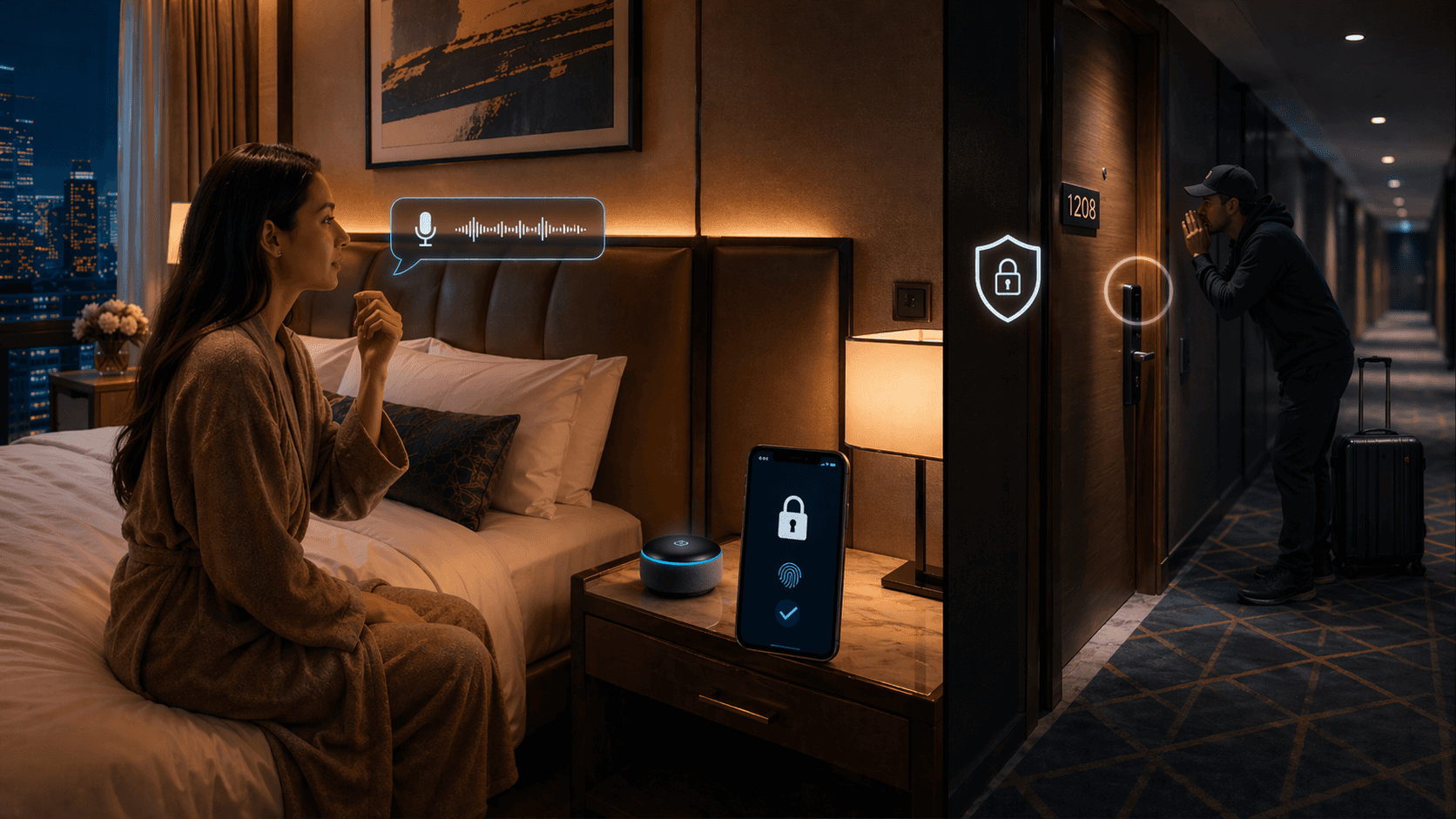
A guest asks the room assistant to unlock the door, while someone else in the corridor listens and repeats the command. That one moment captures both the promise and the risk of Voice-Activated Security Protocols for Hotels. When we design them well, they reduce friction, speed up help in emergencies, and tighten control over who can do what. When we design them badly, they create a new, quiet attack surface that no one on shift feels responsible for.
Key Takeaways
Voice-Activated Security Protocols for hotels must differentiate between low, medium, and high consequence commands to design appropriate controls and protect guest safety.
Strong authentication measures like PIN codes or app confirmations are essential for high-risk voice commands such as unlocking doors or authorising payments, preventing voice spoofing and replay attacks.
Privacy-by-design, including data minimisation, clear consent, and easy opt-out options, is critical to maintaining guest trust when using voice-activated systems in hotel rooms.
Robust device and network hardening, including network segmentation and patch management, significantly reduces the risk of voice endpoint compromise and lateral movement within hotel systems.
Staff workflows must support secure exception handling with clear verification steps to avoid bypass of security controls and ensure consistent, safe guest experiences.
A phased implementation with pilot testing, staff training, and continuous security reviews ensures voice-activated protocols deliver convenience without compromising hotel security.
What Voice-Activated Security Means In A Hotel Context
A hotel lobby at 2am is not the place to discover that "security" meant "turn the lights on with Alexa". In practice, voice in hospitality spans two very different buckets: guest convenience controls and security-relevant controls. We need to separate them from day one because they demand different safeguards.
In a hotel context, Voice-Activated Security Protocols for Hotels usually cover voice-initiated actions that can change risk, access, or accountability, such as:
In-room actions with safety impact: switching on lights after a fall, opening curtains, calling reception, triggering a "help" workflow, or putting the room into a "do not disturb" state.
Access-adjacent actions: requesting a digital key re-issue, unlocking a smart lock (if enabled), or opening connecting doors in suites.
Identity and billing-adjacent actions: asking for folio details, approving a charge, or confirming a late check-out.
Staff actions in back-of-house: voice-driven maintenance tickets, security patrol check-ins, or incident logging while hands are occupied.
The technology is typically an in-room device (or a TV/room hub with microphones) connected to a cloud voice service, which then calls hotel systems such as the PMS, housekeeping, maintenance, digital key platform, or a guest messaging tool. That integration is where the real security work lives.
A practical way to keep scope clear is to label commands by consequence:
Low consequence: "Set temperature to 20°C," "What time is breakfast?"
Medium consequence: "Call reception," "Request extra towels," "Report a spill in the corridor."
High consequence: "Unlock the door," "Re-issue my key," "Authorise payment," "Send security to my room."
Once we do that, we can design controls that fit. Low consequence can be fast and friendly. High consequence needs friction on purpose, like a second factor, a staff confirmation step, or a strict "not supported by voice" rule.
Threat Model: The Real Risks Voice Introduces (And What It Doesn’t Solve)
A voice assistant can feel harmless right up until a guest complains that a stranger's voice from the hallway opened their door. Threat modelling sounds academic, but in hotels it is simply a way to stop surprises.
Here are the risks voice introduces that we should plan for explicitly.
1) "Voice spoofing" and replay
A bad actor does not need to be a hacker to exploit voice. They can record a guest giving a command ("unlock the door", "call reception and cancel the security request") and replay it. They can also stand outside the room and issue commands through the door if the microphone is sensitive.
Control idea: for any command that changes access, money, or identity, we treat voice as an input, not an authority. We add confirmation via the hotel app, a one-time code on the TV, or a call-back from reception.
2) Over-permissive integrations
Hotels often connect voice to "everything" because it demos well. That creates a path where one compromised device can trigger actions in the PMS or guest messaging platform.
Control idea: limit integrations to narrowly scoped APIs and only expose the minimum set of actions per room. If Room 508 speaks, it should only ever affect Room 508.
3) Always-listening anxiety and privacy complaints
Even when devices only listen for a wake word, guests can perceive them as always recording. One poor experience can harm trust across the entire guest experience, especially for families, medical professionals, and anyone travelling for sensitive reasons.
Control idea: visible mute options, clear in-room notices, and a simple "voice off for this stay" workflow at check-in.
4) Social engineering of staff via voice logs
If staff treat a voice transcript as "proof" of a request, an attacker can weaponise that. For example, "I'm the manager, reset the safe code," spoken in-room, could show up as a ticket if the workflow is naïve.
Control idea: staff workflows must use verified guest identity and role-based permissions, not just a transcript.
5) Device-level compromise and lateral movement
A voice endpoint is still a networked computer in a hotel room. If it sits on the wrong VLAN, it can become a stepping stone to other hotel systems.
Control idea: strict network segmentation, locked-down outbound traffic, and a patching standard with monitoring.
Now, what doesn't voice solve? It is important we do not oversell it.
It does not replace physical security controls. A smart lock still needs strong mechanical and electronic protections.
It does not detect non-verbal threats. A voice system will not spot a tailgater, a forced door, or suspicious behaviour in a corridor.
It does not remove the need for trained staff. Guests still need people who can respond calmly and consistently when something feels wrong.
If we frame voice as a way to speed up help and reduce friction, rather than a silver bullet, we design safer systems and set better expectations.
Core Protocol Design: Authentication, Authorisation, And Least Privilege
A single risky command can undo a year's worth of "smart room" investment. The core design question is simple: how do we know who is speaking, what they are allowed to do, and what the system should refuse?
Authentication: proving who is speaking
In hotels, we rarely get perfect voice identity. Guests change, rooms turn over, accents vary, and background noise is constant. So we design layered options:
No authentication (only for low consequence): room controls like lights and temperature.
Step-up authentication (for medium/high consequence): the system asks for a second factor, such as:
a PIN shown on the TV during check-in ("Say your 4-digit room PIN"),
a tap in the hotel app ("Approve this request"),
a one-time code sent by SMS or in-app.
Voice biometrics (use cautiously): it can help for repeat guests, but we should not rely on it alone because replay and spoofing remain possible.
A practical rule we use: if the action can cost money, open access, or reveal personal data, voice alone is not enough.
Authorisation: limiting what that identity can do
Even after we authenticate, we still restrict permissions. We map permissions to roles:
Guest role: room controls, service requests, emergency help.
Registered guest (verified): view folio totals, approve charges, request key re-issue.
Staff role: maintenance commands, room status updates, incident logging.
Supervisor role: override workflows, but only with audit trails.
And we bind permissions to context:
Room-scoped: commands from Room 212 only affect Room 212.
Time-scoped: permissions expire at checkout time, not "sometime later after housekeeping clears the room".
State-scoped: if a room is marked "vacant/dirty", the assistant should not accept guest commands that change access or identity.
Least privilege: the safest default is "no"
Least privilege sounds technical, but the hotel version is straightforward: we do not give the voice system more power than it needs to deliver the experience.
Concrete examples:
Do not allow "unlock door" by voice unless there is a very strong reason, and even then, require step-up authentication and limit it to single-use, short time windows.
If we allow "late checkout", we let voice request it, but staff approve it. The system should not change departure time automatically.
For billing, voice can answer "What's my total so far?" only after verification, and it should avoid reading out itemised charges that might reveal sensitive information to someone else in the room.
If we get these protocol basics right, we reduce both security risk and operational arguments later. Staff stop improvising. Guests get consistent outcomes. And we keep the "smart" part of the hotel from becoming the weak part.
Guest Privacy By Design: Data Minimisation, Consent, And Retention
A guest should not need a law degree to feel safe using voice in their hotel room. Privacy-by-design is not just about GDPR compliance: it is about trust during a stay.
Data minimisation: collect less so we can protect less
Voice systems can generate multiple data types: wake-word detections, audio clips, transcripts, intent logs, device identifiers, and integration logs. We do not need all of that to deliver a good guest experience.
Practical minimisation steps:
Prefer on-device processing for wake word and basic commands where possible.
Store intents, not audio, for most service workflows (for example, store "requested extra towels at 19:12" rather than a full recording).
If transcripts are needed for quality or dispute handling, store them without unnecessary personal identifiers.
Consent: make it clear and reversible
The worst approach is hiding consent in a long terms-and-conditions link at check-in. A better approach is a simple, plain statement with options.
What good consent looks like in a hotel:
Check-in script: "This room has voice controls. You can use them for lighting and service requests. You can mute the microphones any time, and you can opt out for the whole stay."
In-room signage: a small card showing the mute button location and a short privacy summary.
A front desk action: a single toggle in the PMS or guest profile that marks voice disabled, so the device stops accepting commands and the system stops logging requests.
Retention: tie it to the stay and the purpose
Hotels turn rooms fast. Retention must keep up.
A sensible retention pattern:
Operational logs (requests, outcomes, timestamps): retain for a short period that supports complaint handling and service improvement, such as 30–90 days.
Security-relevant events (failed authentication attempts, unusual command patterns): retain longer if required for investigations, but keep access restricted and reviewed.
Audio recordings (if used at all): retain for the shortest possible time, with a clear policy and deletion schedule.
Privacy in shared spaces: the "other person in the room" problem
Hotels face a specific scenario that offices often do not: shared rooms, families, and visitors.
Concrete design choices help:
Avoid reading sensitive data aloud. A voice assistant can say, "I can send your bill total to the TV," rather than speaking it.
For high consequence actions, require a visual confirmation on the TV or app so a person outside the room cannot complete the flow.
If we treat privacy as part of the guest experience, not a compliance chore, we reduce complaints, lower reputational risk, and make adoption much smoother.
Device And Network Hardening For Voice Endpoints In Guest Rooms
A single unpatched device in one guest room can become tomorrow's headline. Hotels have high device churn, variable Wi‑Fi conditions, and a mix of old and new systems, so hardening needs to be realistic and repeatable.
Device hardening: make the endpoint boring to attack
Voice endpoints should be treated like any managed corporate device, even if they sit in a hotel room.
Actionable controls we can standardise:
Remove unnecessary features: disable shopping, third-party skills, or open-ended web browsing on voice platforms.
Lock configuration: use centrally managed profiles so staff cannot "just sign in" with a personal account to fix a problem.
Secure boot and signed updates: choose hardware that supports verified firmware.
Patch discipline: define an update window (for example, weekly) and measure compliance by room count.
Physical tamper resistance: mount devices where cables are not easy to unplug and replace, and label devices with asset IDs.
Network hardening: segment, restrict, monitor
Most real-world hotel breaches come from network paths that were convenient during installation.
We recommend:
Dedicated VLAN for voice endpoints with no direct access to PMS, payment systems, or staff workstations.
Outbound allow-listing: only permit traffic to required voice service domains and hotel integration endpoints.
Strong Wi‑Fi posture: WPA3 where available, and separate SSIDs for guest Wi‑Fi versus IoT/room devices.
Local network isolation: prevent devices in one room from discovering devices in another room.
Integration hardening: protect the "bridge" to hotel systems
The integration layer is where voice meets "real power". We harden it like an API product:
Use short-lived tokens, not long-lived shared secrets.
Enforce per-room identifiers so requests cannot jump between rooms.
Rate-limit high consequence commands to stop brute force behaviour.
Practical test: the corridor shout
A simple, revealing test is to stand in the corridor during a quiet period and speak a command at normal volume. If the room device responds through the door, we adjust microphone sensitivity, wake-word settings, and command design.
Hardening is not glamorous, but it is the difference between a voice programme that scales and one that gets quietly switched off after the first incident.
Operations And Staff Workflows: Handling Exceptions Without Bypassing Controls
When a guest is locked out or anxious, staff will find the fastest way to help. If our controls slow them down with no alternative path, they will bypass them, and that becomes the real vulnerability.
Design for exceptions, because hotels run on exceptions
Voice systems fail in predictable ways: noisy rooms, guests with different speech patterns, Wi‑Fi dropouts, and misunderstood intent ("Do not disturb" versus "Do not disturb me"). We build workflows that keep security intact.
Examples that work in practice:
Key re-issue by voice: voice can start the request, but staff complete it only after normal ID checks at reception or via in-app verification. The system logs both steps.
Emergency help: voice triggers an alert fast, but staff confirm location and severity through a call-back or door knock protocol, not through voice alone.
Billing questions: voice routes the request to a secure channel (TV screen, app message, or printed copy) so staff do not discuss sensitive details in open areas.
Train staff on "what to trust"
A common failure is treating the voice transcript as authoritative. We want staff to treat it like any other message: useful, but not proof.
We can give staff a simple checklist:
Does the request involve access, money, or identity?
Did we complete the required verification step?
Did the system show a verified guest marker or just a text request?
Make the secure path the easy path
If staff need three screens and a supervisor login to handle a legitimate request, they will invent a workaround.
Two practical improvements:
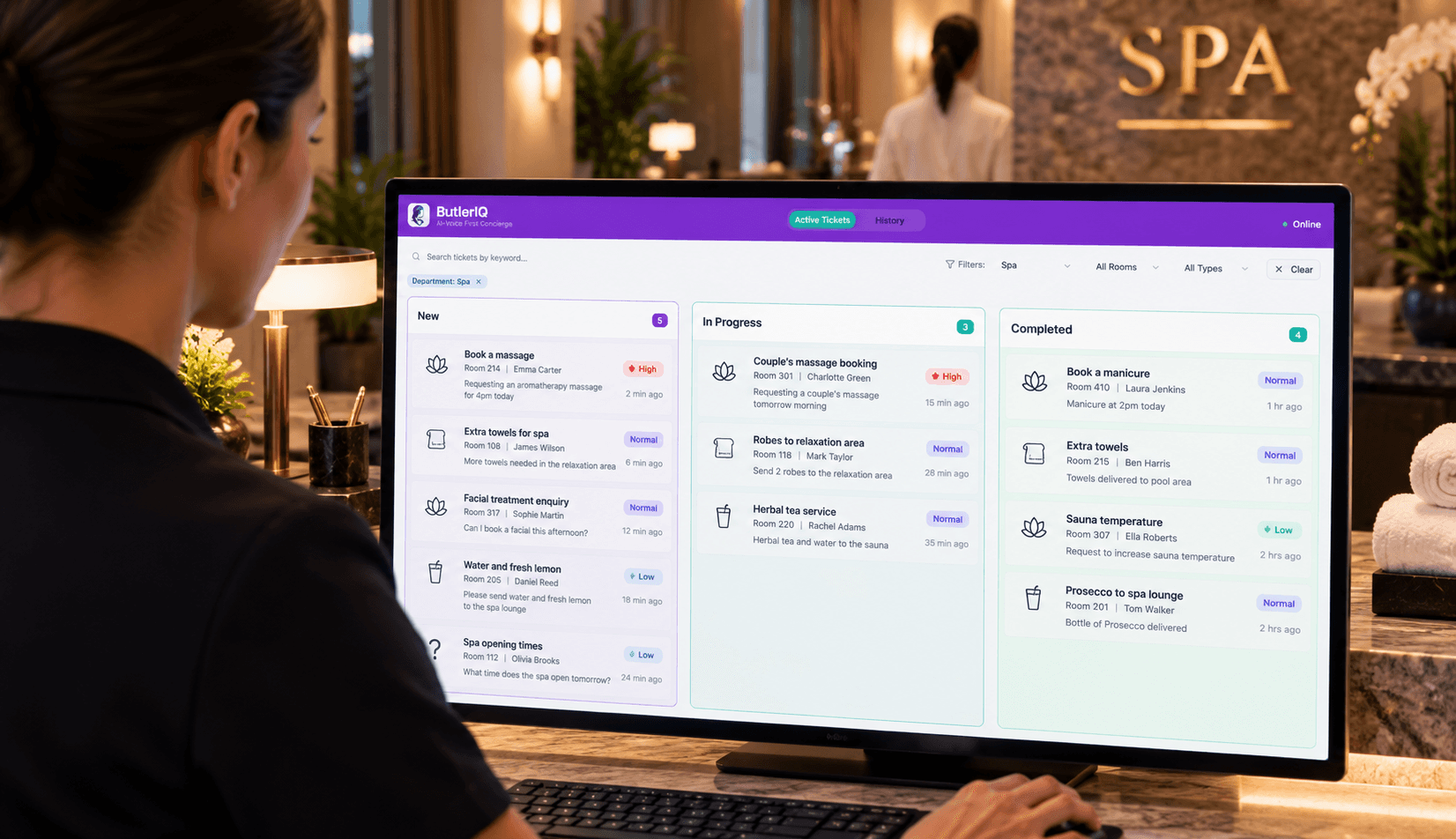
Provide a single staff console view that shows voice requests, verification status, and recommended next steps.
Use pre-approved scripts for sensitive scenarios, such as "I can help, but I need to confirm your identity first. Can you show your ID or approve the request in the app?"
When operations and security work together, the guest experience improves too. Guests get help quickly, staff feel supported, and the hotel does not rely on "common sense" as its main control.
Incident Response And Auditability For Voice Events
If something goes wrong, we need evidence that stands up to scrutiny and a response plan that staff can execute during a busy shift. Voice adds new event types, so we adapt incident response rather than bolt it on.
What we should log (and what we should not)
Useful auditability focuses on decisions and outcomes:
Command intent (for example, "unlock request", "key re-issue request", "panic/help")
Timestamp, device ID, room ID
Authentication method used (none / PIN / app approval)
Authorisation result (allowed / denied)
Integration actions (PMS updated, ticket created, staff notified)
We avoid logging raw audio unless there is a clear, documented reason, because it increases privacy risk and storage burden.
Detecting suspicious patterns
Hotels do not need a complex SOC to spot common abuse patterns. We can set simple alerts, such as:
Multiple failed PIN attempts within 5 minutes in the same room
"Unlock" requests occurring during a room's "vacant" status
Requests that spike after checkout time
A real scenario: a device in a vacant room starts issuing service requests overnight. That can signal tampering, misconfiguration, or a compromised endpoint.
Incident playbooks for the front line
Staff need short playbooks they can follow. For example:
Suspected voice misuse for access: disable voice for the room remotely, revert to standard lock procedures, confirm guest identity, and escalate to duty manager.
Privacy complaint: show the guest how to mute the device, offer opt-out for the stay, document the complaint with the exact room and device ID.
System-wide integration fault: disable high consequence commands globally while keeping low consequence room controls running.
Regular reviews that prevent repeat incidents
A monthly review that combines security, IT, and operations is often enough to improve controls fast. We look at denied commands, exception handling, guest complaints, and any rooms with unusual event volumes.
Auditability is not about surveillance. It is about being able to say, with confidence, what happened, what we did, and how we stop it happening again.
Procurement And Vendor Due Diligence: Contracts, Assurances, And Testing
The biggest security decision often happens before the first device arrives: procurement. A glossy demo can hide unclear data handling, weak support, or an integration model that forces risky shortcuts.
Contract essentials we should insist on
We want agreements that support real operations, not just "best effort" promises.
Key contract points:
Data processing terms: clear roles (controller/processor), sub-processors, and data residency where relevant.
Retention and deletion: what data is stored, for how long, and how deletion is verified.
Security controls: patch timelines, vulnerability disclosure, penetration testing commitments.
Service levels: uptime targets, incident response times, and support hours that match hotel operations.
Exit plan: how we remove devices, wipe data, and migrate integrations without leaving orphaned accounts.
Assurance questions that surface real maturity
We can ask for:
Recent independent security reports (for example, ISO 27001 certification or equivalent assurance)
Details of how the vendor handles authentication and token management
Evidence of secure development practices and bug bounty participation (if available)
Testing: trust, then verify
Before a full rollout, we run tests that mirror hotel reality:
Corridor replay tests for high consequence commands
Room turnover tests: check-out, housekeeping status change, and new check-in, ensuring permissions reset correctly
Network isolation tests: confirm the device cannot scan other room devices
Failure mode tests: Wi‑Fi outage, cloud outage, and PMS downtime, verifying safe defaults
Vendor due diligence is not about catching people out. It is about making sure we can deliver a secure guest experience consistently, even on the busiest weekend of the year.
Implementation Roadmap: Pilot, Rollout, And Continuous Improvement
A rushed rollout creates the worst kind of failure: a system that works in the show rooms but fails in normal rooms with normal guests. A staged roadmap helps us learn without taking unnecessary risk.
1) Pilot: pick rooms that teach us the most
We choose a mix:
A standard floor with high turnover
A quieter floor for baseline comparison
At least one accessible room, because voice can be a genuine support for guests with mobility needs
We set clear pilot success measures, such as:
Reduction in call volume for simple requests
Guest satisfaction feedback on privacy and ease of use
Number of exceptions requiring staff intervention
Any high consequence command attempts and outcomes
2) Rollout: expand capability in layers
We roll out in layers of consequence:
Start with low consequence room controls.
Add service requests with staff confirmation.
Only then consider high consequence workflows, and only with step-up authentication.
This sequencing stops us from deploying the riskiest features before staff and systems are ready.
3) Staff enablement: short, practical training
We keep training simple:
A one-page "what the system can and can't do" guide
A verification checklist for access and billing requests
Clear escalation paths for suspicious activity
4) Continuous improvement: treat voice like a living service
Voice assistants change through software updates, new integrations, and evolving guest expectations.
A workable rhythm:
Weekly patch and configuration compliance checks
Monthly security and operations review of logs and exceptions
Quarterly vendor review and targeted testing (replay, network isolation, turnover)
Because our site work focuses on competitive analysis and content that helps small businesses move faster, we recognise a familiar pattern here: the hotels that win are the ones that measure what matters, learn quickly, and keep tightening the loop. Voice security is no different.
A calm, phased rollout lets us protect guests, support staff, and prove value without gambling on a big-bang launch.
Conclusion
Voice in hospitality can make rooms feel safer and service feel quicker, but only if we treat it as part of the hotel's security system, not a gadget. When we design Voice-Activated Security Protocols for Hotels around clear threat models, step-up authentication, least privilege, and privacy-by-design, we reduce risk without killing convenience. The practical win in 2026 is not "more voice everywhere". It is the right voice controls in the right places, with staff workflows and audit trails that hold up on a bad day as well as a good one.
Frequently Asked Questions about Voice-Activated Security Protocols for Hotels
What are voice-activated security protocols in hotels?
They are systems using voice commands to control room features, access, and safety functions, simplifying guest interaction while integrating with hotel management for secure, efficient service.
How do hotels ensure security when guests use voice commands to unlock doors?
Hotels require additional verification steps like app approval, PIN codes, or staff confirmation before allowing voice commands to unlock doors, preventing unauthorised access through voice spoofing or replay attacks.
What privacy measures protect guests when voice assistants are used in hotel rooms?
Hotels implement clear consent processes, visible mute options, data minimisation, and retain only necessary records for a short time to respect guest privacy and build trust during stays.
Why can't voice-activated security replace traditional hotel security measures?
Voice systems complement but do not replace physical security devices like strong locks, nor do they detect non-verbal threats such as forced entry or suspicious behaviours in public areas.
How do hotels manage staff workflows safely around voice-activated commands?
Staff are trained to verify identity beyond voice transcripts, use secure consoles showing verification status, and follow clear escalation protocols to handle sensitive requests without bypassing security controls.
What steps are involved in implementing voice-activated security in hotels?
A phased approach is used: pilot testing on varied rooms, rolling out low-to-high consequence features gradually, continuous staff training, and ongoing security and operational reviews to ensure safety and guest satisfaction.
Sep 25, 2026
Hospitality Innovation
Guest Request Routing for Hotels in 2026: Cut Front Desk Workload Without Adding Headcount
Manual guest requests quietly eat hours of front desk time every week. See how automatic request routing works, what it saves your team, and how to evaluate it for your property.

Sep 15, 2026
Hotel Upselling Solutions: Why Pre-Arrival Isn't Enough
Hotel upselling doesn't require aggressive sales tactics—it requires smart timing and conversational delivery. Learn how modern hotels use voice-first AI and personalised offers to increase ancillary revenue by £15–£30 per stay while keeping guests feeling genuinely helped, not pressured. This guide covers proven upselling strategies, multilingual AI integration, and weekly KPI tracking for UK SME properties

Aug 14, 2026
Smart Hotel Rooms: Why the First Wave Failed, and What the Next One Looks Like
Smart hotel rooms promised a lot and delivered little. Here's what changed, what a genuinely smart room does in 2026, and how UK operators should approach it.
