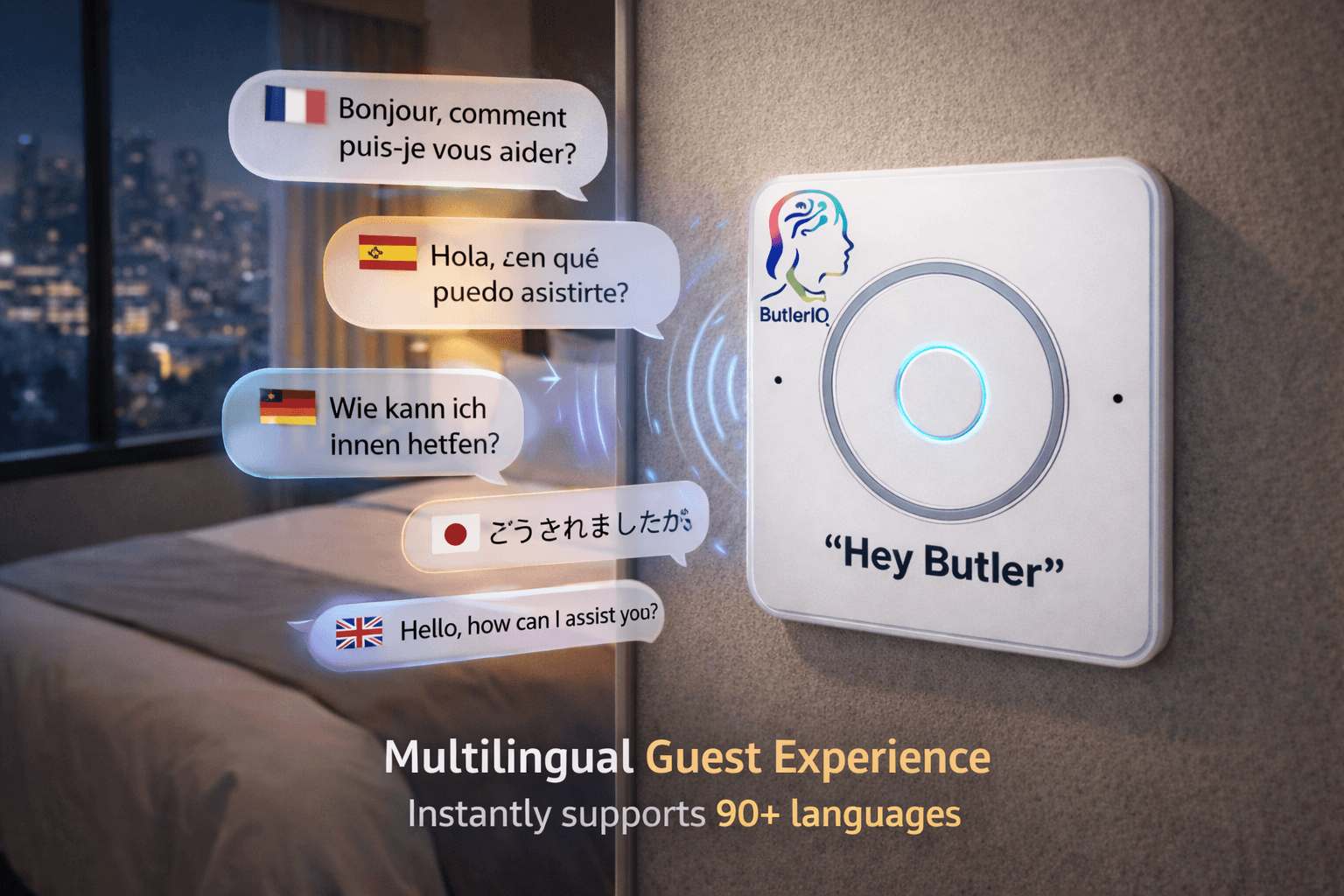
How Multilingual Voice Interfaces Boost Guest Experience
Discover how multilingual voice interfaces enhance guest experience by enabling fast, clear, and inclusive communication in hotels, boosting satisfaction and revenue.
A guest lands late, they're tired, and the first thing they hit is a language barrier at check-in or on the phone to reception. That small moment can turn into a complaint, a refund request, or a review that puts off the next booking. In this guide, we'll show how multilingual voice interfaces boost guest experience by removing friction at the exact moments guests need help most. Done well, they make service feel faster, more personal, and quietly more trustworthy.
Key Takeaways
Multilingual voice interfaces eliminate language barriers at critical guest moments, enhancing the overall guest experience and reducing complaints.
Providing language access through voice AI supports both guests and staff by handling routine queries, allowing staff to focus on personalised service.
Designed correctly, multilingual voice interfaces incorporate natural language detection, context memory, and seamless handoff to humans, avoiding awkward or untrustworthy interactions.
Voice interfaces improve accessibility and inclusivity for international, vulnerable, and digitally less confident guests by offering clear, simple communication in their preferred language.
Success of multilingual voice solutions should be measured by guest satisfaction, operational efficiency, increased revenue from upsells, and improved reputation through clear communication.
Prioritising languages based on guest demographics, handling dialects carefully, updating language content regularly, and using culturally sensitive phrasing ensures effective and respectful communication.
Why Language Access Is Now A Core Part Of Guest Experience
A single misunderstood question at 11pm can cost you more than you think: a room move that doesn't happen, a safety concern that isn't reported clearly, or a guest who gives up and posts a one-star review instead.
Language access has shifted from a "nice extra" to a baseline expectation because travel has changed. Hotels, serviced apartments, and short-stay providers now host guests who book globally, arrive at odd hours, and expect instant answers. When a guest cannot explain "the shower is leaking onto the floor" or "my child has an allergy", the experience stops being hospitality and starts being stress management.
Multilingual support also protects the staff experience. If our front desk team has to play interpreter, they slow down the queue and lose time for higher-value service like upgrades, loyalty recognition, or simply being present. Voice AI can take the repetitive questions, Wi‑Fi codes, breakfast times, late checkout fees, parking rules, and handle them in a guest's preferred language so humans can handle the moments that need judgement.
There's also a commercial reality: guests who feel understood buy more. They're more likely to book a table, accept a room upgrade, add airport transport, or extend their stay when the offer is clear and friction-free. Language access is not only about kindness: it's about conversion at the point of need.
What A Multilingual Voice Interface Is (And What It Is Not)
If we treat multilingual voice as "Google Translate, but spoken", we set ourselves up for awkward, brittle conversations that guests won't trust.
A multilingual voice interface is a voice-driven layer, often powered by conversational AI, that lets guests speak naturally and get spoken answers back, in more than one language. In practice, it usually includes:
Automatic language detection (or an easy prompt like "Say English, Deutsch, العربية").
Speech-to-text and text-to-speech tuned for hospitality noise, accents, and short commands.
Intent recognition for common hotel requests (extra towels, wake-up call, room temperature, lost key).
Context and memory (basic preferences like "no feather pillows", stay dates, room number, prior requests).
A handoff path to a human when confidence drops or the request turns sensitive.
What it is not:
Not a replacement for all staff. Guests still want a human for complaints, empathy, and exceptions.
Not "set and forget". Languages evolve, slang changes, and hotel policies update weekly.
Not only for the website. The best impact comes when voice connects to real systems, PMS/CRM, housekeeping tasks, dining bookings, maintenance tickets.
Not culturally neutral. A literal translation can be technically correct and still feel rude, cold, or confusing.
When we design it as a real service channel, like reception, but faster, we get the upside: fewer misunderstandings, quicker resolution, and more consistent guest communication across shifts.
Where Multilingual Voice Wins: The Highest-Impact Guest Touchpoints
Guests don't judge language support in the abstract: they judge it when they're under time pressure, tired, or dealing with a problem.
The highest-impact touchpoints share three traits: they happen frequently, they come with urgency, and they are easy to standardise. Think check-in questions, room issues, and "what do I do now?" moments. Voice works well here because it removes typing, reduces app friction, and fits how guests behave in a room: they talk.
For operators, these touchpoints also map to measurable outcomes. Every avoided queue reduces abandonment. Every resolved request without a call reduces workload. Every upsell that lands in the guest's own language increases revenue without making staff feel pushy.
Below are the two places we typically see the quickest gains.
Accessibility, Inclusivity, And Trust For International And Vulnerable Guests
A guest who can't explain a safety issue clearly is not just inconvenienced, they are at risk. That's why multilingual voice is as much an accessibility tool as it is a service feature.
For international guests, the obvious benefit is fluency. But the bigger benefit is reduced cognitive load. When someone is jet-lagged, anxious, or travelling with a sick family member, they need short, clear interactions: who to call, what to do, where to go, and what happens next.
For vulnerable guests, inclusive design makes a measurable difference:
Older guests or those with low digital confidence: voice avoids app downloads, logins, and form-filling.
Guests with visual impairment or dyslexia: voice can replace scanning printed information or navigating complex menus.
Neurodivergent guests: consistent phrasing and predictable prompts can reduce uncertainty.
Women travelling alone or guests worried about safety: quick access to clear instructions ("Call reception", "Request security", "Nearest staffed area") builds trust.
Trust is also built through small, practical signals. We can add a confirmation step for sensitive requests ("I will share this with reception now: is that ok?"). We can offer privacy-first options ("Would you like me to speak more quietly?" in devices that support volume control). And we can make it easy to request a person, without making the guest feel like they failed.
Inclusivity is not a marketing statement here: it's a service standard. Guests remember when we make it easy to be understood, especially when they feel exposed or unsure.
Designing The Experience: Tone, Privacy, And When To Hand Off To A Human
A voice assistant can answer in perfect grammar and still feel wrong. Guests notice tone, they worry about privacy, and they lose patience fast when a system refuses to escalate.
Tone that fits hospitality (not tech support)
We design for the moment. A guest reporting a leak needs calm urgency: "I'm sorry about that. I can send maintenance now. Are you safe to stay in the room?" A guest asking about breakfast needs quick clarity: times, location, price, and what's included.
A practical way to keep tone consistent is to create a voice style guide per language:
Greetings that match local norms (formal vs informal forms of address).
Short sentences for noisy environments.
Clear confirmations ("I've booked that for 7pm" rather than "Your request has been processed").
A small set of empathy phrases that don't sound robotic.
Privacy that guests can understand
Privacy fails often come from confusion, not malice. If a guest thinks the device is "always listening", they stop using it.
We build trust by being explicit:
Say when the assistant is active ("I'm ready" with a wake word, or a button press in public spaces).
Explain what gets stored ("I keep this request for your stay only").
Avoid reading personal details aloud in shared areas (full names, booking references, card information).
Handoff rules (and making them feel seamless)
The fastest way to break the experience is to trap the guest in loops. We define handoff triggers and make them visible:
Low confidence: the system is not sure what was said.
High risk: medical issues, safety concerns, harassment, lost child.
High emotion: repeated complaints, angry tone, repeated failures.
High value: VIP arrivals, loyalty members, group bookings.
Then we make the handoff smooth: "I'm going to connect you to our team now. I'll share what you told me so you don't need to repeat it." That single sentence saves time and dignity.
A human-centred design turns voice AI into a partner for staff, not a barrier between staff and guests.
Getting The Languages Right: Prioritisation, Dialects, And Cultural Nuance
Offering "20 languages" looks great on a sales slide. In operations, it can fail if we pick the wrong languages, ignore dialects, or translate phrases that should be rewritten.
Step 1: Prioritise languages based on your real guest mix
We start with data we already have:
Booking source markets (direct, OTA, corporate travel).
Passport data at check-in (where lawful and appropriate).
Call logs and front desk notes ("Spanish speaker needed", "guest used translator app").
Review analysis: complaints that mention communication, rudeness, or confusion.
A simple rule works well: cover the top 3–5 languages that represent the majority of non-native English demand, then expand based on seasonal patterns. A ski resort might need French and Dutch in winter: a city hotel might need Arabic and Mandarin year-round.
Step 2: Handle dialects and accent variation like a real person would
Arabic, Spanish, French, and Chinese are not single "languages" in the way hotels often treat them. Dialect differences can change meaning or politeness.
Practical moves:
Offer dialect selection when it matters ("Español (España)" vs "Español (LatAm)").
Train on local accent samples (tourist-heavy properties hear predictable patterns).
Keep the assistant's output neutral and widely understood unless the guest opts into a local dialect.
Step 3: Translate intent, not words
Cultural nuance shows up in small service moments:
How we apologise.
How direct we are ("No" vs "Not possible at the moment").
How we give instructions (step-by-step vs assumption of shared context).
For example, "You can't check out late" will land badly in most languages. "We're fully booked tomorrow, so we can offer checkout at 12:00 instead of 11:00" gives a reason and a concession.
Step 4: Keep language current
Hotels update policies, menus, and local guidance constantly. We schedule monthly language review for:
New menu items and allergens.
Construction notices ("lift out of service").
Local events that affect guests (marathons, rail strikes).
Getting languages right is less about showing off coverage and more about doing the basics brilliantly, in the languages guests actually use.
How To Measure Success: Satisfaction, Efficiency, Revenue, And Reputation
If we only measure "number of interactions", we miss the point. A multilingual voice interface succeeds when guests feel cared for and staff feel supported.
Satisfaction: prove the experience improved
We track:
CSAT by language (a simple 1–5 after key interactions).
First-contact resolution for common requests (towels delivered, issue fixed).
Drop-off rate (guests who abandon the voice journey mid-way).
Complaint themes in reviews that mention communication or staff helpfulness.
A practical step: add one question to post-stay surveys for international guests, "Did you get help in a language you were comfortable with?", and monitor the change month by month.
Efficiency: protect staff time and reduce queues
Operational metrics that matter:
Calls to reception per occupied room (before vs after).
Average handling time for routine queries.
Peak-time queue length at check-in.
Task completion time for housekeeping and maintenance requests created via voice.
We also look for a qualitative signal: fewer staff having to use their personal phones for translation apps, which is common and risky from a privacy point of view.
Revenue: measure the commercial upside without guesswork
Voice can drive incremental revenue when it offers clear options in the guest's language:
Conversion rate on upsells (late checkout, breakfast add-on, parking).
Restaurant bookings and room service orders generated through voice.
Repeat stay intent (survey) and loyalty enrolment.
To keep attribution honest, we tag voice-driven orders and compare them with the same period last year, adjusted for occupancy.
Reputation: watch what guests say publicly
Reputation often moves slower, but it's visible:
Review mentions of "helpful", "easy", "communication", "language".
Star rating movement in top international markets.
Reduced negative reviews caused by misunderstandings ("nobody explained", "I didn't know").
When we measure across satisfaction, efficiency, revenue, and reputation, we can justify investment with evidence, not enthusiasm, and we can iterate the service like any other guest-facing channel.
Conclusion
Multilingual voice interfaces work best when we treat them as a service promise, not a gadget: guests get clear help in their own language, quickly, and without feeling pushed into a system that can't listen. In 2026, the winners in hospitality will be the teams who remove friction at arrival, make in-stay support effortless, and still know when a human voice matters most. If we get the languages, tone, and handoff right, we don't just reduce frustration, we earn trust, better reviews, and more repeat business.
Frequently Asked Questions
What benefits do multilingual voice interfaces offer to hotel guests?
Multilingual voice interfaces provide guests with quick, personalised support in their preferred language, reducing frustration and misunderstandings, thus enhancing overall guest satisfaction and trust.
How do multilingual voice interfaces improve staff efficiency in hospitality?
By handling routine guest requests like Wi-Fi codes or breakfast times in multiple languages, voice interfaces free up staff to focus on complex tasks requiring human judgment, reducing queues and workload.
Can multilingual voice interfaces understand different dialects and cultural nuances?
Yes, advanced multilingual voice systems prioritise dialects and cultural differences, ensuring communications feel natural and respectful rather than literal translations, which improves guest experience.
When should a multilingual voice interface hand off a guest request to a human staff member?
Handoffs occur when the system detects low confidence in understanding, sensitive issues like safety concerns, or high-emotion interactions, ensuring guests receive empathetic and accurate human support.
What key guest touch points benefit most from multilingual voice technology?
Check-in/check-out, room issues, and urgent queries such as maintenance or safety concerns are high-impact moments where multilingual voice interfaces reduce friction and speed up resolutions.
How can hotels measure the success of their multilingual voice interface implementations?
Success is measured by guest satisfaction scores, reduced call volumes, faster task completion, increased upsell conversion, and improved online reputation reflecting better communication and service.
Sep 25, 2026
Hospitality Innovation
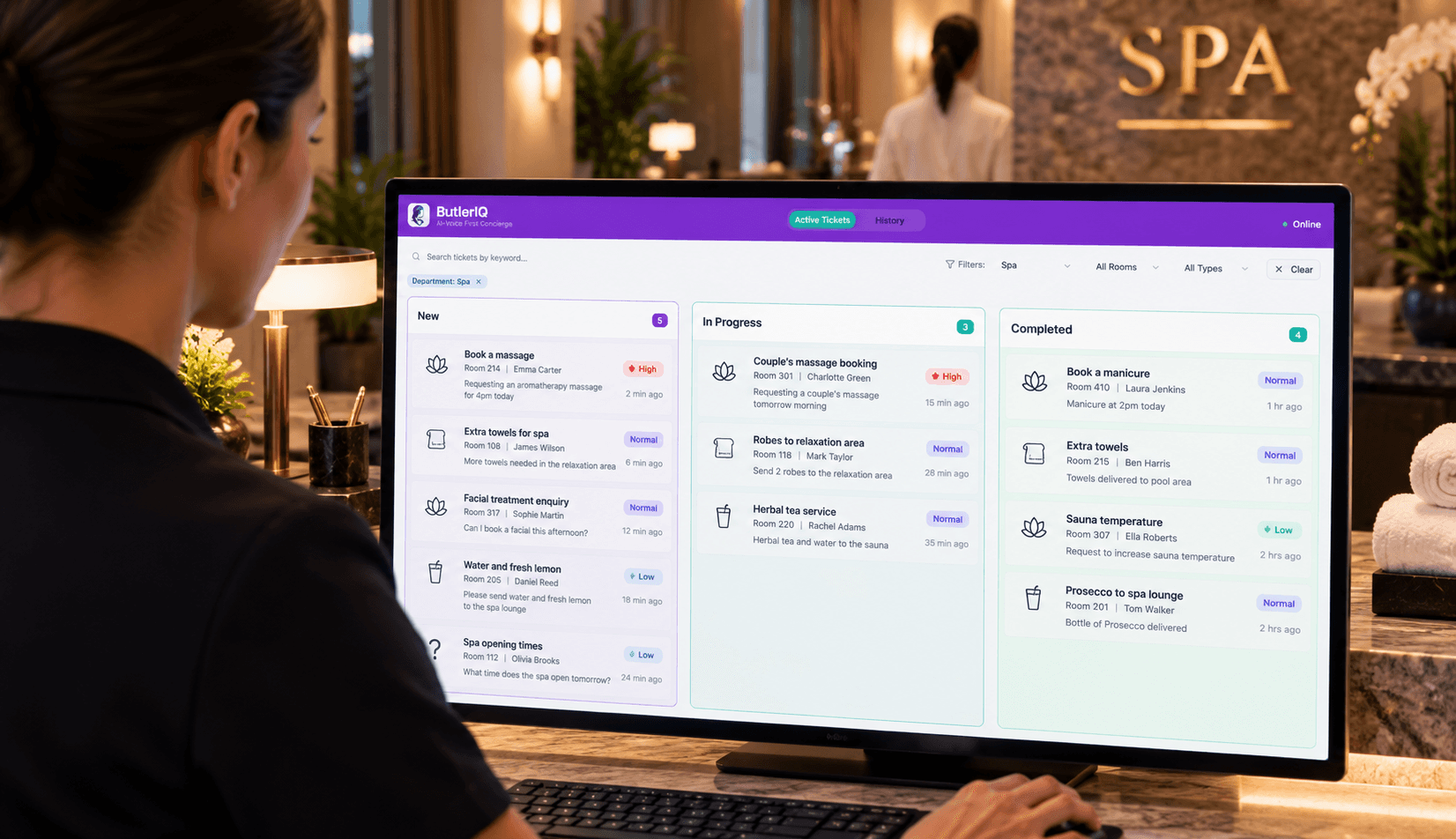
Guest Request Routing for Hotels in 2026: Cut Front Desk Workload Without Adding Headcount
Manual guest requests quietly eat hours of front desk time every week. See how automatic request routing works, what it saves your team, and how to evaluate it for your property.

Sep 15, 2026
Hotel Upselling Solutions: Why Pre-Arrival Isn't Enough
Hotel upselling doesn't require aggressive sales tactics—it requires smart timing and conversational delivery. Learn how modern hotels use voice-first AI and personalised offers to increase ancillary revenue by £15–£30 per stay while keeping guests feeling genuinely helped, not pressured. This guide covers proven upselling strategies, multilingual AI integration, and weekly KPI tracking for UK SME properties

Aug 14, 2026
Smart Hotel Rooms: Why the First Wave Failed, and What the Next One Looks Like
Smart hotel rooms promised a lot and delivered little. Here's what changed, what a genuinely smart room does in 2026, and how UK operators should approach it.
