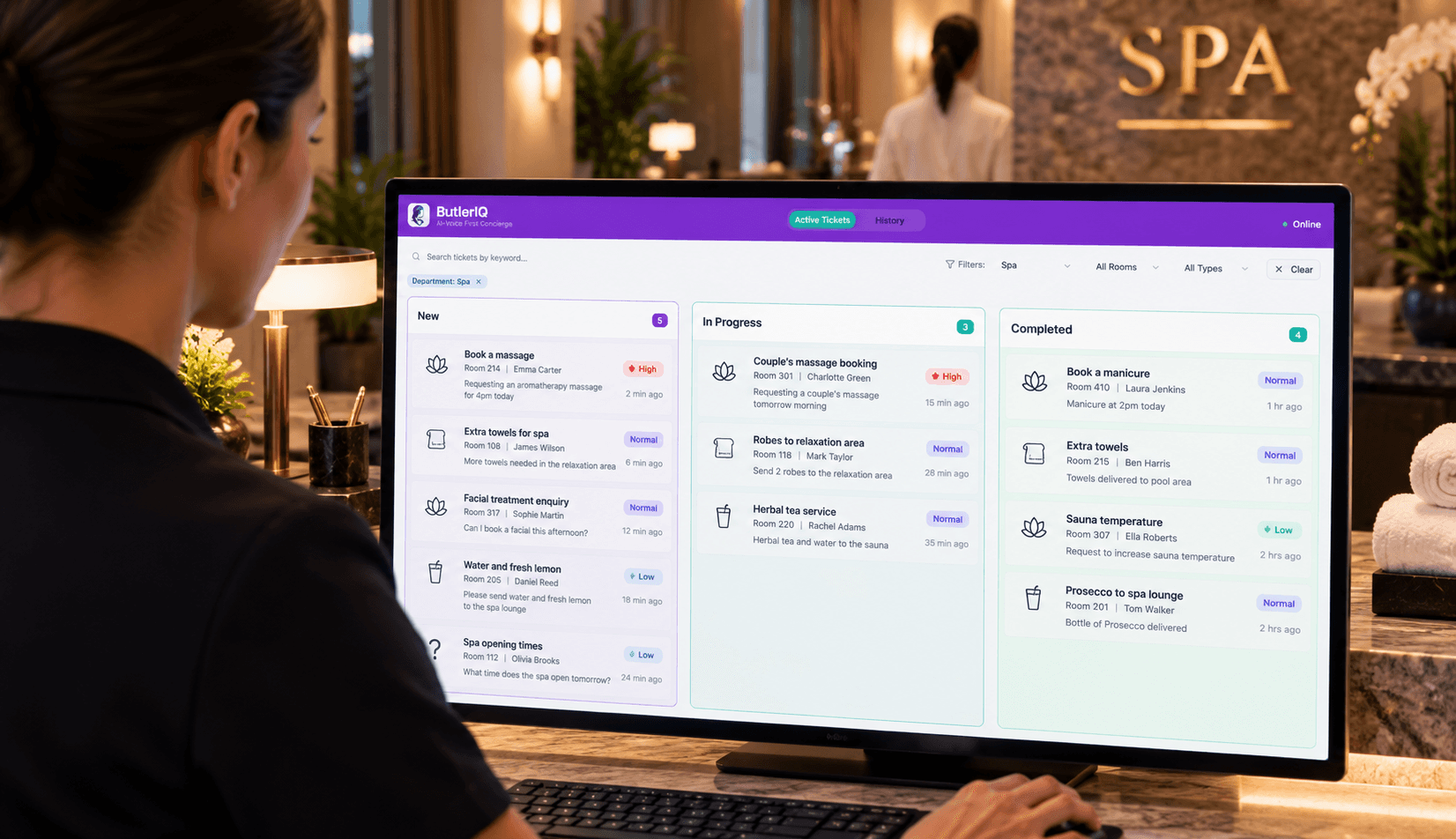
Hospitality Innovation
Guest Request Routing for Hotels in 2026: Cut Front Desk Workload Without Adding Headcount
Manual guest requests quietly eat hours of front desk time every week. See how automatic request routing works, what it saves your team, and how to evaluate it for your property.
If your front desk is still the relay point for every guest request — towels, AC, a late checkout, a maintenance issue — you already know the pattern: it's rarely one big problem that overwhelms the team, it's twenty small ones, each requiring someone to hear it, interpret it, write it down, and pass it to the right department before anything actually happens. We see the fastest efficiency gains when hotels treat guest request routing as a measurable operational lever, not a "nice to have" alongside the PMS. In this guide, you'll get a practical breakdown of where manual routing costs you time, and what automatic routing actually changes.
Key Takeaways
Guest request routing is the process of getting a guest's ask to the right department (housekeeping, maintenance, F&B, front office) without a staff member acting as manual middleware.
Manual routing costs hidden labour time in triage, not task execution — every request eats front desk minutes before a department even starts working on it.
Requests go missing most often at handoff points: shift changes, radio channels, and paper logs that depend on someone remembering to pass information along.
Automatic routing works by capturing the request directly from the guest — in-room, by voice, in their own language — and sending it straight to the owning department.
The efficiency gain isn't replacing staff, it's removing the coordination tax that sits between "guest asked" and "department knows."
Evaluate routing systems the same way you'd evaluate any labour-saving tech: how much admin does it remove, and how visible does it make requests to every department invo/
lved.

Sep 15, 2026
Hotel Upselling Solutions: Why Pre-Arrival Isn't Enough
Hotel upselling doesn't require aggressive sales tactics—it requires smart timing and conversational delivery. Learn how modern hotels use voice-first AI and personalised offers to increase ancillary revenue by £15–£30 per stay while keeping guests feeling genuinely helped, not pressured. This guide covers proven upselling strategies, multilingual AI integration, and weekly KPI tracking for UK SME properties

Aug 14, 2026
Smart Hotel Rooms: Why the First Wave Failed, and What the Next One Looks Like
Smart hotel rooms promised a lot and delivered little. Here's what changed, what a genuinely smart room does in 2026, and how UK operators should approach it.
