A guest emails about parking. Another calls reception from their room asking for the Wi-Fi code. A third is standing at the desk waiting to book a table for dinner, while the phone rings again. None of these requests are difficult. The problem is that they all land on the same few people at the same time.
That is the job a guest communication platform for hotels is meant to do: get every request to the right person, quickly, without the front desk becoming the bottleneck for everything. This guide covers what these platforms actually do in 2026, where most of them stop short, and why the moment that matters most – when the guest is in the room – is the one most hotels still handle with a 1990s telephone.
Key takeaways
A guest communication platform routes guest questions and requests to the right team, instead of funnelling everything through reception.
Most platforms on the market are messaging tools built for pre-arrival and post-stay contact: email, SMS and WhatsApp.
During the stay, guests rarely want to download an app or scan a QR code. They want to ask and get an answer.
Voice-first concierge fills that in-room gap: guests speak naturally, in their own language, and requests appear as tickets for the right department.
When choosing a platform, judge it on guest adoption, staff adoption and how clearly requests are tracked – not on the length of the feature list.
What a guest communication platform for hotels actually does
Strip away the marketing and a guest communication platform does three things:
Captures the request– wherever the guest starts the conversation.
Answers what it can– Wi-Fi details, breakfast times, check-out time, directions – without staff involvement.
Hands off what it can't– extra towels, a dripping tap, a spa booking – to the team that can deliver it, with a clear record of who owns it.
The aim isn't more channels. It's fewer loose ends. Loose ends are what turn a small request into a complaint and a calm shift into a chaotic one.
In practice, a good platform replaces or reduces reliance on:
The in-room phone as the default for every question, which ties up reception for answers that never change.
Printed compendiums and static directories that guests don't read and that go out of date the moment a menu changes.
Sticky notes and verbal hand-offs between reception, housekeeping and maintenance, where requests quietly get lost between shifts.
Copy-and-paste replies that vary depending on who is on duty.
The three stages of guest communication – and the one most hotels miss
It helps to split the guest journey into three stages, because each one calls for a different channel.
Before arrival: messaging works well
Pre-arrival is where email, SMS and WhatsApp shine. Guests are on their phones, planning, and happy to read a message about parking, directions or check-in times. Most guest messaging platforms are built for this stage, and for this stage they do a good job.
After check-out: messaging works well again
Invoices, receipts and feedback requests are naturally asynchronous. A message the guest can read later is exactly right.
During the stay: this is where messaging falls short
Once the guest is in the room, the picture changes. They have just arrived, their bags are on the bed, and they want to know how the shower works or whether room service is still open. At that moment, asking them to scan a QR code, download an app or open a chat window adds friction to something that should take seconds.
So what do guests do? They pick up the room phone and call reception – which is exactly the workload the hotel was trying to reduce. Or they don't ask at all, and the hotel misses the chance to sell them dinner, a late check-out or a spa treatment.
This is the gap ButlerIQ was built for. Instead of another screen to tap, the guest presses a button on a device in their room and asks, in plain language, the same way they would ask a concierge.
Why voice is the natural in-room channel
Voice removes almost every barrier that stops guests using in-room technology:
No app download.Nothing to install, no account to create, no password to forget.
No QR code.Nothing to scan, no small print to read on a phone screen.
No learning curve.Everyone knows how to ask a question out loud.
Multilingual by default.A guest can ask in Spanish, Arabic or Ukrainian and get an answer in the same language, without the front desk needing a translator on shift.
ButlerIQ's in-room guest devicesuse press-to-talk rather than an always-listening wake word. That matters in a hotel room: guests can see exactly when the device is listening, which builds trust and avoids accidental activations.
The device answers from the hotel's own knowledge – rooms, services, departments, opening times – and recommends the hotel's own restaurant, bar and spa before suggesting anywhere outside. For local questions, such as what's on nearby or when the next train leaves, it uses live information.
If you're weighing up what an AI concierge can realistically do today, our guide to AI concierge for hotels and better service without more staffcovers the practical use cases.
From guest request to completed task
Answering questions is only half the job. The other half is making sure requests actually get done.
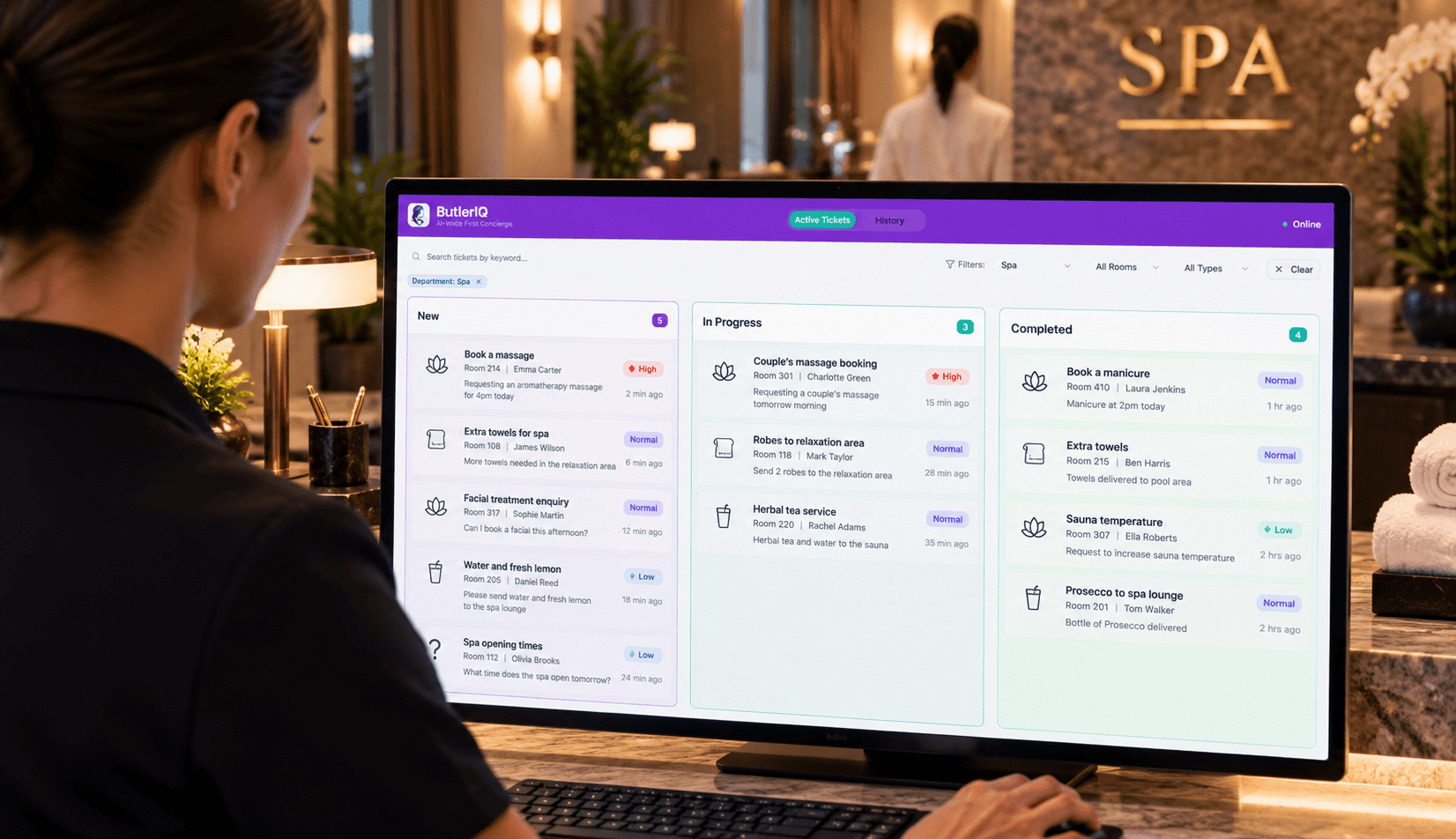
When a guest asks ButlerIQ for something that needs a person – extra pillows, a maintenance fix, a spa booking – it creates a ticket for the right department. Those tickets appear on the ButlerIQ staff dashboard, a simple board with three columns: New, In progress and Done. Anyone on shift can see what has been asked for, who is handling it and what is still outstanding.
Not every request carries the same weight, so tickets come in three levels:
Standard– routine requests such as towels or toiletries.
Urgent– flagged with an audible alert so it isn’t missed.
Emergency– a separate, distinct alarm for situations that need immediate attention.
This is where a lot of front-desk chaos disappears. Requests stop living in someone's head or on a scrap of paper at reception. They're visible, owned and tracked – and the front desk spends less time relaying messages between departments. For the wider picture on reducing pressure at reception, see our piece on front desk hotel software in 2026.
Turning everyday questions into revenue
Every guest question is a small sales opportunity. "Is the restaurant open tonight?" is one step away from a table booking. "What time is check-out?" is one step away from a paid late check-out.
Because ButlerIQ recommends hotel services first, those questions lead naturally to the hotel's own offers rather than to a restaurant down the road. When a guest wants to book, the request goes to the relevant department, who then contact the room to confirm the details. The guest gets a personal follow-up, and the hotel captures revenue that would otherwise have walked out of the door.
Automation without losing the human touch
The risk with automation isn't that it makes hotels less friendly. It's automating the wrong things, so guests feel processed and staff lose control.
A sensible split looks like this:
Automate information.Wi-Fi, breakfast hours, check-out time, directions and amenity details never change from guest to guest. Let the system handle them instantly, at any hour.
Route actions.Anything that needs a person – housekeeping, maintenance, bookings – becomes a ticket for the right team, not a message someone has to remember to pass on.
Keep people for what matters.Complaints, special occasions and sensitive situations belong with your team. Automation should free them up for those moments, not replace them.
Done well, automation makes your hospitality more visible, not less. When routine questions are handled in the room, your staff can be present in the lobby – where guests actually remember the interaction.
What to look for when choosing a guest communication platform
The most expensive mistake isn't buying the wrong features. It's buying a platform that guests ignore and staff quietly work around. Use this checklist in demos and ask to see each item working live.
Guest adoption.Ask: “What do guests have to do to use this – download, scan, sign up, or just ask?” Every extra step reduces usage.
Language coverage.If you host international guests, ask which languages are supported and which have been tested with real guests.
Clear task ownership.Ask to see a request move from guest to department to completion. You want visible statuses, not an inbox that relies on memory.
Prioritisation.Can urgent and emergency requests be told apart from routine ones, with alerts that actually get noticed on a busy shift?
Hotel-first recommendations.Does the system promote your restaurant, bar and spa before external options?
Control over content.How easily can you update what the system knows when a menu, opening time or policy changes? Look for a proper admin consolerather than a support ticket to the vendor.
Practical installation.What does the hardware need? ButlerIQ devices run on Wi-Fi or 4G and are USB-C powered, so they don’t depend on rewiring rooms.
Honest onboarding.Ask who sets it up, what information they need from you, and what week one looks like. A platform only helps once it’s live and trusted by your team.
It's also worth being clear about what you're buying. Messaging platforms are strong before arrival and after check-out. Voice-first concierge is built for the stay itself. Many hotels will benefit from both, so make sure you know which problem each tool actually solves.
Conclusion: meet guests where they are
Front-desk chaos is rarely caused by a team that isn't trying. It comes from requests arriving through too many channels, with no clear owner and no easy way for guests to help themselves.
A guest communication platform should fix that across the whole stay. Messaging covers the before and after. For the hours guests actually spend in your hotel, the simplest interface is the one they already know how to use: their voice.
See how ButlerIQ works in the room and behind the scenes on our products page, or get in touch to arrange a demo.
Frequently asked questions
What is a guest communication platform for hotels?
It's software that captures guest questions and requests, answers routine ones automatically and routes the rest to the right department. The aim is faster responses for guests and less pressure on reception.
What's the difference between guest messaging and a voice concierge?
Guest messaging uses text channels such as email, SMS and WhatsApp, and works best before arrival and after check-out. A voice concierge like ButlerIQ sits in the room, so guests can simply ask out loud during their stay, without an app or QR code.
Do guests need to download an app to use ButlerIQ?
No. Guests press a button on the in-room device and speak. There is nothing to install and no account to create.
Does a voice concierge work for international guests?
Yes. ButlerIQ supports more than 60 languages, so guests can ask in their own language and get a reply in the same language.
Is an in-room voice device always listening?
ButlerIQ uses press-to-talk, so it only listens when the guest presses the button. That makes it clear when the device is active and avoids accidental activations.
How does a guest request reach hotel staff?
Requests that need a person become tickets on the ButlerIQ staff dashboard, sorted into New, In progress and Done, and flagged as standard, urgent or emergency. Staff can see what is outstanding and who is handling it.
Can a guest communication platform increase hotel revenue?
Yes. When the system recommends the hotel's own restaurant, bar and spa first, everyday questions turn into bookings that might otherwise have gone elsewhere.