Hotel Guest Communication Software: A Practical Guide For UK Hoteliers (2026)
Discover how hotel guest communication software streamlines messaging, boosts guest satisfaction, and increases revenue with smart automation and PMS integration.
It only takes one missed WhatsApp message about a broken shower or a late check-in to turn into a one-star review, and you usually find out too late. If you're juggling calls, OTA inboxes, SMS and reception queries with a small team, you end up firefighting instead of running the hotel. In this guide, we explain how hotel guest communication software fits into your day-to-day operation, what to prioritise as an SME, and how to roll it out without creating yet another system your staff ignore.
Key Takeaways
Hotel guest communication software centralises all guest messages into one unified inbox, enabling faster, clearer responses and reducing operational risks.
Integrating communication software with your PMS allows for personalised, efficient service like pre-arrival messages and seamless handling of guest requests.
Automation and AI features handle common queries and routine tasks without losing the personal touch, improving response times especially during busy periods.
Structured workflows assign messages to the right departments, ensuring requests are completed promptly and reducing internal communication breakdowns.
Rolling out software in phases with staff input and tracking simple ROI metrics ensures successful adoption and continuous improvement.
Choosing software based on busiest day scenarios, clear cost understanding, and integration capabilities is critical for SME hotel operational success.
What Hotel Guest Communication Software Is (And Where It Fits In Your Tech Stack)
A guest asks for extra towels via SMS, another wants restaurant recommendations on WhatsApp, and a third replies to your Booking.com message thread. If those conversations live in three places, you don't have a "comms problem", you have an operational risk.
Hotel guest communication software is the layer that centralises guest messaging into one staff-facing workspace, so you can handle pre-arrival questions, in-stay requests, and post-stay follow-ups without hopping between channels. In practice, it works like a hub: it pulls conversations in, gives you tools to route and respond, and (when it's set up properly) adds guest context so your team don't have to ask the same questions twice.
Where it fits in your tech stack matters, especially for UK SMEs with lean teams. This software typically sits alongside your PMS, not instead of it. Your PMS remains the "system of record" for reservations, profiles and charges: guest communication is the "system of action" for service delivery and quick responses. When the platform integrates with the PMS, you can do practical things like:
Trigger a pre-arrival message 48 hours before check-in with parking details and door codes.
See the guest's stay dates and room number in the conversation, so you don't waste time confirming basics.
Hand off a request to housekeeping with clear ownership and a time stamp.
If you're mapping your stack, think in workflows rather than logos. Start with what you already use (PMS, channel manager, email, telephony), then check whether the comms platform can sit cleanly between "guest message received" and "task completed". For a sense of how vendors package these components, it helps to review a provider's platform view, like the way ButleriQ groups capabilities under its product suite at https://www.butleriq.ai/products.
The key takeaway: you're not buying "chat". You're buying a repeatable way to capture requests, respond fast, and coordinate delivery, even when reception is busy and staffing is tight.
The Real-World Benefits: Better Guest Experience, Smoother Operations, And More Revenue
When you're short-staffed on a Friday night, the real cost isn't just slow service, it's the knock-on effect: queues at reception, missed requests, inconsistent updates, and guests who feel ignored.
Better guest experience (because speed and clarity win)
Guests increasingly default to messaging because it feels low-effort: they can ask for an iron while on the train, or check breakfast times from bed. The win for you is simple and measurable: faster first response and fewer "did you get my message?" follow-ups. One practical move is to set a service standard your team can actually hit, such as "first response within 15 minutes during staffed hours", then use quick replies for common questions like parking, Wi‑Fi, or late check-out pricing.
If you want the guest journey to feel seamless, focus on the three points where anxiety spikes: pre-arrival (directions, parking, access), first hour after check-in (room issues), and checkout morning (bills, taxis). A structured approach to these moments is explored in https://www.butleriq.ai/blog/creating-seamless-guest-journeys-with-ai-voice-assistants, and the same principle applies whether you use chat, voice, or both: remove friction before it becomes a complaint.
Smoother operations (because one inbox beats five tabs)
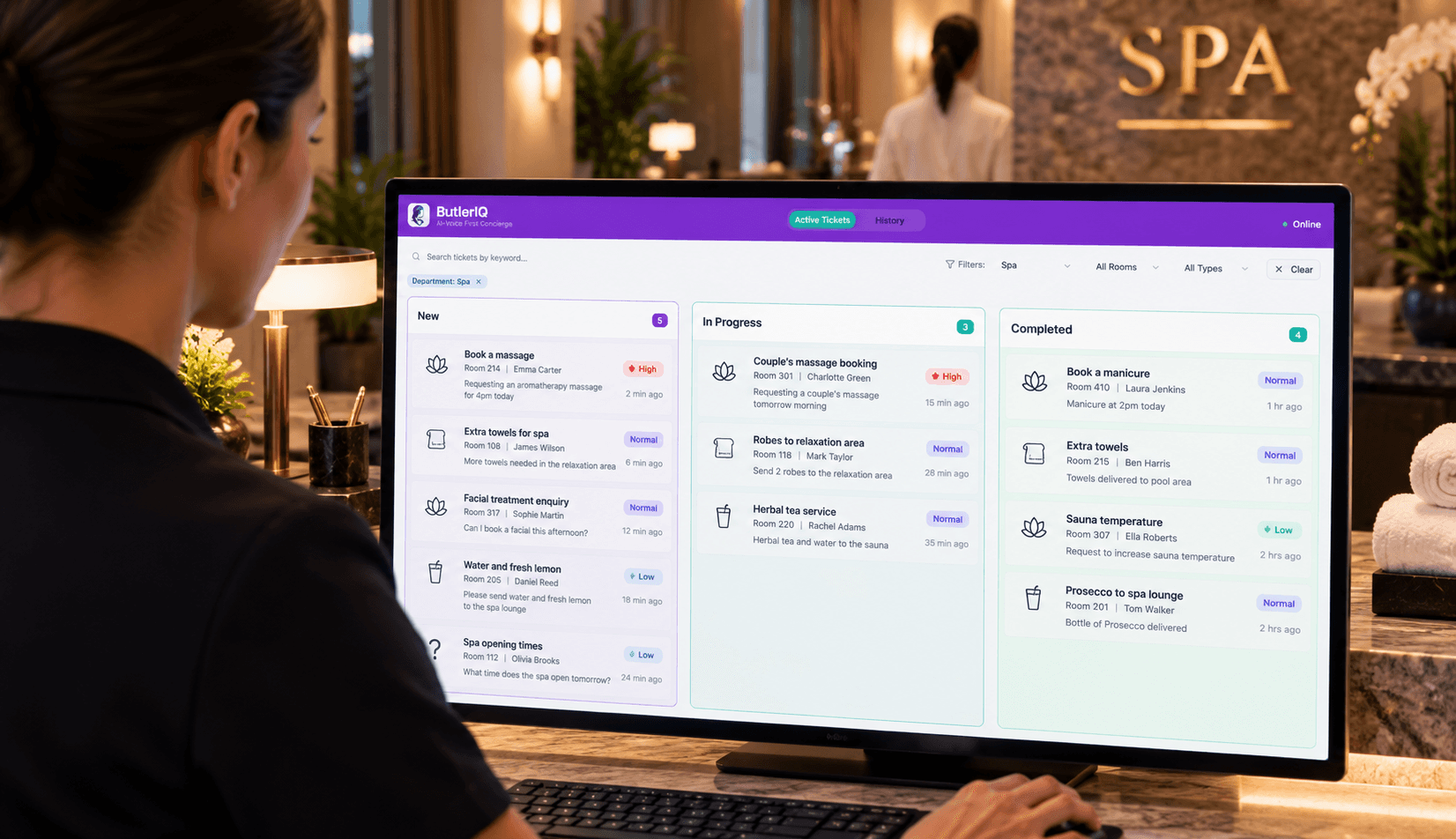
Operationally, a unified inbox reduces the most common failure in small hotels: messages being "owned by nobody". With the right setup, you can assign conversations (or individual requests) to roles like "Housekeeping", "Maintenance", or "Duty Manager", and you can track status the same way you would track tasks on a paper log, except it's time-stamped and visible across shifts.
A concrete workflow that works well for SMEs is a simple triage rule:
Reception handles anything answerable in under two minutes (times, directions, simple policy).
Housekeeping gets service requests (towels, linen, amenities) with a target time.
Maintenance gets faults with a photo request and a clear escalation path.
This cuts internal calls and corridor hunting, which is exactly where time disappears.
More revenue (because the right message at the right time sells)
Upsell revenue usually comes from timing, not persuasion. Pre-arrival is the high-leverage window: guests are planning and more open to upgrades. A practical example: send a message two days before arrival offering early check-in for £15 or late check-out for £20, and stop offering once you hit operational capacity. During the stay, you can target add-ons that match real behaviour, such as "Need dinner plans tonight? We can book you a table nearby" or "Spa slots available at 16:00 and 18:00".
The important part is control: you want offers to be easy to enable, easy to pause, and clearly attributed so you can see whether they worked.
Features That Matter Most For SMEs: Unified Inbox, Automation, AI, Workflows, And Integrations
A platform demo can look brilliant until your receptionist has 30 open chats, two no-shows, and a coach party asking about luggage storage. For SMEs, the right features are the ones that still work when it's busy.
Sep 25, 2026
Hospitality Innovation
Guest Request Routing for Hotels in 2026: Cut Front Desk Workload Without Adding Headcount
Manual guest requests quietly eat hours of front desk time every week. See how automatic request routing works, what it saves your team, and how to evaluate it for your property.

Sep 15, 2026
Hotel Upselling Solutions: Why Pre-Arrival Isn't Enough
Hotel upselling doesn't require aggressive sales tactics—it requires smart timing and conversational delivery. Learn how modern hotels use voice-first AI and personalised offers to increase ancillary revenue by £15–£30 per stay while keeping guests feeling genuinely helped, not pressured. This guide covers proven upselling strategies, multilingual AI integration, and weekly KPI tracking for UK SME properties

Aug 14, 2026
Smart Hotel Rooms: Why the First Wave Failed, and What the Next One Looks Like
Smart hotel rooms promised a lot and delivered little. Here's what changed, what a genuinely smart room does in 2026, and how UK operators should approach it.
