
Hotel Guest Experience Technology: 7 Upgrades for 2026
Seven practical hotel guest experience technology upgrades for 2026 — from mobile check-in to smart messaging — with rollout tips for independent hotels.
Hotel Guest Experience Technology: 7 Practical Upgrades for 2026
You can deliver a brilliant stay and still lose guests if check-in queues drag, requests get missed, or messages go unanswered. Guests now judge you on the full journey, from booking to post-stay, and they notice every bit of friction. We see hotel guest experience technology working best when it removes hassle without removing warmth. In this guide, you'll get seven practical upgrades you can carry out in 2026, with clear examples and rollout tips that fit an independent hotel budget.
The Seven Upgrades at a Glance
Mobile check-in and pre-arrival messaging
A mobile web guest portal (no app download needed)
Centralised guest messaging on WhatsApp and SMS
Digital keys and smart access
In-room controls and voice assistance
Opt-in personalisation guests actually welcome
Operational automation and PMS integrations
Key Takeaways
Hotel guest experience technology enhances guest satisfaction by smoothing key touchpoints like arrival, messaging, and request handling without sacrificing personal warmth.
Implementing mobile check-in, centralised messaging, and digital keys can significantly reduce delays and increase convenience for guests.
Personalisation should focus on opt-in preferences that guests expect, maintaining trust by avoiding intrusive data usage and providing simple consent options.
Integrating hotel systems to share guest data prevents repetition and errors, enabling consistent and efficient service across departments.
Operational automation should focus on routine tasks with clear escalation rules to support staff, ensuring high service quality even during busy times.
Successful rollout requires staff buy-in, targeted training on service style, and clear KPIs to measure impact on guest experience and operational efficiency.
What "Great Guest Experience" Means Today (And Why Technology Now Shapes It)
If you've ever had a guest say, "The room was lovely, but…", you already know experience is fragile. In 2026, great usually means the guest stays in control: they can arrive smoothly, get answers fast, feel safe, and enjoy consistency from first message to final invoice.
The shift is practical, not philosophical. Guests expect self-service options (mobile check-in, contactless payment, digital receipts) the same way they expect Wi-Fi. If you don't offer them, your team becomes the bottleneck, and the guest experiences that as "slow service", even when your staff are doing their best.
Technology now shapes the experience because it connects the journey. When your booking data, preferences, and service requests sit in separate systems, you end up asking the guest to repeat themselves. When those systems talk to each other, you can remember the simple things that feel personal (allergy note, late check-out preference, language choice) without turning hospitality into a spreadsheet.
The Core Guest Journey Touchpoints Technology Can Improve
You can spend money on gadgets and still miss the moments that drive reviews. A better approach is to map the journey and fix the touchpoints where friction shows up most often.
Pre-stay (reduce uncertainty and increase add-ons): Send a timed message 3–5 days before arrival that confirms parking, breakfast times, and check-in options, and includes one relevant upsell (for example, "early check-in if you arrive before 1pm"). If you're short on time, automate the basics and keep a human review for VIPs or long-stay guests.
Arrival (remove queues): Mobile check-in, ID capture, and pre-authorised payment can turn a 7-minute desk interaction into a 60-second welcome. If your property has waves of arrivals (weddings, coach groups), even a simple self-service kiosk can stop the lobby from becoming the first negative impression.
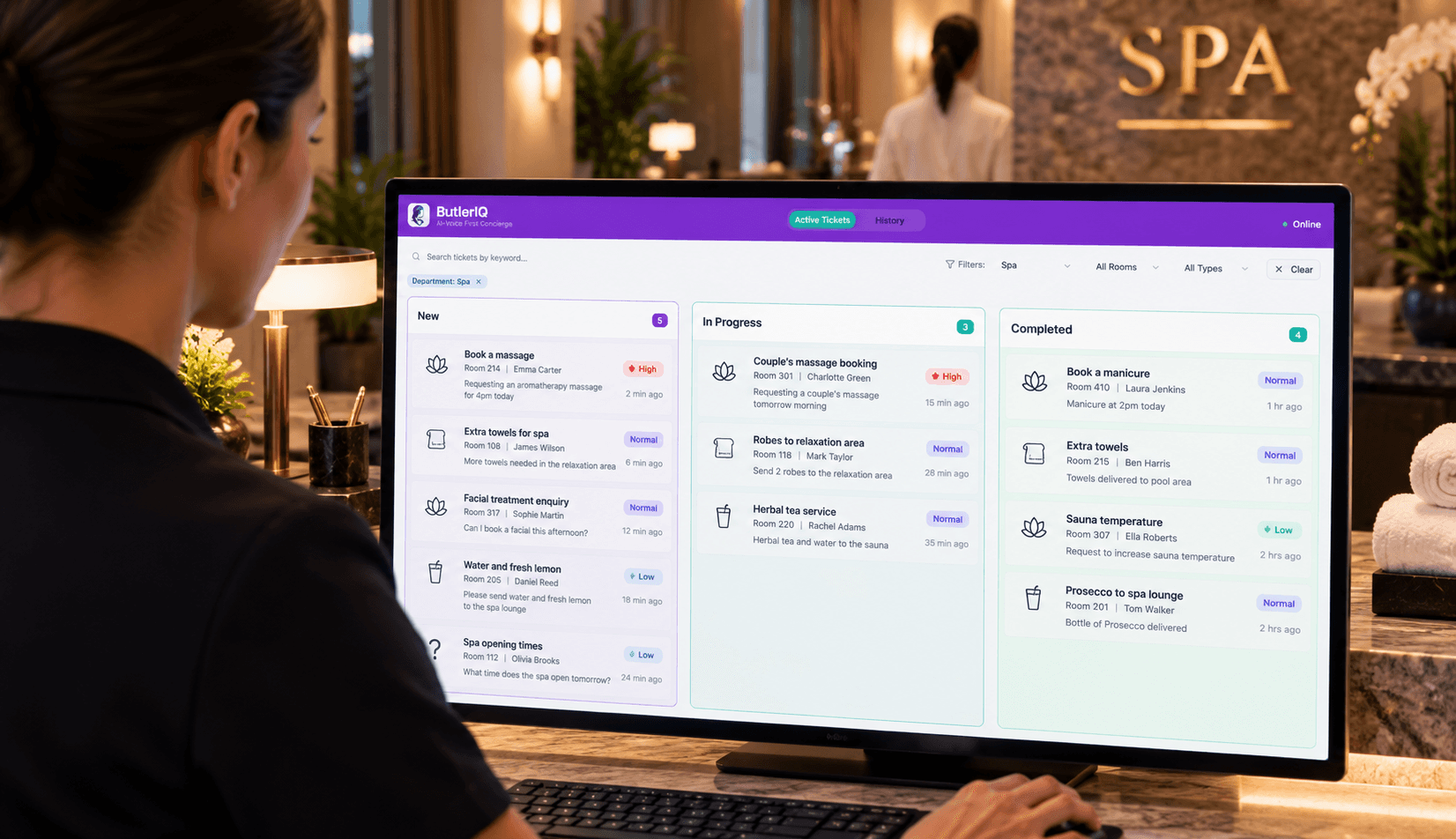
In-stay (route requests properly): Guests don't care which department owns a task: they care that someone responds quickly. When requests come in by phone, WhatsApp, email, and "I told your colleague earlier", things get lost. Centralised messaging that routes to housekeeping or maintenance reduces missed jobs and the awkward "we didn't know" conversation. This is how ButlerIQ handles in-stay requests: a guest asks out loud in their room, and the request lands on a live board where staff can accept, assign, and complete it — with nothing lost in a handover.
Departure and post-stay (protect reputation): Express check-out, automatic invoices, and a well-timed feedback request within 12–24 hours capture issues while you can still fix them. If you're building loyalty, you can pair that with a tailored return offer based on stay type (business, couple, family) rather than blasting the same discount to everyone.
Guest-Facing Hotel Technology Guests Actually Use (Use Cases That Matter)
The quickest way to waste budget is to install tech guests ignore. Focus on tools that reduce effort in moments they already find annoying: waiting, searching, and repeating themselves.
1) A mobile web portal instead of a heavy app. Many independent hotels don't need a downloadable app that guests forget. A mobile web portal can handle check-in, ID capture, local info, and service requests with a single link in the pre-arrival message. You can add digital room guides (Wi-Fi steps, TV inputs, breakfast rules) so staff don't answer the same questions 30 times a day.
2) Messaging on the channels guests already use. WhatsApp and SMS often beat phone calls because guests can message from the lift or while out for dinner. Set expectations in the first message (for example, "We reply within 5 minutes between 7am–11pm"). If you're considering AI to handle FAQs and triage, compare approaches using an AI concierge for hotels that improves service without adding headcount, then decide what must always stay human (complaints, compensation, safety).
3) Digital keys and smart access where it genuinely helps. Digital keys work best when you have repeat guests, late arrivals, or limited night cover. Start with a pilot on one floor or one room type so you can test battery life, guest support scripts, and what happens when a phone dies at 11pm.
4) In-room controls that solve a specific pain. Guests won't use "smart room" features just because they exist. They will use simple controls that reduce frustration: one-button lighting scenes, easy temperature adjustment, and a clear "do not disturb / make up room" status that feeds housekeeping. If you're exploring voice interfaces, make sure they support real needs like multilingual help or accessibility: the examples in how multilingual voice interfaces boost guest experience are a good reference point for what guests actually ask for.
This is the gap ButlerIQ was designed to close: a voice-first, in-room concierge that lets guests ask for what they need naturally, in their own language — no app download, no QR code — and routes every request straight to the right team. It replaces the in-room phone and the printed directory with something guests actually use.
Omnichannel Engagement And Personalisation Without Becoming "Creepy"
Personalisation can lift reviews, until it makes a guest feel watched. The line usually gets crossed when you use data they didn't realise you collected, or you use it in a way that feels unrelated to their stay.
Start with opt-in preference data that guests expect you to remember: room temperature range, pillow type, dietary notes, accessibility requirements, language choice, and communication channel. Make the consent moment obvious and simple: a tick box during check-in or in the pre-arrival form that says exactly what you'll use it for (service delivery vs marketing).
Then keep personalisation contextual and restrained. A good example: if a guest selects "late arrival", your system can automatically send the door code or late check-in instructions at 6pm. A bad example: referencing that they browsed spa prices on your site if they never booked.
Omnichannel matters because guests switch channels mid-journey. If they message on WhatsApp, then call the desk, your team should see the thread and the last promise made ("extra towels in 10 minutes"). Put a rule in place: one guest profile, one conversation history, one owner for follow-up.
Finally, protect trust with easy opt-out. Include a "stop marketing messages" option in every campaign, and keep service messages separate from promotions. If you want a practical way to connect personalisation to repeat stays without overdoing it, the ideas in this 2026 playbook for building guest loyalty with AI translate well to independents when you scale them down to a few high-impact moments.
Operational Automation And Integrations That Protect Service Quality
When staff are stretched, service slips in predictable places: slower response times, inconsistent handovers, and missed details. Automation helps most when it removes repetitive admin and makes ownership clear, not when it tries to "replace hospitality".
Automate the routine, keep judgement with people. Examples that work well in independent hotels include: automatic booking confirmations with key info, ID capture and payment pre-authorisation before arrival, request categorisation ("extra pillow" to housekeeping, "air con not working" to maintenance), and status updates back to the guest ("job received", "on the way", "completed"). Each automation should have an escalation rule, such as: if a request is not accepted within 5 minutes, notify the duty manager.
Integrate to avoid data silos. If your messaging tool doesn't sync with your PMS, staff end up retyping guest names, room numbers, and notes, and mistakes creep in at 9pm when the desk is busy. A basic integration checklist you can use in vendor demos:
Does it write back to the PMS (not just read)?
Can it create tasks for housekeeping and maintenance with timestamps?
Does it log conversation history against the guest profile?
Can it handle multiple properties if you grow?
Use AI carefully for forecasting and staffing. Even simple demand patterns (Sunday night business travellers vs Saturday leisure couples) can guide rota decisions and inventory planning. The goal is to protect service quality: put your best people on the highest-risk shifts, and reduce the "sorry, we're short-staffed" moments that lead to poor reviews.
If you want a concrete operational view of where the time goes, it's worth scanning hotel staff efficiency tools in 2026 and comparing those ideas to your own daily pain points (queues, admin, call volume, task chasing).
Rolling It Out In The Real World: Budget, Buy-In, Data, And Training
Even the right tech fails if it lands badly on site. The typical failure mode is simple: you buy a tool, nobody uses it properly, and guests end up with two ways to request help, neither of them reliable.
1) Set KPIs that reflect guest outcomes and cost-to-serve. Pick 3–5 measures you can track monthly, such as average check-in time, request response time, number of repeat stays, review score on "service", and ancillary revenue per stay. Tie each tech upgrade to one KPI before you sign a contract.
2) Start with visible quick wins. Arrival and messaging usually deliver the fastest impact because guests feel them immediately. A practical rollout sequence for independents is: (a) centralised messaging and request routing, (b) pre-arrival forms and mobile check-in, (c) digital compendiums and in-room guidance, then (d) smart access or in-room controls.
3) Get buy-in from the people who will live with it. Run a 30-minute "day in the life" workshop with reception, housekeeping, and maintenance. Ask one blunt question: "Where do requests get lost?" Build your configuration around that answer, then appoint one internal owner per department to keep standards consistent.
4) Treat data and privacy as part of the guest experience. Document what you collect (ID images, preferences, chat logs), why you collect it, and how long you keep it. Make access role-based (for example, housekeeping does not need payment data). If a guest asks, staff should have a plain-English answer in under 10 seconds.
5) Train for service style, not just button clicks. Write short scripts that fit your brand voice: how to introduce mobile check-in, how to recover when a digital key fails, and how to hand over a complex request. Two role-play scenarios per team, "late arrival, tired guest" and "maintenance issue, upset guest", will do more than a long manual.
Conclusion
If you're choosing hotel guest experience technology in 2026, aim for fewer tools that work together, not more features that sit unused. Fix the friction points guests actually feel: arrival, messaging, request handling, and clear in-room guidance. We recommend you pilot one upgrade, measure the impact on time and reviews, then scale in phases so the human welcome stays front and centre.
If voice-first guest service is on your shortlist, see how ButlerIQ works — an in-room AI concierge that answers guest questions, takes requests in any language, and routes them straight to your team.
Frequently Asked Questions About Hotel Guest Experience Technology
What does a great guest experience mean in hotels today? A great guest experience today means a frictionless, personalised, safe, and consistent journey throughout booking, stay, and post-stay, enabled by technology that enhances convenience and speed without losing the human touch.
How can technology improve the arrival experience for hotel guests? Technology like mobile check-in, digital keys, pre-authorised payments, and self-service kiosks can reduce queues and waiting times, turning lengthy check-ins into quick, smooth welcomes that guests appreciate.
What types of guest-facing technologies do guests actually use and prefer? Guests prefer mobile web portals over heavy apps for check-in and service requests, messaging via familiar channels like WhatsApp or SMS for quick responses, and smart in-room controls that reduce frustration, such as simple lighting and temperature adjustments.
How can hotels personalise guest experiences using technology without seeming intrusive? By collecting opt-in preference data like room temperature and language choices with clear consent, using that data contextually (for example, sending late check-in instructions only when relevant), and ensuring easy opt-outs to maintain trust.
Why is integrating operational automation important for hotel service quality? Automation helps remove repetitive tasks like booking confirmations and service request routing while integrations with PMS and housekeeping systems prevent data silos and errors, allowing staff to focus on personalised hospitality and maintain high service standards.
What are recommended steps for rolling out guest experience technology in independent hotels? Start with clear KPIs tied to guest outcomes, focus on quick wins like centralised messaging and mobile check-in, involve staff through workshops for buy-in, ensure strong data privacy practices, and provide targeted training for tech use combined with hospitality skills.
Sep 25, 2026
Hospitality Innovation
Guest Request Routing for Hotels in 2026: Cut Front Desk Workload Without Adding Headcount
Manual guest requests quietly eat hours of front desk time every week. See how automatic request routing works, what it saves your team, and how to evaluate it for your property.

Sep 15, 2026
Hotel Upselling Solutions: Why Pre-Arrival Isn't Enough
Hotel upselling doesn't require aggressive sales tactics—it requires smart timing and conversational delivery. Learn how modern hotels use voice-first AI and personalised offers to increase ancillary revenue by £15–£30 per stay while keeping guests feeling genuinely helped, not pressured. This guide covers proven upselling strategies, multilingual AI integration, and weekly KPI tracking for UK SME properties

Aug 14, 2026
Smart Hotel Rooms: Why the First Wave Failed, and What the Next One Looks Like
Smart hotel rooms promised a lot and delivered little. Here's what changed, what a genuinely smart room does in 2026, and how UK operators should approach it.
