
Overcoming Common Issues in Hotel Voice AI Integration: A ButlerIQ Guide for 2026
Voice AI can cut front desk workload and boost guest experience, but only if the rollout avoids common traps. This ButlerIQ guide covers the PMS integration, UK GDPR compliance, and escalation mistakes that most often derail hotel voice AI deployments — and how to get it right in 2026.
If you've ever watched the front desk drown in calls and in-room requests while guests queue up, you already know the real cost of "we'll deal with it later". Voice AI can fix that, but only if you avoid the integration traps that stall rollouts, frustrate staff, and create compliance headaches.
We built ButlerIQ, the voice-first AI concierge platform for hotels, specifically to close this gap. Guests say "Hey Butler" or press a single button on the in-room device, and the request goes straight to your team through the ButlerIQ staff console — no app download, no QR code, no queue at reception. In this guide to overcoming common issues in hotel voice AI integration, we share the six problems that most often derail deployments and the practical steps we use to get ButlerIQ hotels live smoothly in 2026.
Key Takeaways
Starting hotel voice AI integration with clear, measurable use cases focused on high-volume tasks ensures quicker ROI and smoother deployment.
Treat integration as a comprehensive data flow project requiring confirmed read/write permissions and addressing legacy hotel systems and fragmented guest data.
Compliance with UK GDPR demands transparent consent, tailored data retention, and thorough vendor due diligence to maintain guest trust — standards we hold ButlerIQ to on every deployment.
Design voice AI interactions for real-world conditions, accounting for accents, noise, multilingual needs, and confirming critical details to reduce errors.
Establish clear escalation protocols with natural handovers and context-rich routing into the ButlerIQ staff console, so your team never starts from zero.
Plan phased rollouts with practical testing and continuous improvement cycles to maximise efficiency, control costs, and enhance guest experience.
Start With The Right Use Cases, Success Metrics, And Guest Journeys
A rollout usually fails before you even touch an API, because the first use case is vague. If your brief says "reduce calls" or "improve guest experience", you'll struggle to design the right flows, train staff, or prove ROI.
Start with two to three high-volume, low-ambiguity use cases that you can measure in weeks, not quarters. For most ButlerIQ properties, that looks like: in-stay guest requests (housekeeping, maintenance, extra amenities), pre-arrival information (parking, check-in times, directions), local recommendations and bookings (restaurants, taxis, experiences), and post-stay feedback collection. Pick the ones that currently create queue pressure at reception or go unanswered out of hours.
Then define one primary metric per use case, plus a guardrail metric that stops you "optimising" the wrong thing. For example:
In-stay requests: average time to log a task in the ButlerIQ staff console (primary) + task rework rate (guardrail)
Local recommendations and upsells: upsell revenue per 100 interactions (primary) + opt-out or decline rate (guardrail)
Pre-arrival questions: self-resolution rate (primary) + call-to-reception rate (guardrail)
Finally, map the guest journey in three lanes — pre-arrival, in-stay, post-stay — and decide where ButlerIQ completes the full interaction versus where it triages and hands over. A practical rule: if the action requires negotiation (rate changes, complaint resolution), design for a fast handover to your team; if it's repeatable (Wi-Fi help, breakfast times, restaurant recommendations), aim for full resolution through the device.
If you need a clearer picture of where voice fits across the wider stay, our view aligns closely with the patterns in creating seamless guest journeys with AI voice assistants, especially around handling predictable "where/when/how" questions at scale.
PMS, CRM, And Task System Integration Pitfalls: Data Flow, Read/Write Access, And Legacy Constraints
The most expensive surprise in hotel voice AI integration is discovering that your systems can't actually do the thing you promised guests. A common example: ButlerIQ can read availability or guest details from the PMS, but it can't write changes back, so it takes the request and then… stalls.
Treat integration as a data flow project, not a "connect the dots" checkbox. For each use case, write down the required actions and the exact system of record:
Guest request: identify guest and room (PMS) → create task (ButlerIQ staff console) → update status (same)
Upsell or amenity order: confirm the offer (ButlerIQ) → post the charge (PMS folio) → confirm with guest
Escalation: detect intent (ButlerIQ) → raise an urgent staff console task → notify the on-duty team member → resolve and close
Three pitfalls show up repeatedly:
Read-only integrations. You need explicit confirmation of read/write permissions, with real examples such as "add a room service charge to a folio" or "update a housekeeping task status". Don't accept "we integrate with your PMS" without a list of supported operations.
Legacy back-of-house systems. Older housekeeping or maintenance ticketing tools — sometimes still a shared radio channel or a paper log — can make clean handoffs difficult, which leads to duplicated requests or guests repeating themselves. Ask early: can ButlerIQ push tasks directly into your existing system, does it need its own staff console, can it flag urgency, and can it route by department and shift?
Dirty or fragmented guest data. If names, room numbers, and stay details are inconsistent across systems, ButlerIQ will struggle to identify the right guest and personalise the response. A quick win is to standardise room and guest identifiers and enforce one "primary guest contact" field.
Mitigation is simple but not easy: insist on documented APIs, run end-to-end tests for your top two flows, and start with a narrow integration scope that you know is stable.
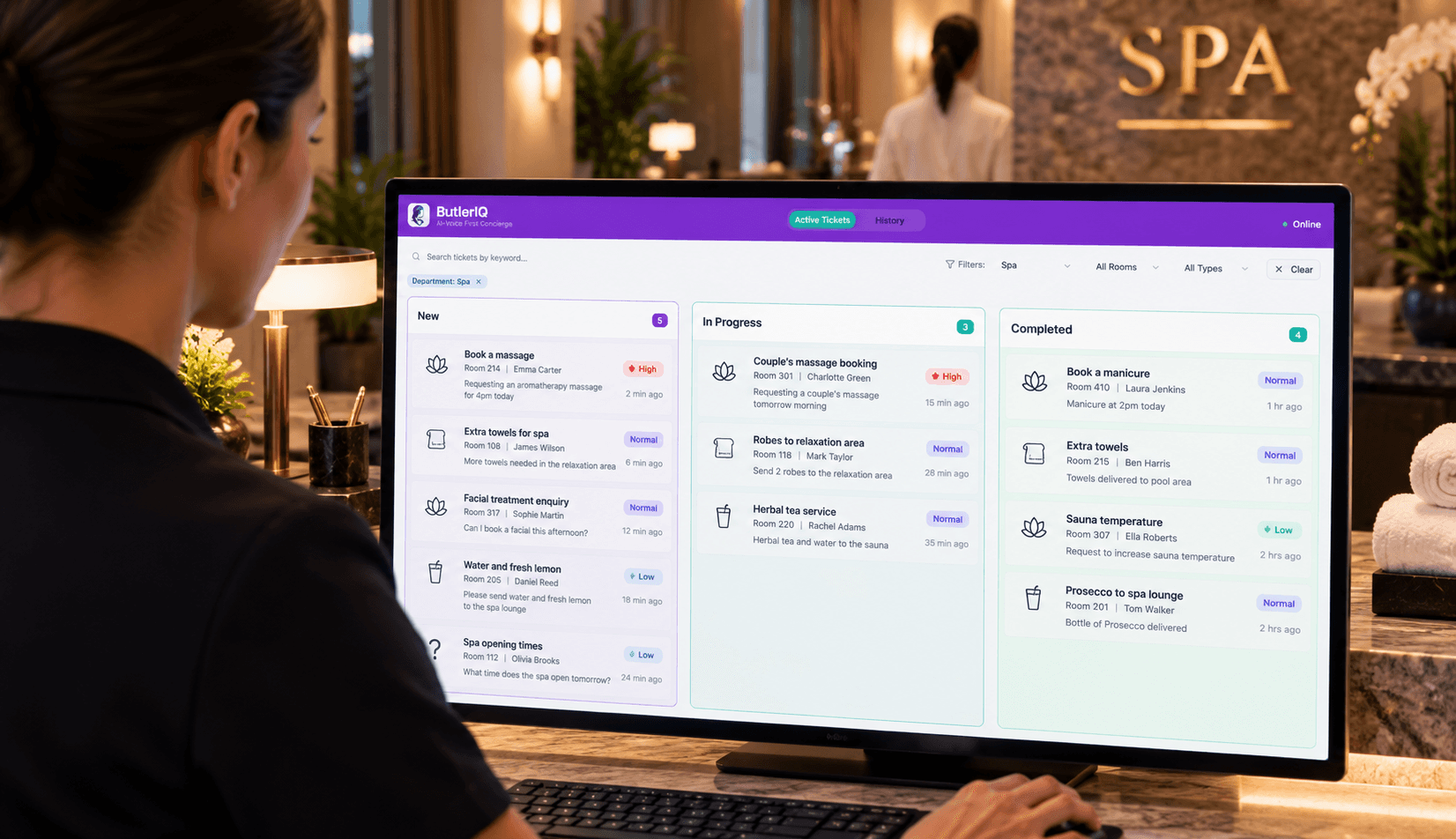
If you want to see what "operational visibility" looks like once requests start moving across systems, the ButlerIQ Staff Console is built for exactly this — your team can see what ButlerIQ captured, what it routed, and what still needs action, without chasing messages across tools.
Privacy, Security, And UK Compliance: Consent, Data Retention, And Vendor Due Diligence
One poorly handled consent moment can undo months of trust, especially when a guest asks about payments, passports, or raises a complaint. In the UK, you need to treat any hotel voice AI — ButlerIQ included — as a data processing system under UK GDPR, not as a novelty in the room.
Start with consent and transparency. If ButlerIQ processes and stores guest voice requests or transcripts, you must tell guests clearly and early — a short line on the device, in the room directory, or in a brief spoken prompt: the purpose ("to action your requests and improve service"), and how to reach a person instead. If you serve international travellers, keep the wording simple and avoid legal jargon.
Next, set data retention rules that match the use case. A housekeeping request transcript does not need the same retention window as a billing query. You can often reduce risk by storing only what you need — intent labels, timestamps, and a short summary — while deleting raw audio after a defined period.
Then do vendor due diligence like you would for any critical system:
Confirm where data is stored and processed (UK/EU is usually simpler for compliance conversations).
Check sub-processors, breach notification timelines, and security controls such as access logging and encryption.
Run a DPIA if the processing is likely high risk (for example, if you use analytics that could profile guest behaviour).
A useful sanity check: if you can't explain to a guest what data you keep and why in one minute, your setup is too complex. It's the standard we hold ButlerIQ to on every property.
If security is a bigger concern because you're handling access requests or night-time incidents, it's worth aligning your approach with the principles in voice-activated security protocols for hotels, especially around minimising sensitive capture and tightening escalation paths.
Conversation Design That Works In The Real World: Accents, Noise, Multilingual, And Intent Gaps
In a demo, ButlerIQ hears every word clearly. In a real hotel room, it hears a suitcase wheel, a running shower, or a guest calling out from across the room with the TV on. If you don't design for that mess, you'll get false confirmations and frustrated guests.
Design begins with the reality of speech in UK hospitality: regional accents, international English, and code-switching ("Can I have late checkout mañana?"). You can reduce failures with three practical choices:
Confirm critical details, not everything. Confirm room number, item, and time; don't repeat the whole request back like a robot. For example: "Two extra towels to room 214, on their way."
Use constrained questions when the stakes are high. Instead of "What time would you like breakfast?" ask "Is 8am or 9am better?" when scheduling something time-sensitive.
Plan for low confidence. If intent confidence drops, ButlerIQ should switch from guessing to clarifying: "Are you asking about your room, or something in the hotel?"
You also need an intent map that matches what guests actually ask. Start with the top 20 intents that drive volume: Wi-Fi, breakfast times, parking, spa opening hours, accessible rooms, pet policy, local recommendations, and "speak to reception". Track "no match" utterances weekly, then add intents in batches so you don't destabilise what already works.
Multilingual support is not just translation, and it's core to how we built ButlerIQ: guests can speak in 60+ languages, and ButlerIQ will detect, respond, and route in-language wherever possible. You still need a clear way to switch language and a fallback that resolves the request. If your property gets strong demand from a few language groups, prioritise those first and measure the deflection rate by language.
For more on designing voice experiences that handle multilingual guests without awkward handoffs, see how multilingual voice interfaces boost guest experience — it covers practical patterns for switching, confirming, and falling back gracefully.
Escalation And Human Handover: When ButlerIQ Should Step Aside And How To Route Cleanly
Nothing damages confidence faster than a device that refuses to hand over when a guest is clearly frustrated. ButlerIQ needs escalation that feels natural, and routing that works every time, including at 2am when you're running a skeleton shift.
Define escalation triggers in three layers:
Explicit requests: "reception", "manager", "I want to complain". Treat these as immediate, high-priority tasks in the ButlerIQ staff console, and prompt the guest to call or visit reception directly if it's urgent.
Risk and sensitivity: billing disputes, refund requests, medical incidents, security concerns, or anything involving personal documents. Route straight to a person, and avoid collecting extra detail through the device.
Complexity signals: repeated corrections ("No, that's not what I said"), long pauses, or multiple failed confirmations. After two failed turns, ButlerIQ should stop guessing and offer a handover.
Routing has to be operationally clean. That means deciding, per trigger, whether ButlerIQ raises an urgent staff console task with a call-back request, pages the on-duty team member directly, or — where your phone system supports it — connects the guest to a live line. In all cases, pass context: room number, guest name if known, and a short summary of what was asked, so nobody has to start from zero.
Give staff a simple playbook so they don't feel ambushed by AI-created tasks. For example: "Start by confirming the summary on the console, then ask one question to close the gap." It saves time and reduces the "I've already explained this" frustration.
If you want your overall service model to feel joined-up rather than split between automation and people, the operating ideas in an AI concierge for hotels are a good reference point, particularly on where humans add value and where automation should stay out of the way.
Cost, ROI, And Rollout Planning For SMEs: Phased Launches, Testing, And Continuous Improvement
The quickest way to waste budget is to launch voice AI across every room at once, then spend months firefighting edge cases. SMEs do better when you treat rollout like a controlled operational change, with a small scope and a tight feedback loop — it's how we run every ButlerIQ hotel trial.
Start by building a simple ROI model using numbers you already have:
Calls and requests per day to reception
Missed or unanswered request rate (even a rough estimate helps)
Average handling time for your top three request types
Labour cost per hour for the team covering reception and floor requests
Current upsell or ancillary revenue per stay
Then choose a phased launch that limits risk:
Phase 1 (2–4 weeks): after-hours request handling for FAQs and simple amenity questions, on a pilot floor or a small batch of devices, with aggressive handover rules.
Phase 2 (4–8 weeks): daytime request handling for top intents, plus task creation into the staff console for housekeeping and maintenance.
Phase 3 (ongoing): upsells, post-stay feedback, and deeper PMS write-back actions once integrations are proven.
Testing should be practical, not theoretical. Run 30–50 scripted interactions that include background noise, accents, and interruptions. Then run a "shadow period" where ButlerIQ listens and classifies but does not act, so you can see intent accuracy before you let it create tasks or post charges.
Continuous improvement is where ROI is won. Review a monthly dashboard in the ButlerIQ admin and analytics layer: resolution rate by intent, handover reasons, "no match" volume, and the top five phrases that cause misroutes. Then fix one thing at a time — add an intent, adjust confirmation wording, or tighten an escalation trigger.
If you're trying to connect the dots between efficiency and guest experience in a way that makes sense to a small team, the perspective in hotel staff efficiency tools in 2026 can help you frame the rollout as workload protection, not just tech spend.
Conclusion
Overcoming common issues in hotel voice AI integration comes down to disciplined scoping, integration you can prove end-to-end, and controls that protect guests and staff. If you start with measurable use cases, design for real-world speech, and build reliable escalation into the ButlerIQ staff console, you can go live smoothly in 2026 without blowing your SME budget. We treat the first 60 days of every ButlerIQ hotel trial as a learning loop, not a one-time install.
Frequently Asked Questions on Hotel Voice AI Integration
What are the key use cases to focus on for successful hotel voice AI integration? Focus on high-volume, low-ambiguity use cases like in-stay guest requests, pre-arrival questions, local recommendations, and post-stay feedback. These are the use cases ButlerIQ is built around, and they deliver measurable impact quickly when properly integrated.
How can hotels avoid common PMS and back-of-house integration pitfalls with voice AI? Avoid read-only system connections by confirming write permissions, test end-to-end data flows, and limit initial integrations to stable systems. Make sure legacy housekeeping and maintenance tools can receive tasks from ButlerIQ cleanly, with urgency flags and department routing, to avoid duplicated requests and guest frustration.
What privacy and security measures must UK hotels implement with voice AI? Hotels must give guests clear, early notice about how their voice requests are processed, set data retention policies aligned with use case, comply with UK GDPR, perform vendor due diligence, and conduct Data Protection Impact Assessments for high-risk processing to protect guest data.
How should conversation design address real-world challenges in hotel voice AI? Design to handle varied UK accents, background noise, multilingual guests, and low-confidence recognition by confirming critical details, constraining questions when needed, and providing clear fallback options. ButlerIQ supports 60+ languages, which makes this especially important for properties with international guests.
When should ButlerIQ escalate to human staff, and how is this managed? Escalate immediately on explicit guest requests, sensitive issues like billing disputes, or repeated failures to understand the request. Use clean routing through the ButlerIQ staff console with full context passed along, and give staff a simple playbook to ensure smooth, efficient handovers that maintain guest trust.
What is the best approach for SMEs to roll out hotel voice AI cost-effectively? Start with a phased launch — begin with after-hours FAQs and simple requests on a pilot floor, then expand to daytime triage and task creation. Use practical testing and monthly dashboard reviews in the ButlerIQ admin layer to optimise intent recognition and escalation, ensuring ROI and workload protection.
Sep 25, 2026
Hospitality Innovation
Guest Request Routing for Hotels in 2026: Cut Front Desk Workload Without Adding Headcount
Manual guest requests quietly eat hours of front desk time every week. See how automatic request routing works, what it saves your team, and how to evaluate it for your property.

Sep 15, 2026
Hotel Upselling Solutions: Why Pre-Arrival Isn't Enough
Hotel upselling doesn't require aggressive sales tactics—it requires smart timing and conversational delivery. Learn how modern hotels use voice-first AI and personalised offers to increase ancillary revenue by £15–£30 per stay while keeping guests feeling genuinely helped, not pressured. This guide covers proven upselling strategies, multilingual AI integration, and weekly KPI tracking for UK SME properties

Aug 14, 2026
Smart Hotel Rooms: Why the First Wave Failed, and What the Next One Looks Like
Smart hotel rooms promised a lot and delivered little. Here's what changed, what a genuinely smart room does in 2026, and how UK operators should approach it.
