Future Tech, Voice Tech, Hospitality Tech
AI Voice Assistants for Hotels: The End of the Front Desk Bottleneck?
AI voice assistants are transforming hotel operations—reducing front desk workload, improving guest experience, and unlocking new revenue opportunities.
The front desk is quietly breaking
Every hotel operator knows the 6pm moment.
Check-ins stacking up. Phones ringing. Guests asking the same five questions:
“What time is breakfast?”
“Can I get more towels?”
“Where’s the nearest parking?”
None of these are complex.
All of them are constant.
And here’s the uncomfortable truth: most hotels are still solving this with people, phones, and pressure.
That model doesn’t scale.
Especially when:
Up to 80% of guest queries can be repetitive and automatable in messaging environments
Staff are already stretched across operations
This isn’t a service problem.
It’s a system design problem.
What is an AI voice assistant for hotels?
An AI voice assistant for hotels is a voice-enabled system placed in the guest room that allows guests to:
Ask questions naturally (“What time is checkout?”)
Request services (“Send housekeeping”)
Discover hotel amenities and local experiences
Trigger purchases and upgrades
Unlike apps or chatbots, it removes friction entirely.
No downloads.
No searching.
No waiting.
Just ask → get a result.
Why current “solutions” don’t really fix the problem
Hotels haven’t ignored the issue. They’ve tried to modernise it.
You’ve got:
QR codes
Mobile apps
Chatbots
WhatsApp messaging
On paper, it looks like progress.
But here’s the issue:
These solutions still rely on guest effort
And guests don’t want effort.
They want immediacy.
In fact:
65% of guests want hotel technology to be more advanced than what they currently experience
Yet most tools still require searching, clicking, or typing
So the friction remains — just in a different form.
Voice AI vs Apps vs Chatbots
This is where the shift becomes obvious:
Approach | Reality in hotels |
|---|---|
Apps | Low adoption, high friction |
QR codes | Functional, but clunky |
Chatbots | Faster, but still effort-driven |
Voice AI | Instant, natural, zero friction |
Voice wins because it aligns with human behaviour, not system design.
This is where AI voice assistants change the game
Instead of:
“Find the information”
It becomes:
“Just ask for it”
A guest walks into their room and says:
“Can I get two extra pillows?”
“Book me dinner tonight”
“What’s good nearby?”
And it just… happens.
No queues.
No calls.
No delays.
What this looks like in a real hotel
Let’s make this tangible.
A guest checks in after a long day of travel.
Instead of calling reception:
WiFi details → answered instantly
Towels → routed to housekeeping
Dinner → recommended + booked
Late checkout → upsell triggered
Meanwhile:
Front desk interruptions drop
Requests go directly to departments
Staff focus on real guest interactions
And this matters because:
37% of hospitality staff spend 1–2 hours daily switching between systems
56% of operators admit they miss upsell opportunities due to operational gaps
Voice AI doesn’t just improve experience — it removes inefficiency.
The operational impact!
Hotels adopting AI-driven automation are seeing real shifts:
1. Fewer repetitive tasks
AI handles common requests instantly, freeing up staff
→ Many properties already automate large portions of guest communication
2. Faster service delivery
Requests go directly to the right team
→ No manual relay through reception
3. Better staff utilisation
Teams focus on high-value interactions
4. Consistency at scale
Every guest gets the same accurate response — instantly
And the industry is already moving this way:
78% of hotel chains are using AI today
89% plan to expand AI usage in the next 1–2 years
This isn’t early adoption anymore.
It’s becoming baseline.
Multilingual support isn’t optional anymore
Hotels are global. Your staff aren’t always.
Voice AI solves that instantly.
Guests speak naturally in their own language
AI responds in real time
No translation friction
And the demand is clear:
60% of guests are willing to share data for personalised AI-driven experiences
76% of guests are comfortable with AI tailoring their experience
Guests aren’t resisting this.
They’re expecting it.
The overlooked opportunity: upsell in the moment
Most hotels treat upselling as a pre-arrival email problem.
That’s a mistake.
The highest intent moment is during the stay.
When a guest asks:
“Can I check out later?”
“Is there anything to do tonight?”
That’s not a query.
That’s revenue.
And AI amplifies this:
AI-driven personalisation can increase conversion rates by 8–15%
That’s not marginal.
That’s meaningful revenue uplift — without increasing traffic.
Where most platforms still fall short
Most “AI in hospitality” today is:
text-based
reactive
channel-dependent
It lives in:
apps
messaging platforms
web chat
Which means:
Guests still have to engage with a system
Voice removes that barrier entirely.
It operates:
in-room
in-context
in real time
That’s the difference.
Where ButlerIQ fits
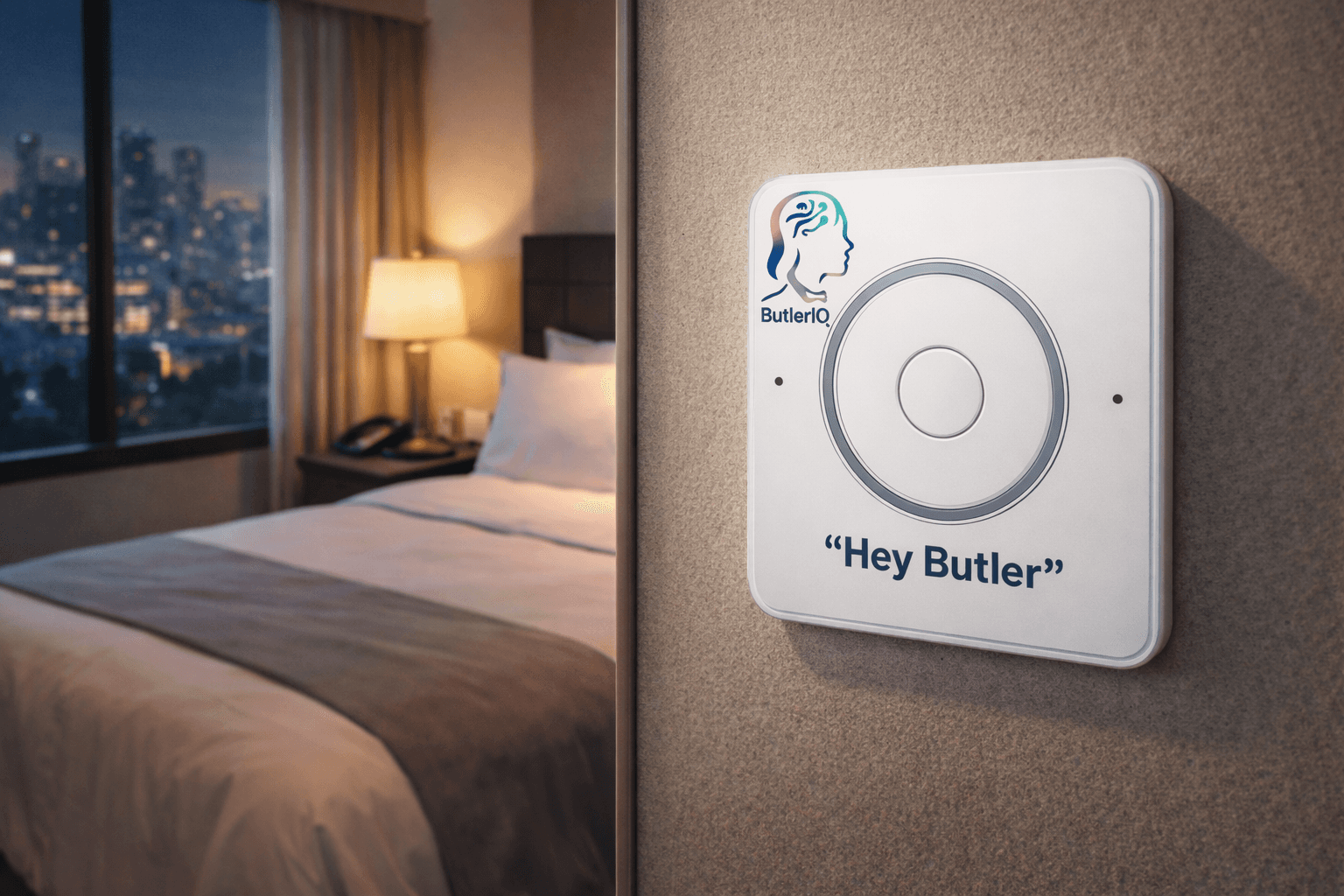
This is exactly the space ButlerIQ is built for.
Not as another chatbot.
Not as another channel.
But as a voice-first AI concierge that:
handles guest requests instantly
supports 60+ languages
integrates into hotel operations
drives real-time upsells
reduces front desk workload
It doesn’t replace hospitality.
It removes the friction around it.
The bigger shift happening in hospitality
Zoom out.
The industry is changing fast:
AI in hospitality is growing at 50%+ annually
76% of hotel executives say AI is fundamentally changing the industry
Nearly 40% of travellers are already using AI tools in travel planning
This isn’t a trend.
It’s infrastructure.
FAQ: AI Voice Assistants in Hotels
Do hotels already use voice assistants?
Yes. Many hotels already use AI for guest communication, with adoption accelerating rapidly across the industry.
Do voice assistants replace staff?
No. They remove repetitive work so staff can focus on high-value guest interactions.
Are guests comfortable using AI in hotels?
Yes. A majority of guests are already comfortable with AI-enhanced experiences and expect more of it.
What languages can AI assistants support?
Modern systems support dozens of languages, enabling real-time multilingual guest interaction.
Final thought
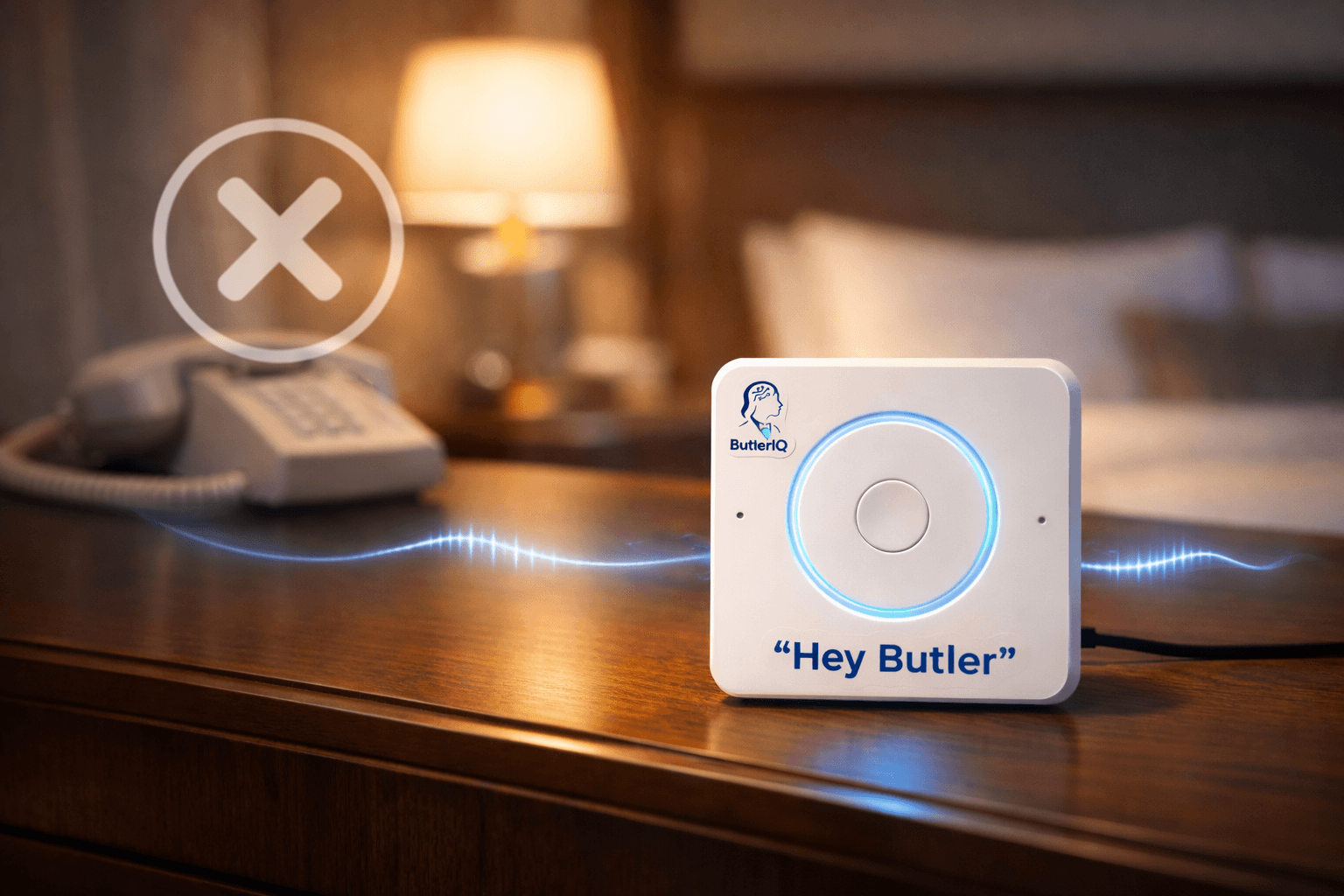
The hotel room phone hasn’t evolved in decades.
It still:
creates friction
relies on staff availability
doesn’t scale
AI voice assistants may quietly replace it.
Not overnight.
But steadily.
Because once hotels experience:
fewer interruptions
better guest experiences
increased revenue
There’s no real reason to go back.