Luxury Hotel Technology in 2026: The Quiet Layer That Protects Five-Star Service
Luxury hotel technology in 2026 should be invisible. Discover how voice concierge, 60+ language support, and smart task routing protect five-star service.
You can spend a fortune on interiors and staff training, then lose the magic because the Wi-Fi drops, the room controls confuse guests, or check-in feels like a queueing system. Your guests won't praise "innovative systems" — they'll notice friction, and they'll remember it.
In 2026, one technology has moved from novelty to genuine infrastructure for luxury hotels: voice. Not the clunky wake-word assistant of five years ago, but a natural, multilingual, always-ready concierge layer that removes friction at the exact moments guests need help most — without requiring an app, a login, or a second thought.
In this guide, we break down luxury hotel technology in 2026 as the quiet layer that protects high-touch service, sharpens personalisation, and keeps choice in the guest's hands.
Key Takeaways
Luxury hotel technology in 2026 should be seamless and invisible, enhancing guest comfort without causing confusion or delays.
Voice has emerged as the most natural guest interface — no app, no learning curve, no language barrier. In 2026, leading properties are deploying voice concierge systems that support 60+ languages out of the box.
Guests expect fast, reliable Wi-Fi, intuitive room controls, and personalised yet unobtrusive experiences tailored to their preferences.
Offering both digital and personal service options ensures guests have choice without compromising the luxury feel or creating second-class experiences.
A cohesive guest-facing tech stack that integrates check-in, digital keys, in-room controls, voice, and messaging improves efficiency and guest satisfaction.
Back-of-house technology must enable proactive service with shared profiles, automated task routing, and staffing forecasts to prevent service failures before the guest ever notices them.
Robust data security and clear privacy controls are essential to maintain guest trust while delivering respectful personalisation aligned with brand consistency.
What Luxury Guests Expect From Technology Today (Without Feeling "Techy")
A guest arrives late from Heathrow, walks into a dark room, and can't work out which switch controls the bedside lamps. That one moment can undo hours of five-star service — not because you lacked technology, but because it got in the way.
In 2026, luxury guests tend to expect tech to disappear into the experience. They want fast, reliable Wi-Fi that doesn't require three logins, TV streaming that works first time, and room controls that feel obvious within seconds. If you're upgrading, treat "effortless" as a measurable target: for example, aim for under 60 seconds from entering the room to having lights set, temperature adjusted, and streaming connected.
Voice changes that target entirely. Instead of finding the right panel or opening an app, a guest simply says what they need. "Turn on the reading lights." "I'd like some extra towels." "What time does the spa close?" The room responds. A request is logged and routed. No buttons, no menus, no waiting.
They also expect subtle personalisation that feels respectful. Remembering a pillow type, preferred room temperature, or a minibar swap is welcome — guessing sensitive details isn't. The simplest rule: personalisation should be helpful, not revealing (e.g., "We've set the room to your usual 20°C," not "We noticed you slept badly last time").
Finally, luxury is about choice, not obligation. Some guests want app-based check-in, a digital key, and messaging-only concierge. Others want a person to greet them and handle everything. Your technology should support both paths without judgement — and without creating a "second-class" experience for guests who avoid apps. Voice sits in the middle of that spectrum perfectly: it's immediate and personal, but requires nothing from the guest except speaking naturally.
Why Voice Is the Right Interface for Luxury Hotels in 2026
Five years ago, voice assistants in hotels felt like a gimmick. By 2026, three things have changed that make voice genuinely compelling for luxury properties.
1. Language is no longer a barrier.
A premium hotel in London, Dubai, or Singapore serves guests from dozens of countries in the same week. English-only interfaces, or even bilingual ones, create invisible friction. A guest from South Korea, Brazil, or the UAE shouldn't have to mentally translate their request before they can ask for a late checkout or extra pillows.
Modern voice concierge platforms — including ButlerIQ — now support over 60 languages natively. That means a guest can speak in their own language, and the system understands, responds, and routes the request correctly without any manual intervention from staff. For luxury operators, this is significant: it removes an awkward moment, protects the service standard, and quietly signals that your property respects every guest equally.
2. It's the only interface that requires no learning.
Apps require downloads. Tablets require navigation. Wall panels require finding the right button. Voice requires nothing except speaking. For tired or elderly guests, for guests with accessibility needs, or for guests who simply don't want friction, voice is the lowest possible barrier.
That's particularly important for the first 10 minutes in a room — the window where guests form their strongest impressions. If they can get the environment right with a few words rather than a few taps, the experience starts well.
3. Every request becomes a tracked, routable task.
This is where voice earns its operational case. When a guest calls the front desk to ask for towels, that request lives in someone's memory (or doesn't). When a guest asks ButlerIQ, the request is captured, categorised, and routed automatically to the right department — housekeeping, maintenance, F&B, or concierge — and appears on a live task management board that staff can see, claim, and update in real time.
The result is that nothing falls through the gaps between shifts, and managers have full visibility into what's been requested, what's been fulfilled, and where delays are building. That's not a marginal efficiency gain — it's the difference between proactive service and reactive damage control.
The Core Guest-Facing Tech Stack in Luxury Hotels
You can have a beautiful app and still deliver a messy experience if systems don't join up. The risk isn't that you lack features — it's that your guest-facing tools tell different stories in different places, and your team spends the day apologising.
A practical luxury guest-facing stack in 2026 usually includes:
A guest app or web portal for check-in/out, booking spa and dining, service requests, and local recommendations.
Digital key and identity flow that works smoothly with your door locks and reduces front desk bottlenecks.
In-room control surface (tablet, TV UI, wall panel, or mobile) for lighting, temperature, curtains, "Do Not Disturb", and housekeeping preferences.
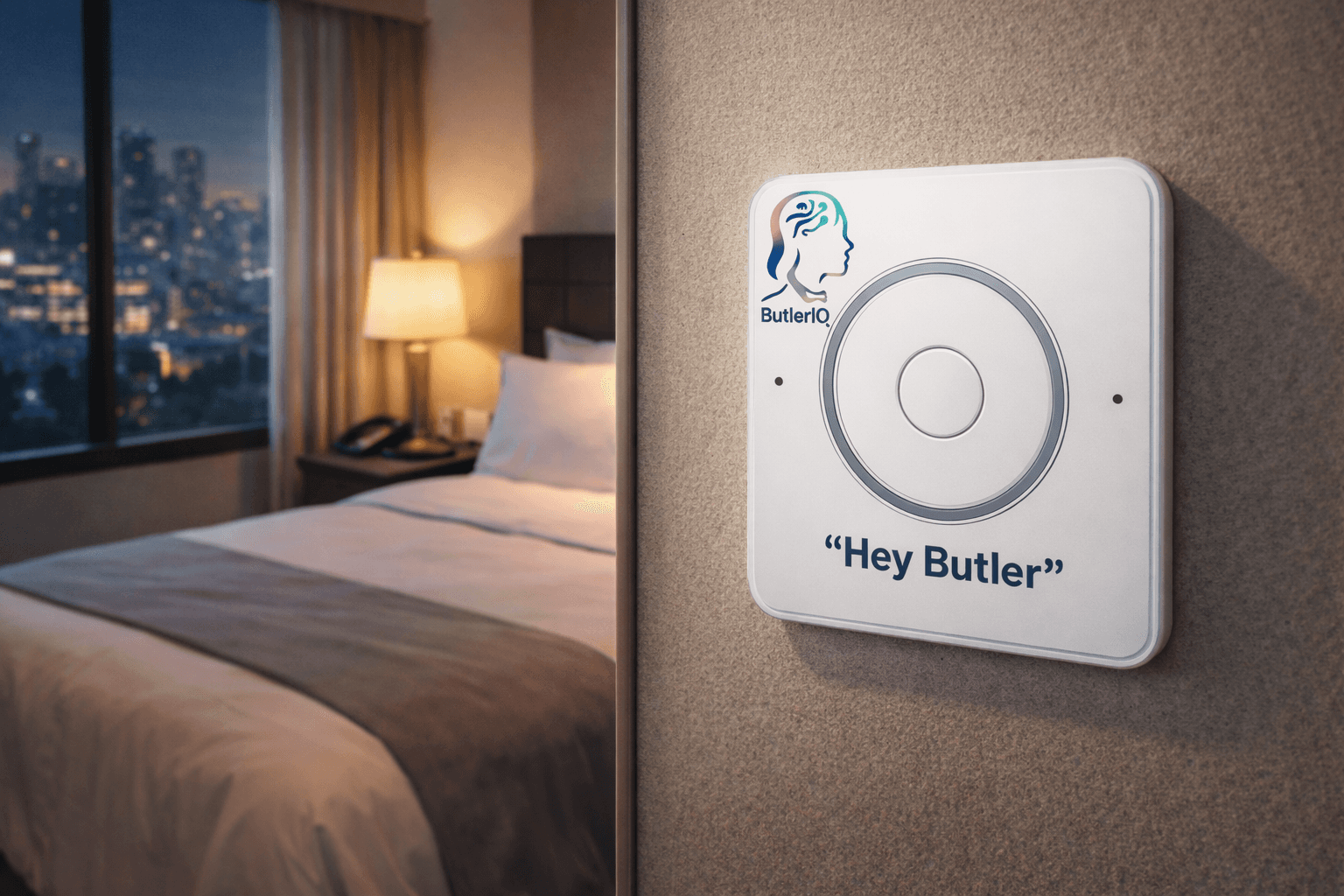
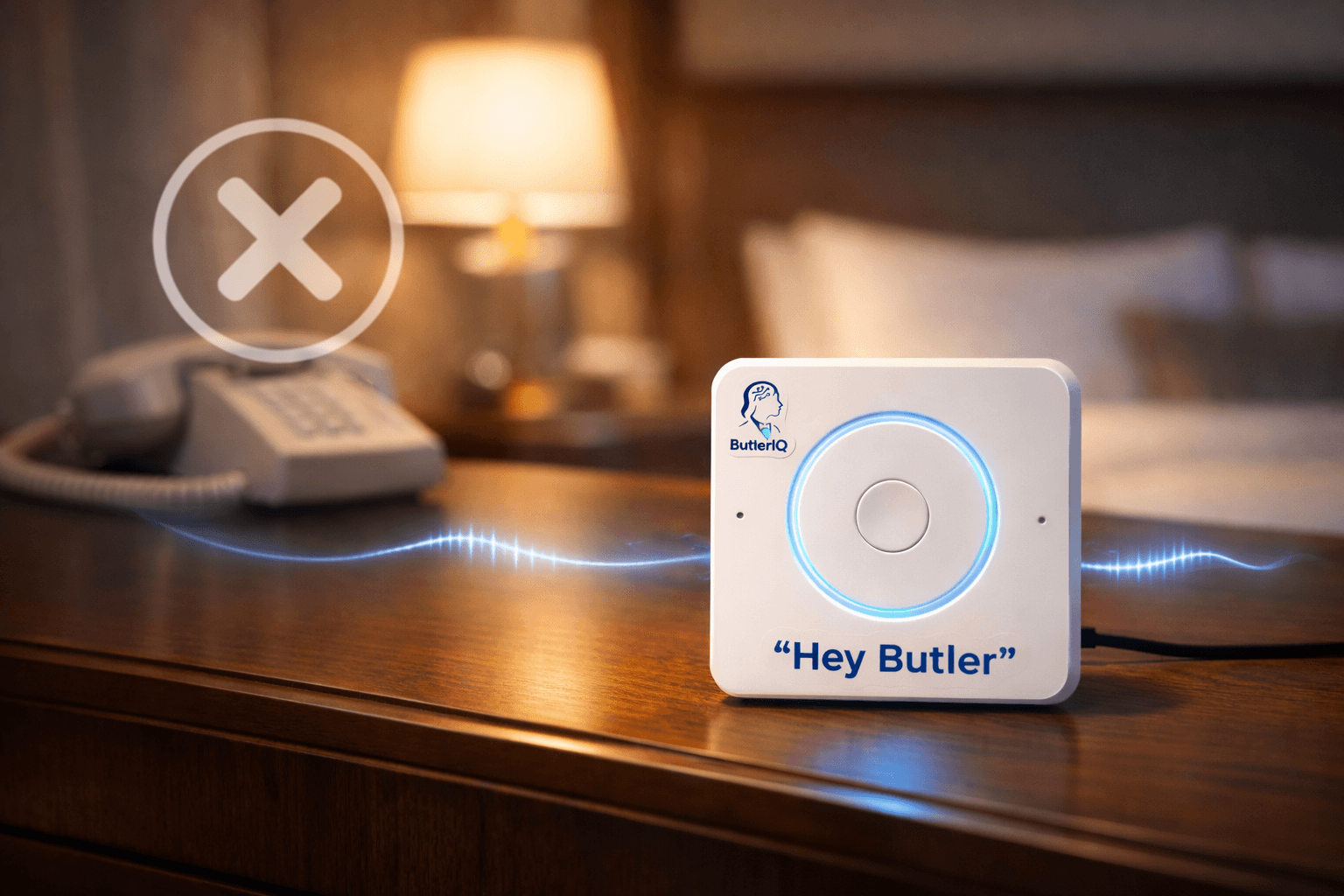
Voice concierge as the always-on, zero-friction layer for guest requests, questions, and room controls — available in the guest's own language without any setup.
Guest messaging (WhatsApp-style) that mirrors your service tone and routes requests to the right team.
A guest profile/CRM layer that connects preferences to your PMS and service workflows.
In-room entertainment with casting and personalised welcome content that doesn't require guests to type passwords on a remote.
The key addition in 2026 is treating voice as a first-class channel — not a bolt-on — that connects directly to your task routing and staff workflows. If someone asks ButlerIQ for room service at midnight, that request should appear on the F&B team's board immediately, not land in a shared inbox someone may or may not check.
If you're planning investment, start with the moments guests notice most: arrival, first 10 minutes in the room, first service request, and checkout. Voice addresses all four cleanly.
Smart Rooms That Personalise Comfort, Privacy, and Atmosphere
A guest shouldn't need a mini training session to make the room feel right. The cost of getting this wrong shows up in small complaints ("the room felt stuffy", "the curtains were fiddly") that quietly erode review scores.
Smart rooms work best when they focus on comfort, privacy, and atmosphere:
Comfort presets: "Sleep", "Wake", "Relax", and "Work" scenes that adjust lighting colour/brightness, temperature, and curtains. A concrete step: define each scene with exact settings (e.g., Sleep = 19°C, blackout curtains closed, bedside lights at 10%). With voice, guests can activate these with a single phrase — or tweak them naturally ("make it a bit cooler").
Privacy controls: A clear "Do Not Disturb" mode that also suppresses non-essential notifications and prevents accidental service knock-ups. Pair it with a simple indicator for staff. ButlerIQ includes a dedicated privacy mode that guests can set by voice — and a visible mute option so the device is clearly inactive.
Quiet personalisation: Settings that follow a guest across stays only if they consent, with an easy way to reset to default for privacy-sensitive travellers.
Voice control fits here particularly well, but only when it's predictable. A short, reliable command set outperforms a sprawling one — "turn on reading lights", "set sleep mode", "request extra towels" covers 80% of what guests actually want. Multilingual support means the same command set works whether a guest says it in English, Japanese, German, or Arabic.
The practical guardrails in ButlerIQ.ai: how multilingual voice interfaces boost guest experience are especially relevant for properties serving mixed-language travellers — which, in 2026, means most luxury hotels.
Mobile and Contactless Touchpoints That Still Feel Exclusive
Some guests love speed and privacy, but they still want to feel looked after. The risk with contactless is that it can feel like you've replaced service with self-service — especially in luxury.
You can keep it exclusive by designing mobile touchpoints around recognition and control:
Mobile check-in with optional human welcome: Let guests bypass the desk, but trigger a discreet "arrival alert" so a host can greet them by name, offer a drink, or escort them if they want it.
Digital key as a choice: Make it available for convenience, not mandatory. A policy that works well: always offer a physical key card without any awkwardness.
Curated in-room dining and service requests: QR menus can feel cheap if they look generic. Use branded design, concise copy, and a small number of high-quality choices — with dietary filters that actually work. Better still, allow guests to order via voice: "I'd like to order the sea bass and a glass of Chablis" is a more natural experience than scrolling a digital menu.
Messaging that matches your tone: If your brand voice is formal and calm, your messages should be too. Build response templates for common requests (extra hangers, late checkout, pillow menu) so every team member sounds consistent.
When this is done well, the guest feels in control while your team stays present in the background — ready to step in at exactly the right time.
Back-of-House Technology That Enables Proactive, High-Touch Service
Luxury service breaks down behind the scenes first. A guest asks for a crib, the request gets lost between shifts, and suddenly you're solving a problem at 11pm when you should be delivering calm.
Back-of-house technology should reduce the "chasing" that drains your team. In practice, that means three capabilities:
1. One shared view of the guest. A consolidated profile that pulls from your PMS, guest messaging, preference history, and — critically — voice interactions, so staff don't ask the same questions twice. A simple operational win: surface the top five practical preferences (room temperature, pillow type, allergies, wake-up preference, minibar swaps) rather than a long record nobody reads.
2. Automated task routing and service recovery. This is where the operational value of voice becomes clearest. Every request made through a voice concierge like ButlerIQ is automatically categorised and routed to the right department — housekeeping, maintenance, F&B, concierge — and lands on a live task management board. Staff see new requests appear in real time, claim them, and update status as they're fulfilled.
That board also tracks response times and escalates automatically if a deadline passes (e.g., towels within 10 minutes, engineering within 20). Managers get a live view of bottlenecks and can reassign tasks in seconds. This is what transforms service from reactive to proactive — the system flags "late" before the guest has to.
3. Smarter forecasting. Demand and staffing forecasts that protect the guest experience during peaks. If you can predict spa demand by daypart or anticipate late checkouts after a conference, you can schedule cover and avoid visible strain.
If you're assessing vendors, look for workflow clarity: can a supervisor see the full request queue at a glance, reassign tasks, and spot patterns across shifts? The type of operational approach covered in hotel staff efficiency tools in 2026 is a useful benchmark, because it ties tech choices to response times and staff wellbeing rather than shiny features.
And don't ignore the front desk. Even in luxury, queues signal disorder. If you reduce arrivals friction with better systems — and capture guest requests via voice rather than phone calls — you free staff to offer the "human extras" guests remember. The real-world impact is laid out well in front desk hotel software in 2026.
Data, Security, and Brand Consistency: Getting Personalisation Right
Personalisation can tip from impressive to uncomfortable in a single sentence. If a guest feels watched, you don't just lose trust — you create a story they'll repeat to colleagues.
Start with data discipline. You should only collect what you can justify operationally, store it securely, and set retention rules you can explain. A practical approach many luxury teams use is a "preference tier" model:
Tier 1 (service-critical): Allergies, accessibility needs, safety notes. Keep it tightly controlled and visible only to staff who need it.
Tier 2 (comfort): Temperature, pillow type, housekeeping timing, room location preference.
Tier 3 (nice-to-have): Dining preferences, favourite drink, celebration dates. Optional and always easy to opt out.
Build consent into the journey, not into a hidden policy page. For example, during digital check-in: "Do you want us to remember your room comfort settings for next time?" with clear yes/no choices.
For voice specifically, privacy controls need to be obvious. ButlerIQ includes a physical mute option and a clear visual indicator when the device is listening — and disabling voice doesn't break room controls or other in-room functions. The operational security considerations in voice-activated security protocols for hotels cover the rules worth setting before rollout.
Security also needs to be practical: role-based access for staff (housekeeping doesn't need full guest profiles), multi-factor authentication for admin tools, and access logs for sensitive preferences so you can audit issues quickly.
Finally, treat brand consistency as part of the technology spec. Your app, in-room controls, TV welcome screen, voice responses, and guest messaging should use the same tone, typography, and service language. A concrete step: create a short "digital service style guide" — greeting lines, apology lines, response time expectations — so technology feels like your hotel, not a generic platform.
Conclusion
In 2026, the best luxury hotel technology doesn't shout for attention — it removes friction, protects privacy, and helps your team deliver calm, proactive service. Voice has become the clearest expression of that principle: it's the only interface that works equally well for a guest speaking Mandarin at 2am and one speaking Portuguese at noon, with no setup, no app, and no learning curve.
If you focus on the guest's first 10 minutes, build a joined-up stack, and connect every guest-facing channel to a single task routing system your team can actually use, you can make digital touchpoints feel as considered as the welcome at the door.
Invisible, in 2026, is a real competitive advantage.
Frequently Asked Questions About Luxury Hotel Technology
What do luxury guests expect from hotel technology in 2026 without feeling overwhelmed? Luxury guests expect technology to be invisible and effortless — fast Wi-Fi, intuitive room controls, seamless TV streaming, and subtle personalisation like remembering pillow preferences — all without feeling intrusive or complicated. Voice interaction is increasingly central to that expectation: guests can simply speak a request rather than navigate a panel or open an app.
Why is voice the most important technology for luxury hotels in 2026? Voice removes the last friction point that other technologies still have: the learning curve. There's no app to download, no menu to navigate, and no language barrier — modern voice concierge systems like ButlerIQ support over 60 languages natively, meaning every guest can interact naturally in their own language. Combined with automatic task routing to hotel staff, voice transforms from a novelty into genuine operational infrastructure.
How does voice concierge connect to hotel staff and operations? When a guest makes a request via voice, it's automatically captured, categorised, and routed to the right department — housekeeping, maintenance, F&B, or concierge — and appears on a live task management board. Staff can see, claim, and update requests in real time. Managers get full visibility into response times and can spot bottlenecks before they become service failures. This is what makes voice operationally valuable, not just guest-friendly.
Which core technologies make up a luxury hotel's guest-facing tech stack? A typical luxury hotel tech stack includes a guest app or portal for check-in and bookings, digital keys, integrated in-room controls for lighting and temperature, voice concierge for zero-friction requests in 60+ languages, personalised guest messaging, a connected CRM system, and user-friendly in-room entertainment.
How do smart rooms personalise comfort and privacy for luxury hotel guests? Smart rooms adjust settings like temperature, lighting scenes, and curtains based on guest preferences and time of day, offer clear "Do Not Disturb" modes, and provide simple voice or app controls — all while respecting privacy with optional data retention across stays. Voice makes preset activation natural: guests say "sleep mode" rather than hunting for the right button.
Can guests choose between digital and traditional services in luxury hotels? Yes — luxury hotel technology should offer genuine choice. Guests can use app-based check-in and digital keys or opt for personalised human service, without any sense of second-class treatment. Voice sits naturally in the middle: it's immediate and personal, but doesn't require a phone or an account.
How does back-of-house technology improve service in luxury hotels? Back-of-house systems provide consolidated guest profiles, automated task routing from guest-facing channels including voice, and demand forecasting to ensure prompt, proactive, high-touch service. A live task management board gives supervisors full visibility across departments, so requests are fulfilled within target times and nothing is lost between shifts.
What measures ensure data security and privacy in luxury hotel voice systems? Luxury hotels implement strict data minimisation, consent-led collection, secure storage with role-based access, and clear opt-out options. For voice specifically, physical mute controls and clear visual indicators when the device is active are essential — and disabling voice should never break other room functions. These controls maintain guest trust while enabling respectful personalisation across all channels.