Hotel Management, Guest Experience, AI in Hospitality
Multilingual Guest Experience: How Hotels Can Serve Global Guests at Scale
Discover how hotels can deliver seamless multilingual guest experiences using AI—supporting 90+ languages without adding staff.
Hospitality is global. Your service needs to be too.
Walk into any hotel today — especially in major cities.
Your guests aren’t all from one place.
They’re:
business travellers
international tourists
families from across continents
And they all bring one expectation:
👉 “I should be able to communicate easily.”
The problem?
Most hotels simply can’t meet that expectation consistently.
The reality: language is still a major barrier
Even the best hotels struggle here.
Because multilingual service is hard to scale:
Hiring multilingual staff is expensive
Coverage isn’t consistent across shifts
Some languages are rarely supported
Miscommunication leads to poor experiences
And it shows up in small but critical moments:
incorrect orders
misunderstood requests
missed upsell opportunities
guest frustration
This isn’t just inconvenient.
👉 It directly impacts guest satisfaction.
Why this problem is getting bigger, not smaller
Global travel is only increasing.
Guest expectations are rising.
And the gap between:
what guests expect
what hotels can deliver
is widening.
Because guests compare your experience to:
Google Translate
voice assistants
real-time translation tools
They don’t lower expectations when they travel.
They bring them with them.
Why traditional solutions don’t scale
Hotels have tried to solve this in a few ways:
1. Multilingual staff
Works… but only where available
Not scalable across all languages
2. Printed materials
Menus, guides, instructions
👉 Static
👉 Limited
👉 Often outdated
3. Translation apps
Guests use their own tools
👉 Not integrated into hotel service
👉 Breaks the experience
Each of these helps.
None solve the core problem:
👉 real-time, natural communication at scale
What a true multilingual guest experience looks like
Let’s strip it back.
A guest should be able to:
speak in their own language
ask naturally
get an immediate, accurate response
receive service without confusion
No switching apps.
No awkward translation moments.
No delays.
That’s the standard.
Why voice-first AI unlocks this
This is where things change.
Modern AI systems can now:
understand natural speech across dozens of languages
translate in real time
respond conversationally
trigger real hotel actions
So instead of:
“Do you speak English?”
It becomes:
“Just speak.”
What this looks like in practice
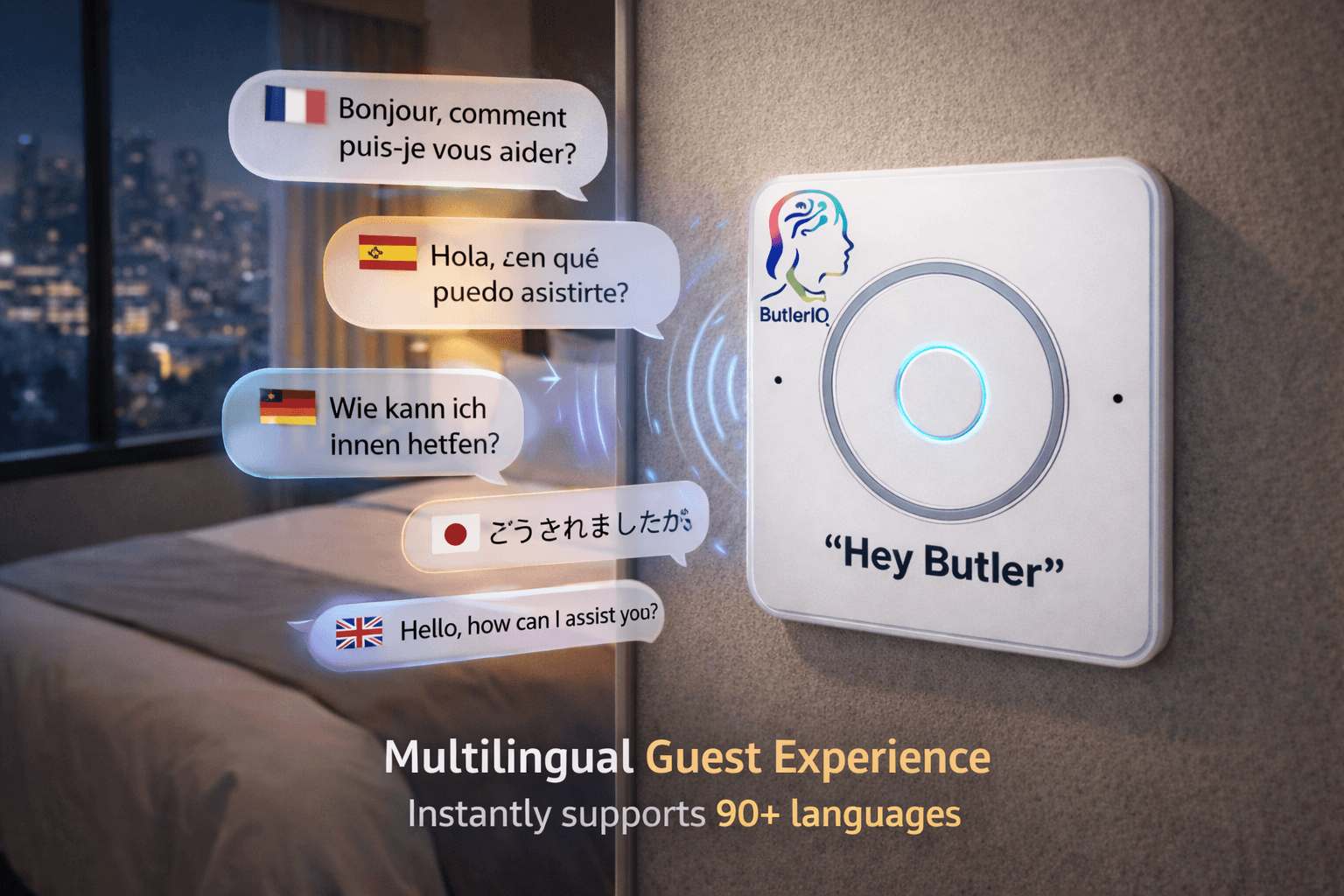
A guest from Spain walks into their room:
“¿A qué hora es el desayuno?”
They receive an instant response — in Spanish.
A guest from Germany asks:
“Kann ich später auschecken?”
They’re offered a late checkout — in German.
A guest from Japan requests:
“タクシーを呼んでください”
The system arranges it.
No confusion.
No translation gap.
No delay.
The scale advantage: 90+ languages without additional staff
This is where the model breaks traditional limitations.
Instead of:
hiring for language coverage
managing shift gaps
relying on availability
Hotels can support:
👉 90+ languages instantly, 24/7
That’s not incremental improvement.
That’s a step change.
The operational impact (beyond just translation)
Multilingual AI doesn’t just improve communication.
It transforms operations.
1. Fewer misunderstandings
Requests are captured accurately
2. Faster service
No need for translation or clarification
3. Consistent experience
Every guest gets the same quality of response
4. Reduced staff pressure
No reliance on finding the “right” language speaker
The hidden upside: revenue unlock
This is where it gets overlooked.
If a guest can’t communicate easily:
👉 they don’t buy
They won’t:
order food
upgrade rooms
book services
Not because they don’t want to…
Because it’s too difficult.
Remove that barrier, and suddenly:
👉 revenue opportunities increase
Why most hotels underestimate this
Language is often treated as:
👉 a “nice to have”
But in reality, it’s:
👉 a core experience driver
Because communication is at the centre of everything:
service
satisfaction
spending
Where ButlerIQ fits into this
ButlerIQ is built to remove this barrier completely.
As a voice-first AI concierge, it enables:
real-time communication in 90+ languages
natural, conversational interaction
instant response to guest requests
seamless integration into hotel operations
No apps.
No translation tools.
No friction.
Just:
👉 “Speak, and it’s handled.”
The bigger shift in global hospitality
Hotels are moving from:
limited language support
staff-dependent communication
fragmented experiences
To:
universal communication
AI-driven interaction
seamless global service
And once that becomes possible…
It becomes expected.
FAQ: Multilingual Guest Experience
How many languages can AI support in hotels?
Modern systems can support 90+ languages with real-time understanding and response.
Does this replace multilingual staff?
No — it enhances capability and removes gaps, especially for less common languages.
Is real-time translation accurate enough?
Yes, modern AI systems are highly accurate for common hospitality interactions.
Does this improve guest satisfaction?
Significantly. Guests feel more comfortable and confident when they can communicate naturally.
Final thought
Hospitality is built on making guests feel understood.
Not just welcomed.
Understood.
And language has always been the barrier.
Now, for the first time, it doesn’t have to be.